patent · US3907645
Cholesterol assay
23 September 1975
Page 1 — bibliographic record
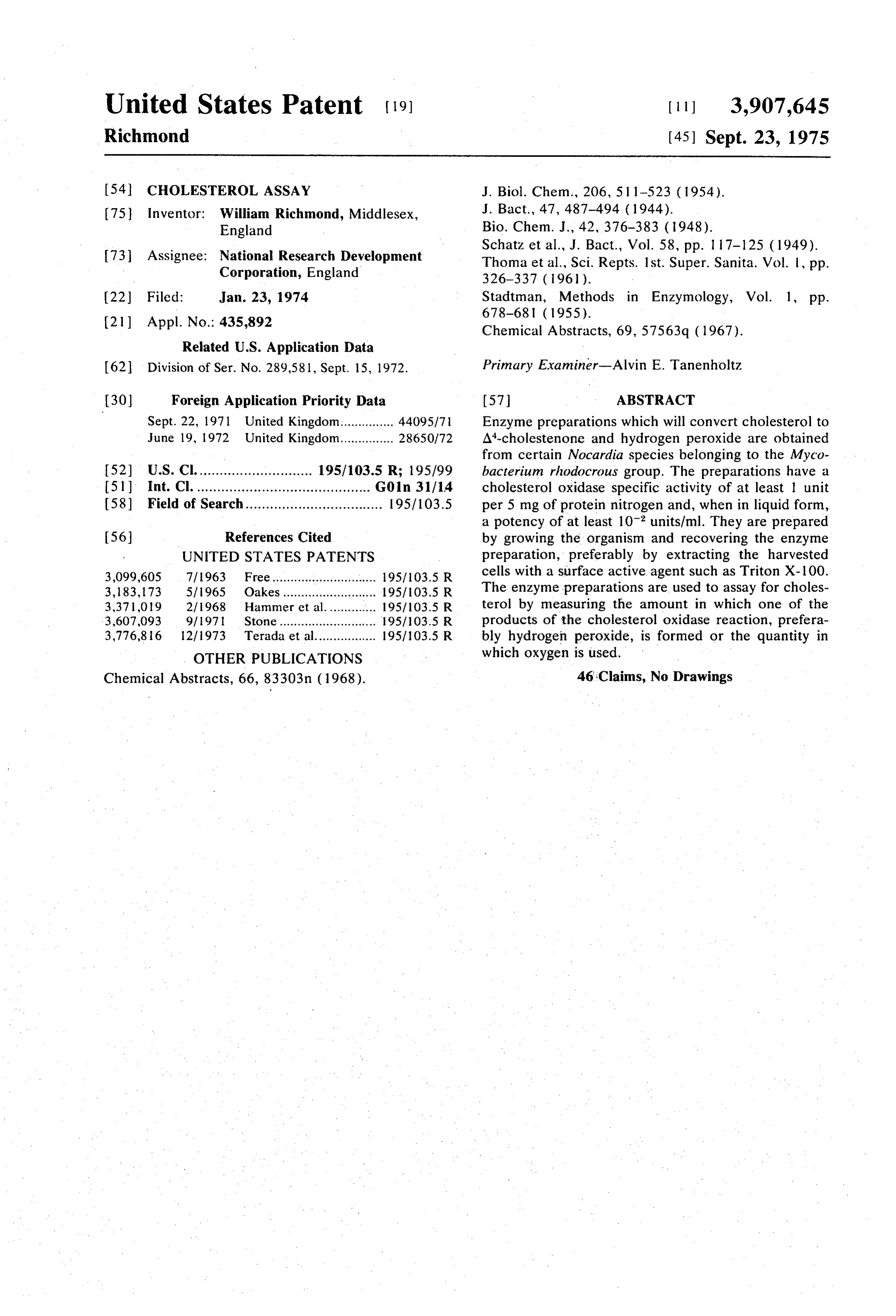
United States Patent (19) (11) 3,907,645 Richmond (45) Sept. 23, 1975 54 CHOLESTEROL ASSAY J. Biol. Chem., 206, 51 1-523 (1954). 75 Inventor: William Richmond, Middlesex, J. Bact., 47, 487-494 (1944). England Bio. Chem. J., 42,376-383 (1948).
73 Assignee: National Research Development Schatz et al., J. Bact., Vol. 58, pp. 117-125 (1949). Corporation, England Thoma et al., Sci. Repts. 1st. Super. Sanita. Vol. 1, pp.
22 Filed: Jan. 23, 1974 Stadtman, Methods in Enzymology, Vol. 1, pp.
(21) Appl. No.: 435,892 Chemical Abstracts, 69, 57563q (1967). Related U.S. Application Data 62 Division of Ser. No. 289,581, Sept. 15, 1972. Primary Examiner-Alvin E. Tanenholtz 30 Foreign Application Priority Data 57 ABSTRACT Sept. 22, 1971 United Kingdom............... 4409517 Enzyme preparations which will convert cholesterol to June 19, 1972 United Kingdom............... 2865O172 A-cholestenone and hydrogen peroxide are obtained from certain Nocardia species belonging to the Myco 52 U.S. Cl............................. 195/103.5 R; 195/99 bacterium rhodocrous group. The preparations have a 5ll Int. Cl............................................ G01n 31/14 cholesterol oxidase specific activity of at least 1 unit 58) Field of Search.................................. 195/103.5 per 5 mg of protein nitrogen and, when in liquid form, a potency of at least 10 units/ml. They are prepared 56 References Cited by growing the organism and recovering the enzyme UNITED STATES PATENTS preparation, preferably by extracting the harvested 3,099,605 7/1963 Free............................. 1951 103.5 R cells with a surface active agent such as Triton X-100. 3,183, it 73 5? 1965 Oakes.......................... 195/103.5 R The enzyme preparations are used to assay for choles 3,371,019 2/1968 Hammer et al.............. 195/103.5 R terol by measuring the amount in which one of the 3,607,093 9, 1971 Stone........................... 195/103.5 R products of the cholesterol oxidase reaction, prefera 3,776,816 2/1973 Terada et al................. 195/103.5 R bly hydrogen peroxide, is formed or the quantity in OTHER PUBLICATIONS which oxygen is used.
Chemical Abstracts, 66, 83303n (1968). 46 Claims, No Drawings
Page 2
CHOLESTEROL ASSAY
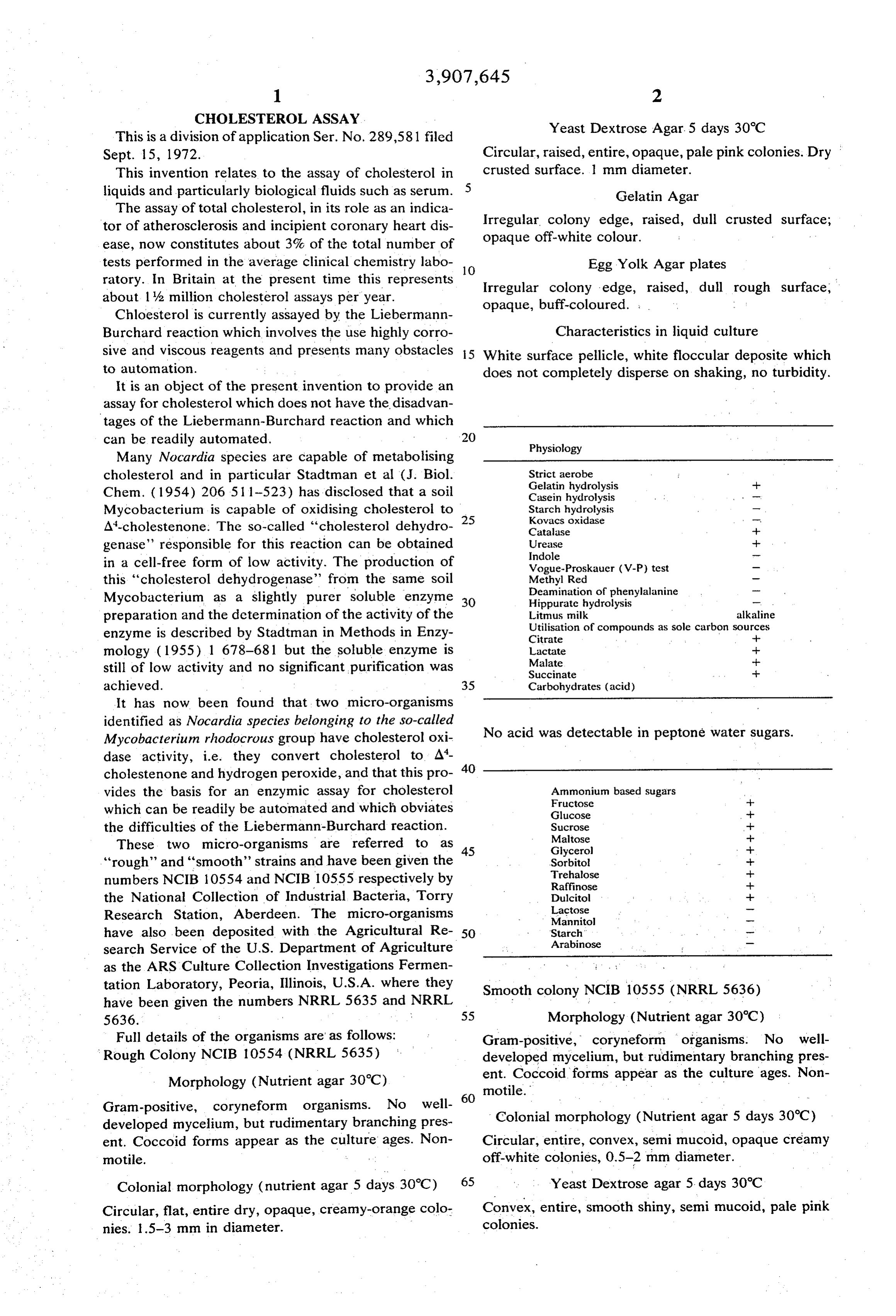
This is a division of application Ser. No. 289,581 filed Yeast Dextrose Agar. 5 days 30°C Sept. 15, 1972. Circular, raised, entire, opaque, pale pink colonies. Dry This invention relates to the assay of cholesterol in crusted surface. 1 mm diameter. liquids and particularly biological fluids such as serum. Gelatin Agar The assay of total cholesterol, in its role as an indica tor of atherosclerosis and incipient coronary heart dis Irregular colony edge, raised, dull crusted surface; ease, now constitutes about 3% of the total number of opaque off-white colour.
tests performed in the average clinical chemistry labo 10 Egg Yolk Agar plates ratory. In Britain at the present time this represents Irregular colony edge, raised, dull rough surface, about 1% million cholesterol assays per year.
Chloesterol is currently assayed by the Liebermann opaque, buff-coloured. . .
Burchard reaction which involves the use highly corro Characteristics in liquid culture sive and viscous reagents and presents many obstacles 5 White surface pellicle, white floccular deposite which to automation. does not completely disperse on shaking, no turbidity. It is an object of the present invention to provide an assay for cholesterol which does not have the disadvan tages of the Liebermann-Burchard reaction and which can be readily automated. 20
Physiology
Many Nocardia species are capable of metabolising cholesterol and in particular Stadtman et al (J. Biol. Strict aerobe Gelatin hydrolysis
Chem. (1954) 206 51 1-523) has disclosed that a soil Casein hydrolysis Mycobacterium is capable of oxidising cholesterol to 25 Starch hydrolysis Kovacs oxidase
A-cholestenone. The so-called “cholesterol dehydro Catalase genase' responsible for this reaction can be obtained Urease
Indole in a cell-free form of low activity. The production of Vogue-Proskauer (V-P) test this “cholesterol dehydrogenase” from the same soil Methyl Red Deamination of phenylalanine
Mycobacterium as a slightly purer soluble enzyme Hippurate hydrolysis preparation and the determination of the activity of the Litmus milk alkaline enzyme is described by Stadtman in Methods in Enzy Utilisation of compounds as sole carbon sources
mology (1955) 1678-681 but the soluble enzyme is lactate
Malate
still of low activity and no significant purification WaS Succinate -- achieved. 35 Carbohydrates (acid) It has now been found that two micro-organisms identified as Nocardia species belonging to the so-called
Mycobacterium rhodocrous group have cholesterol oxi No acid was detectable in peptone water sugars. dase activity, i.e. they convert cholesterol to A 40 cholestenone and hydrogen peroxide, and that this pro vides the basis for an enzymic assay for cholesterol Ammonium based sugars Fructose which can be readily be automated and which obviates Glucose the difficulties of the Liebermann-Burchard reaction. Sucrose Maltose
These two micro-organisms are referred to as 45 Glycerol “rough" and “smooth' strains and have been given the Sorbito Trehalose numbers NCIB 10554 and NCIB 10555 respectively by Raffinose the National Collection of Industrial Bacteria, Torry Dulcitol Research Station, Aberdeen. The micro-organisms Lactose Mannitol have also been deposited with the Agricultural Re 50 Starch" Arabinose search Service of the U.S. Department of Agriculture as the ARS Culture Collection Investigations Fermen tation Laboratory, Peoria, Illinois, U.S.A. where they Smooth colony NCIB 10555 (NRRL 5636) have been given the numbers NRRL 5635 and NRRL 5636. 55 Morphology (Nutrient agar 30C) Full details of the organisms are as follows: Gram-positive, coryneform organisms. No well Rough Colony NCIB 10554 (NRRL 5635) developed mycelium, but rudimentary branching pres Morphology (Nutrient agar 30°C) ent. Coccoid forms appear as the culture ages. Non
Gram-positive, coryneform organisms. No well 60 Colonial morphology (Nutrient agar 5 days 30°C) developed mycelium, but rudimentary branching pres ent. Coccoid forms appear as the culture ages. Non Circular, entire, convex, semi mucoid, opaque creamy motile. off-white colonies, 0.5-2 mm diameter. Colonial morphology (nutrient agar 5 days 30°C) 65 Yeast Dextrose agar 5 days 30°C Circular, flat, entire dry, opaque, creamy-orange colo Convex, entire, smooth shiny, semi mucoid, pale pink nies. 1.5-3 mm in diameter. colonies.
Page 3
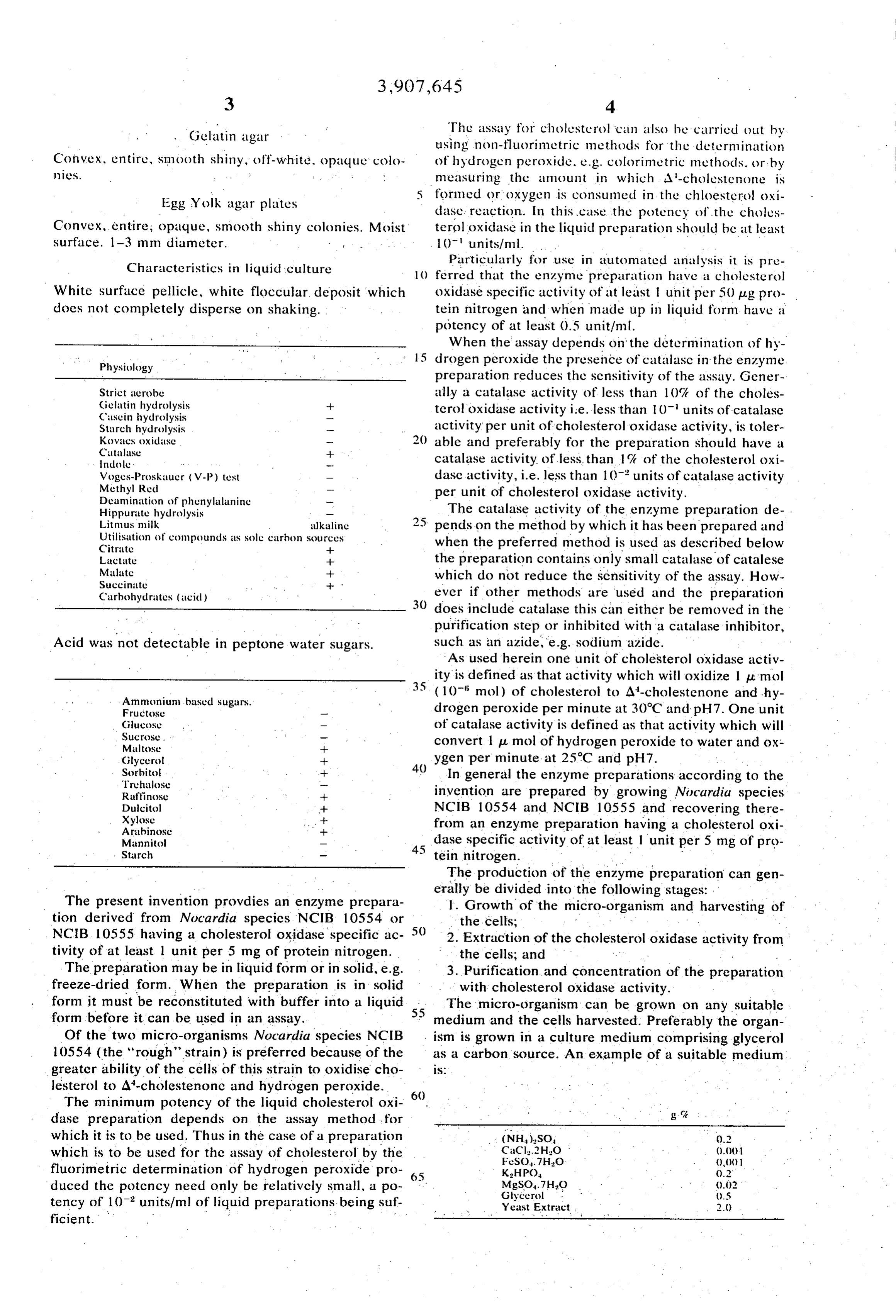
Gelatin agar The assay for cholesterol can also be carried out by using non-fluorimetric methods for the determination
Convex, entire, smooth shiny, off-white, opaque colo of hydrogen peroxide, e.g. colorimetric methods. or by nies. measuring the amount in which A-cholestenone is 5 formed or oxygen is consumed in the chloesterol oxi
Egg Yolk agar plates dase reaction. In this case the potency of the choles
Convex, entire; opaque, smooth shiny colonies. Moist terol oxidase in the liquid preparation should be at least surface. 1-3 mm diameter. 1 () units/ml.
Particularly for use in automated analysis it is pre
Characteristics in liquid culture ferred that the enzyme preparation have a cholesterol White surface pellicle, white floccular deposit which oxidase specific activity of at least unit per 50 pug pro does not completely disperse on shaking. tein nitrogen and when made up in liquid form have a potency of at least 0.5 unit/mi.
When the assay depends on the determination of hy 15 drogen peroxide the presence of catalase in the enzyme
Physiology preparation reduces the sensitivity of the assay. Gener
Strict aerobe
ally a catalase activity of less than 10% of the choles
Casein hydrolysis terol oxidase activity i.e. less than 10 units of catalase Starch hydrolysis -- activity per unit of cholesterol oxidase activity, is toler Kovacs oxidase
able and preferably for the preparation should have a
Indole ru catalase activity of less than 1% of the cholesterol oxi Voges-Proskauer (V-P) test
Methyl Red dase activity, i.e. less than 1 () units of catalase activity
Deannination of phenylalanine per unit of cholesterol oxidase activity. Hippurate hydrolysis
The catalase activity of the enzyme preparation de
Utilisation of compounds as sole carbon sources pends on the method by which it has been prepared and
Citrate when the preferred method is used as described below Lactate
Malate
Succinate
Carbohydrates (acid) : the preparation contains only small catalase of catalese which do not reduce the sensitivity of the assay. How ever if other methods are used and the preparation does include catalase this can either be removed in the purification step or inhibited with a catalase inhibitor,
Acid was not detectable in peptone water Sugars. such as an azide, e.g. sodium azide. As used herein one unit of cholesterol oxidase activ
ity is defined as that activity which will oxidize 1 u mol
Ammonium based sugars. ( 10 mol) of cholesterol to A-cholestenone and hy Fructose drogen peroxide per minute at 30°C and pH 7. One unit Clucose
Sucrose. ' of catalase activity is defined as that activity which will
Maltose convert 1 pulmol of hydrogen peroxide to water and ox Glycerol ygen per minute at 25°C and pH7.
. Sorbitol
Trichlose
In general the enzyme preparations according to the
Raffinose invention are prepared by growing Nocardia species Dulcitol
Xylose
NCIB 10554 and NCIB 10555 and recovering there
Arabinosc from an enzyme preparation having a cholesterol oxi Mannitol dase specific activity of at least 1 unit per 5 mg of pro Starch tein nitrogen.
The production of the enzyme preparation can gen erally be divided into the following stages:
The present invention provdies an enzyme prepara 1. Growth of the micro-organism and harvesting of tion derived from Nocardia species NCIB 10554 or the cells; : NCIB 10555 having a cholesterol oxidase specific ac 2. Extraction of the cholesterol oxidase activity from tivity of at least 1 unit per 5 mg of protein nitrogen. the cells; and
The preparation may be in liquid form or in solid, e.g. 3. Purification and concentration of the preparation freeze-dried form. When the preparation is in solid with cholesterol oxidase activity. form it must be reconstituted with buffer into a liquid The micro-organism can be grown on any suitable form before it can be used in an assay. medium and the cells harvested. Preferably the organ Of the two micro-organisms Nocardia species NCIB ism is grown in a culture medium comprising glycerol 10554 (the "rough" strain) is preferred because of the as a carbon source. An example of a suitable medium greater ability of the cells of this strain to oxidise cho is:
lesterol to A-cholestenone and hydrogen peroxide. 60
The minimum potency of the liquid cholesterol oxi g% dase preparation depends on the assay method for which it is to be used. Thus in the case of a preparation (NH)SO 0.2 which is to be used for the assay of cholesterol by the CaCl2HO
fluorimetric determination of hydrogen peroxide pro KHPO, ().2 duced the potency need only be relatively small, a po MgSO4.7 HO Glycerol
tency of 10 units/ml of liquid preparations being suf Yeast Extract 2.() ficient. - . . ; -
Page 4
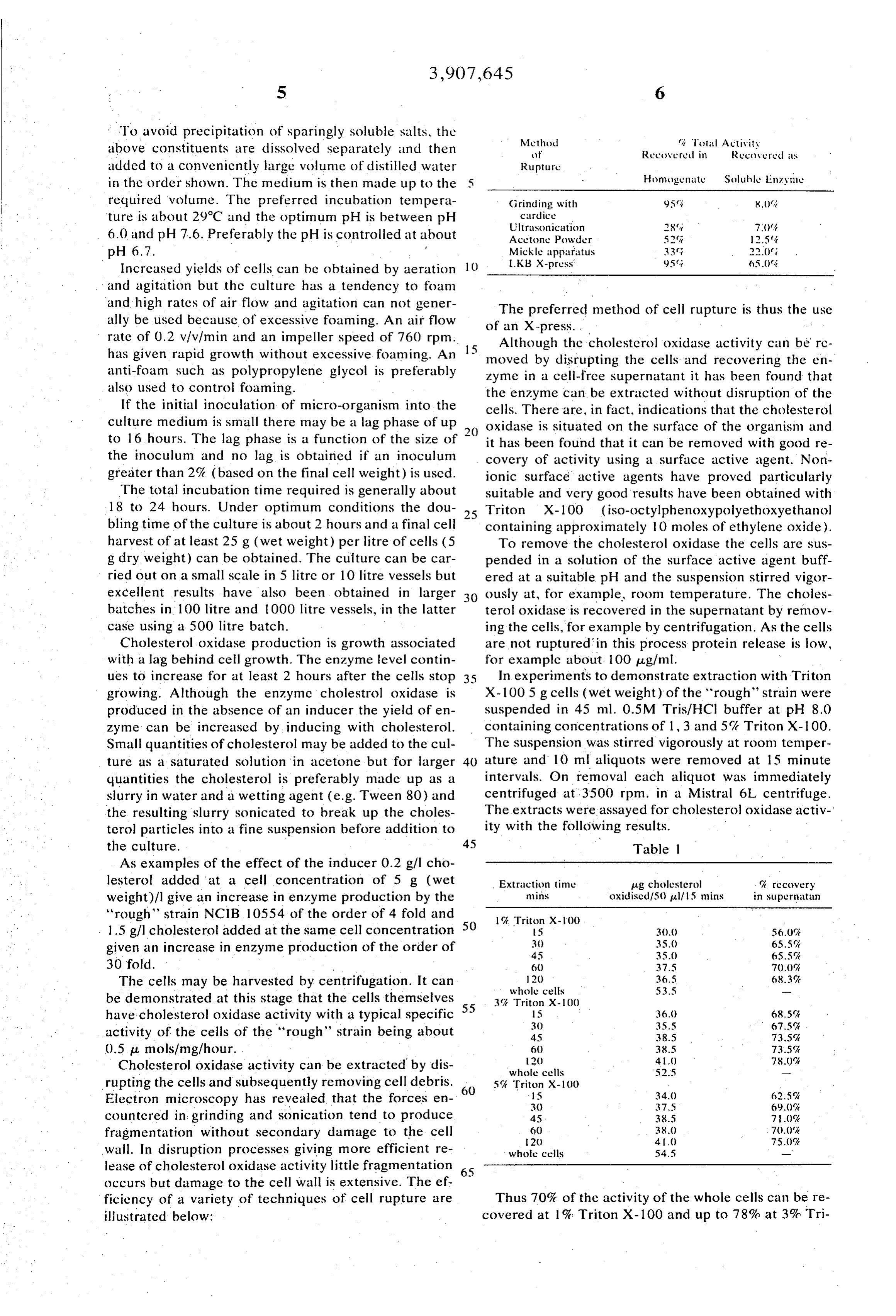
To avoid precipitation of sparingly soluble salts, the above constituents are dissolved separately and then Meth) % Total Activity
added to a conveniently large volume of distilled water Rupture in the order shown. The medium is then made up to the Honogenate Soluhle Enzyme required volume. The preferred incubation tempera Grinding with 95. 8.) ture is about 29°C and the optimum pH is between pH cardice
6.0 and pH 7.6. Preferably the pH is controlled at about Acton Powder 5% 1.5 + pH 6.7. i Mickle apparatus 33?. ().
Increased yields of cells can be obtained by aeration 10 and agitation but the culture has a tendency to foam and high rates of air flow and agitation can not gener The preferred method of cell rupture is thus the use ally be used becausc of excessive foaming. An air flow of an X-press. . .
rate of 0.2 v/v/min and an impeller speed of 760 rpm. 15 Although the cholesterol oxidase activity can be re has given rapid growth without excessive foaming. An moved by disrupting the cells and recovering the en anti-foam such as polypropylene glycol is preferably zyme in a cell-free supernatant it has been found that also used to control foaming. the enzyme can be extracted without disruption of the If the initial inoculation of micro-organism into the cells. There are, in fact, indications that the cholesterol culture medium is small there may be a lag phase of up oxidase is situated on the surface of the organism and to 16 hours. The lag phase is a function of the size of it has been found that it can be removed with good re the inoculum and no lag is obtained if an inoculum covery of activity using a surface active agent. Non greater than 2% (based on the final cell weight) is used. ionic surface active agents have proved particularly The total incubation time required is generally about suitable and very good results have been obtained with 18 to 24 hours. Under optimum conditions the dou 25 Triton X-100 (iso-octylphenoxypolyethoxyethanol bling time of the culture is about 2 hours and a final cell containing approximately 10 moles of ethylene oxide). harvest of at least 25 g (wet weight) per litre of cells (5 To remove the cholesterol oxidase the cells are sus g dry weight) can be obtained. The culture can be car pended in a solution of the surface active agent buff ried out on a small scale in 5 litre or 10 litre vessels but ered at a suitable pH and the suspension stirred vigor excellent results have also been obtained in larger ously at, for example, room temperature. The choles batches in 100 litre and 1000 litre vessels, in the latter terol oxidase is recovered in the supernatant by remov case using a 500 litre batch. ing the cells, for example by centrifugation. As the cells Cholesterol oxidase production is growth associated are not ruptured in this process protein release is low, with a lag behind ceil growth. The enzyme level contin for example about 100 ug/ml.
ues to increase for at least 2 hours after the cells stop In experiments to demonstrate extraction with Triton growing. Although the enzyme cholestrol oxidase is X-1005 g cells (wet weight) of the “rough' strain were produced in the absence of an inducer the yield of en suspended in 45 ml. 0.5M Tris/HCl buffer at pH 8.0 zyme can be increased by inducing with cholesterol. containing concentrations of 1, 3 and 5% Triton X-100. Small quantities of cholesterol may be added to the cul The suspension was stirred vigorously at room temper ture as a saturated solution in acetone but for larger 40 ature and 10 m aliquots were removed at 15 minute quantities the cholesterol is preferably made up as a intervals. On removal each aliquot was immediately slurry in water and a wetting agent (e.g. Tween 80) and centrifuged at 3500 rpm. in a Mistral 6L centrifuge. the resulting slurry sonicated to break up the choles The extracts were assayed for cholesterol oxidase activ terol particles into a fine suspension before addition to ity with the following results.
the culture. Table 1 As examples of the effect of the inducer 0.2 g/l cho lesterol added at a cell concentration of 5 g (wet Extraction time pig cholesterol % recovery weight)/l give an increase in enzyme production by the mins oxidised/50 ftlf 15 mins in supernatan “rough' strain NCIB 10554 of the order of 4 fold and 50 1% Triton X-100 1.5 g/l cholesterol added at the same cell concentration s
given an increase in enzyme production of the order of 45 350 65.5% 30 fold. O 37.5 70.0% The cells may be harvested by centrifugation. It can 20 whicle cells
be demonstrated at this stage that the cells themselves 3% Triton X-100 have cholesterol oxidase activity with a typical specific 55 30
activity of the cells of the "rough' strain being about 45 38.5 73.5% 0.5 p. mols/mg/hour. () 38.5 73.5%
Cholesterol oxidase activity can be extracted by dis whole cells 52.5 rupting the cells and subsequently removing cell debris. 60 S. Trith X-1 (0
Electron microscopy has revealed that the forces en 15
countered in grinding and sonication tend to produce 45 38.5 7.0% fragmentation without secondary damage to the cell 60
wall. In disruption processes giving more efficient re whole cells S4.5 w lease of cholesterol oxidase activity little fragmentation 65 occurs but damage to the cell wall is extensive. The ef ficiency of a variety of techniques of cell rupture are Thus 70% of the activity of the whole cells can be re illustrated below: covered at 1% Triton X-100 and up to 78% at 3% Tri
Page 5
ton X-100. The surface active agent will, however, re overpower limited announts of catalase with peroxi main in the cholesterol oxidase solution. In the assay dase. In addition it is possible to inhibit any concentra method as described below it has been found that the tion of catalase likely to be found in the surfactant ex presence of Triton X-100 may be advantageous but tract with an inhibitor for example sodium azide. that the optimum concentration in the assay mixture is 5 The effect of catalase on the sensitivity of an assay about 0.25%, higher concentrations being inhibitory. can be demonstrated as follows: The enzyme preparation should thus not have a level of A catalase solution was prepared by dissolving 20 pull surface active agent greater than that which produces of a crystalline suspension of catalase in 50 ml ().()5 M an acceptable level in the assay mixture. Thus although phosphate buffer pH 7.0.
the most rapid release of enzyme can be obtained at 3% 0.5 ml of this catalase solution was found to break Triton X-100 it may be preferable to work at a lower down 7.04 EM H.O. (in a final volume of 2.5 ml) in 2.0 concentration, e.g. 1% Triton X-100. It may, however, minutes. On this basis the catalase activity of the solu be necessary to remove the surface active agent, for ex tion can be said to be 7.04 units per ml at pH 7.0 and ample by dialysis or gel filtration, or alternatively by 25°C.
precipitating the protein (enzyme) out of the surface 5 Varying amounts of this catalase solution were intro active agent solution. duced into a cholesterol assay system containing 0.5 Although the cholesterol oxidase preparation pro units of cholesterol oxidase in 2.0 ml and the reduction duced by extraction of the cells with a surface active in sensitivity of the assay observed. agent may, in Some cases, have a specific activity and a potency which is sufficient to conduct an assay it is almost always necessary to purify and concentrate the Units catalasu added % reduction in sensitivity extract before it can be used practically in a cholesterol assay. In the case of a fluorimetric determination of hy 0.704
drogen peroxide the enzyme preparation should have ().074 34.3% a potency of at least 10 units/ml to provide a result 2 5 in a short enough time for an assay to be useful in prac tice particularly where the analysis is automated the However, the inclusion of 0.1 % sodium azide in the preparation should have a potency of at least 10 and reaction mixture completely inhibited even the highest preferably 0.5 units/ml. level of catalase, thus giving 100% sensitivity even in . . In the case of a non-fluorimetric assay the prepara 30 the presence of catalase.
tion should have a potency of at least 10 units/ml and Catalast should, however, generally be removed from preferably for automated analysis at least 0.5 units/ml. the preparation or at least reduced in amount, for ex The preparation may be prepared with a higher po ample by chromatography on DEAE cellulose. tency for example 5 units/ml or more but at higher lev Suitable means for purifying the enzyme preparation els of potency will generally be diluted with buffer be obtained by surface active agent extraction and option fore use in a test. ally catalase removal include ammonium sulphate pre In all cases the preparation must have a cholesterol cipitation and/or chromatographic methods and/or re oxidase specific activity of at least 1 unit per 5 mg. pro duced pressure evaporation. For example the prepara tein nitrogen. At higher levels a protein nitrogen the tion may be concentrated by ammonium sulphate pre amount of protein present may make the assay solution 40 cipitation or polyethylene glycol precipitation, desaited too viscous or interfere in the assay. A specific activity on a Sephadex column and then subjected to ion ex of at least 1 unit per 50 pug protein nitrogen is pre change chromatography. It may be necessary in this ferred. A particularly suitable enzyme preparation has step to concentrate the activity of the preparation by been found to be an aqueous preparation with a spe about 15 to 40 fold.
cific activity of 1 unit of cholesterol oxidase activity per For example concentration and purification may be 28 pug protein nitrogen, a potency of 5 units/ml and carried out by substrate affinity chromatography. Se containing 3%. v/v Triton X-100. This preparation may phadex LH-20, prepared by hydroxy propylation of be diluted for use in an assay, for example with 0.01 M G-25, has both hydrophilic and lipophilic properties phosphate buffer, so that for automated analysis it con and can be swollen in polar organic solvents, water, or tains 0.5 units/ml or for manual analysis 0.1 units/ml. 50 mixtures thereof. LH-20 may be swollen in ethanol sat The enzyme preparation having cholesterol oxidase urated with cholesterol (e.g. approximately 4.0 g %) activity need not be in aqueous form and it may be, for and a column may be packed with LH-20 prepared in example, in the form of a freeze-dried powder. In addi this fashion. Cholesterol may be uniformly distributed tion to the preparation of a soluble lyophilised powder, throughout the gel by washing the column with distilled the enzyme can be present as a concentrated, buffered water and finally the column may be equilibrated with solution or in suspension with ammonium sulphate 0.05M potassium phosphate buffer at pH 7.5. Substan (with or without added buffer). tial purification of the enzyme preparation may be Although very little protein is extracted with the cho achieved by the use of such a column.
lesterol oxidase some catalase activity is generally pres Preferably the enzyme preparation is first subjected ent in the surfactant extract. The amount of catalase to ion-exchange chromatography or substrate affinity activity which can be tolerated in the final enzyme chromatography, preferably chromatography as DEAE preparation depends upon the assay method to be used, cellulose, and then further concentrated by ultrafiltra the catalase activity of the preparation being important tion or reduced pressure evaporation.
where the assay involves measuring the amount of H.O. The invention also provides methods for assaying for produced. As described in more detail below sonne cholesterol in a liquid, in particular a biological fluid assay methods in which H2O, is determined include the such as serum or plasma. The assay methods described use of peroxidase and in some cases it is possible to are not, however, limited to biological fluids and can be
Page 6
applied quite generally for cietermining the amount of oxygen uptake or the amount in which at least one of cholesterol present in any industrial or food product or the products if formed. Under suitable standardised in any industrial process where cholesterol assay may conditions it is possible to estimate the amount of cho be considered necessary or desirable. lesterol present from the amount of a product formed The invention provides a method of assaying for cho- 5 or the amount of oxygen used in a given time even if the lesterol in a liquid which comprises incubating the liq- reaction has not been allowed to go to completion. uid with an enzyme preparation capable of oxidising Ass mentioned above, when hydrogen peroxide- - is- esti
the cholesterol into A'-cholestenone and hydrogen per- mated fluorimetrically the liquid enzyme preparation and disting the tly t pre- should have a cholesterol oxidase specific activity of at e d y yeasuring the amount of hydrogen Peroxide 10 least 1 unit per 5 mg of protein nitrogen and a potency prou uced. ' of at least 10 units/ml. With any other estimation The invention also provides a method of assaying for technique, i.e. measuring the NA of hydrogen per R N. s which comprises incubating the oxide colorimetrically, measuring the oxygen uptake, s .. qu CEO preparation derived fronn e.g. with an oxygen electrode, or measuring the amount ocarata species N IB O554 or NCB 10555 the en of A-cholestenone produced either directly by its car
ERNRS
city e procbonyl absorption or by forming a derivative which is measured colorimetrically, the liquid enzyme prepara ucts of the cholesterol oxidase reaction is formed or the tion should have a cholesterol oxidase specific activity Out in which oxygen is used in the cholesterol oxi- of at least unit per 5 mg of protein nitrogen and a po dase reaction. .. tency of at least 10 units/ml. t The method according to the invention can be used w
The assay may, of .course, either be carried out as an to assay free or total cholesterol in serum. Cholesterol is, of course, never free in plasma in the true sense as individual test on a single sample or a plurality of sam it..".a is always- kWcombined
pias with phospholipids, is soand proteins sis ples may be tested on an automated basis. The pre 25 ferred enzyme preparation for automated analysis is triglycerides in soluble lipoprotein - complexes. Incorpo- 2 one with a cholesterol oxidase specific a activity of at ration of a surface active agent in the assay mixture, leas east l unit per 50 pug of protein nitrogen and a potency however, causes dissolution of these complexes, under of at least 0.5 unit/ml gentle conditions, allowing all the free cholesterol to be Pref abi th T. t of hvid id enzymically oxidised. The estimation of free choles- referably the amount of hydrogen peroxide pro
terol may be useful for screening a and purposes a may, in 30 duced isA. measured r t by a y system which comprises ts capable of und a chro
fact, obviate the need to measure total cholesterol. mogenic reagent or reagents capable of undergoing a s a v is w is pra colour change in the presence of hydrogen peroxide, Cholesterol also occurs in serum in the form of esters the amount of hvid eroxid sent being me: and, if total cholesterol is to be assayed, the cholesterol db lori E. perc x e pe E. bound in this way must first be brought into a form in y E. rically it. to our change which it can be attacked by cholesterol oxidase by sa- 35 C e chromogenic reagent or reagents. ponifying the esters, for example by reaction with alco- In one preferred method the hydrogen peroxide pro holic potassium hydroxide. Reaction with 1.0 N KOH duced is measured by means of quadrivalent-titanium at 75°C effects rapid saponification without coagula- and xylenol orange which react to form a stable red col tion of protein. our with hydrogen peroxide (Taurnes & Nordschow, To conduct the assay the optionally saponified fluid Amer. J. Clin. Path. (1968), 49, 613). The amount of is then incubated with cholesterol oxidise and the reac- hydrogen peroxide produced is measured by the inten tion sity of the colour.
W In another preferred method the amount of choles
Cholesterol -- OoloreroHO
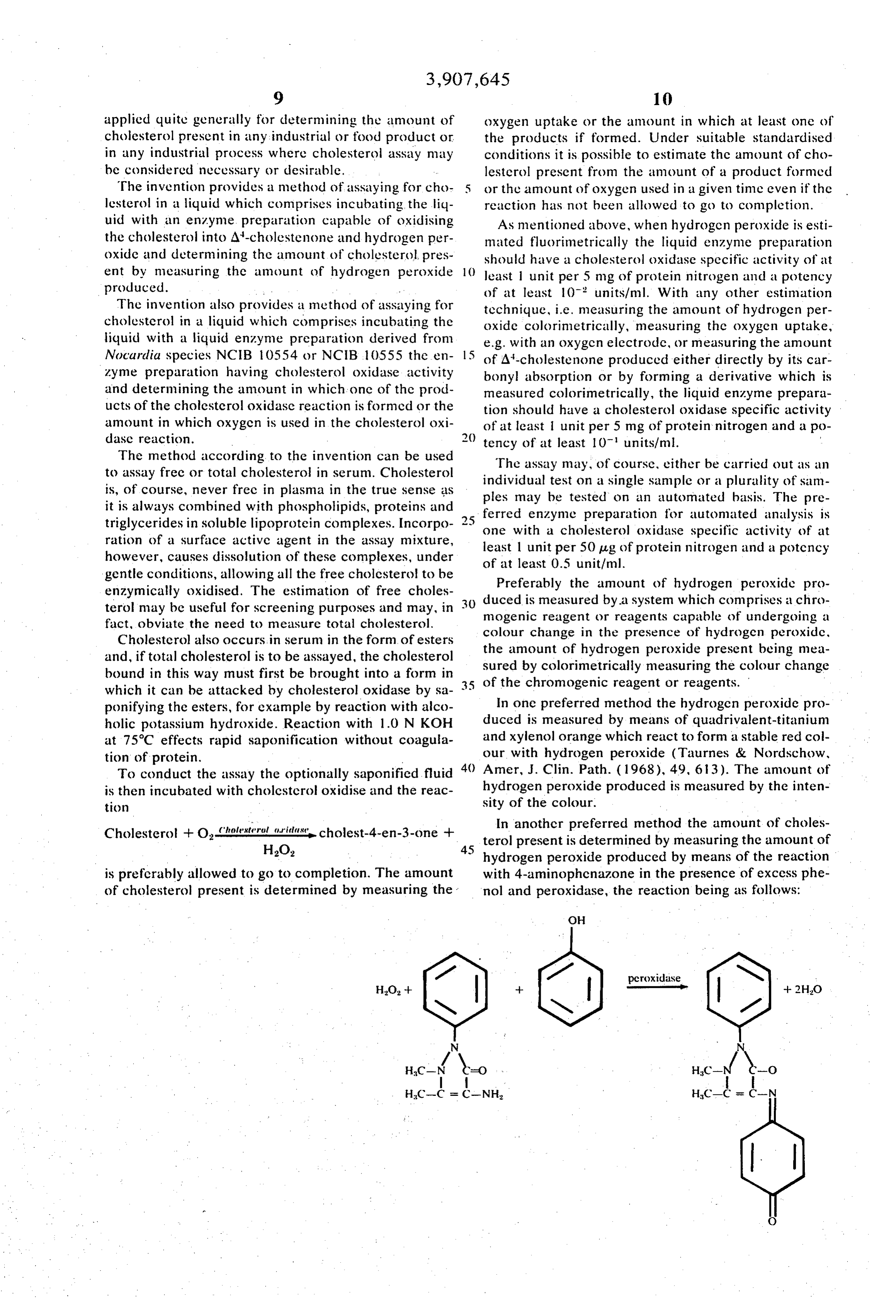
cholest-4-en-3-one o 45 terol present is determined by measuring the amount of 2/ hydrogen peroxide produced by means of the reaction is preferably allowed to go to completion. The amount with 4-aminophenazone in the presence of excess phe of cholesterol present is determined by measuring the nol and peroxidase, the reaction being as follows:
peroxidase
HO + -- awaiian -- 2HO
Page 7
Thus the preferably saponified extract is reacted with Although measuring the hydrogen peroxide pro cholesterol oxidase in the presence of peroxidase, 4 duced is is the preferred method of determining the aminophenazone and phenol and the optical density is amount of cholesterol present in the biological fluid measured at 510 nm. It can be shown that there is a lin being assayed it is also possible to use other techniques ear relationship between the AOD (difference in opti to: obtain the required assay. For example, the oxygen cal density) between a test solution and a control con uptake in the cholesterol oxidase reaction can be mea taining no cholesterol and the amount of cholestenone sured using an oxygen electrode by the technique de produced. The cholesterol oxidase, peroxidase, 4 scribed by Updike & Hicks in Nature, Lond. (1967) aminophenazone and phenol can be made up into a sin 214, 986 and Makin & Warren in Clin. Chim. Act.' gle reagent and used in this form. (1970) 29, 493. Alternatively the oxidation product A In a typical assay according to this method 0.1 ml of cholestenone can be measured for example as its 2,4- serum may be added to 1.0 ml alcoholic KOH (1 N) diphenyl hydrazone or iso-nicotinic acid hydrazone, or and incubated at 75°C for 5 minutes. 0.1 ml of the sa if a.sufficiently pure enzyme is used in a concentration ponified extract may then be added to 2.5 ml of a cho that exhibits low absorption at 240 nm (or if the en lesterol oxidase/peroxidase/4-aminophenzone/phenol 15 zyme is immobilised) the cholesterol can be assayed by reagent and the mixture incubated at 30° to 37°C for 5 the increase in absorption at 240 nm due to the A-' minutes and the colour read at 510 nm. Y cholestenone formed by enzymic oxidation. . . . . In this test a 0.1% solution of cholesterol may pro As mentioned above cholesterol assay can either be duce a turbidity when added to the enzyme reagent giv conducted ing an optical density of about 0.05. A 0.1% solution of ber of assaysonareanconducted automated basis where a large: num in succession or small num cholestenone treated in the same manner may also pro bers of samples can be analysed individually. The rea duce a turbidity giving an optical density of about 0.08. gents required for the assay will depend upon the par These conditions would only be encountered in an ex ticular method but when a HO, determination is used tremely abnormal serum containing 1,000 'mg% cho as the basis of the assay the reagents will generally.com lesterol but the presence of a surface active agent such prise (1) the cholesterol oxidase preparation, and (2) as 0.1% Triton X-100 in the enzyme reagent prevents, ... one or more other reagents. required for determining this turbidity, i.e. neither the substrate nor the product the amount of HO, produced. Some of the other rea produce during the reaction a colloidal suspension gents may be compatible with the cholesterol oxidase which would interfere with spectrophotometry. and may be incorporated into the enzyme preparation Any other suitable reaction of hydrogen peroxide 30 to give a combined reagent. In the case of assay meth may be used to measure the amount produced and ods requiring the presence of peroxidase this can bein hence the amount of cholesterol in the serum. Exam cluded with the cholesterol oxidase to form a combined ples of such reactions with the references where a fuller liquid or freeze dried enzyme:preparation. In the case description of the reaction may be found are as follows: 3 5 of a freeze dried preparation this is reconstituted be l. 2,6-dichlorophenol indophenol can be used as the fore use by addition of buffer. In all cases the reagents oxygen acceptor instead of 4-aminophenazone in a : , are generally supplied in a concentrated form and di coupled peroxidase reaction (Clark, & Timms, . . luted immediately before use. A reagent such as alco Proc. Assoc. Clin. Biochem. (1968) 5, 61) . . . . holic potassium hydroxide for saponifying the biologi 2. Hydrogen peroxide can be reacted with guaiacum 40 cal fluid is also required when total cholesterol is to be in the presence of peroxidase to give a blue product measured but this will generally be supplied by the user (Morley, Dawson & Marks, Proc. Assoc. Clin. Bio as will buffer and other reagents required for dilution. chem. (1968) 5, 42) For automated analysis the cholesterol oxidase prep 3. Iodine is liberated from potassium iodide on reac aration is supplied either in concentrated or freeze tion with hydrogen peroxide and the liberated io 45 dried form to be diluted or reconstituted before use. If dine can then be reacted to form a pink colour with required by the analysis the preparation may also con diethyl-p-phenylenediamine (Thompson, Clin. tain peroxidase. The other reagents will generally be Chim. Acta. (1969) 25, 415). . supplied by the user. . . . . . . . . . . 4. Iodine is liberated from iodide by reaction with hy Where individual tests are to be performed kits of the drogen peroxide and polyvinyl pyrrolidine is used 50 reagents can be supplied.
to shift the absorption of iodine from the near u.V. The invention thus also provides a kit for assaying the towards the visible where is absorption can be read amount of cholesterol in a liquid comprising in associa at 470 nm (Wate and Marbach, Clin. Chem.' tion
. Under the action of peroxidase hydrogen peroxide 55 i. an enzyme preparation which is derived from No oxidises homovanilic acid to a highly fluorescent cardia species NCB 10554 or NCIB 10555 and product in alkaline solution (Protein does not in which has a cholesterol oxidase specific activity of terfere with this reaction at a 40-fold dilution of plasma). The product can be measured fluorimetri at least 1 unit per 5 mg of protein nitrogen; and cally (Phillips & Elevitch, Amer. J. Clin. Path. 60.
(1968) 49, 622) ii. at least one reagent which is capable of being used 6. Hydrogen peroxide reacts with iodine in the pres in the determination of the amount in which a ence of a molybdenum (IV) catalyst. If a known ex product is formed in the cholesterol oxidase reac cess of thiosulphate is used to reduce the iodine as tion.
it is produced residual thiosulphate can be titrated 65 Component (i) is thus the enzyme preparation gener coulometrically with iodine. (Simon, Christian & ally in a form more concentrated than required in the Purdy, Clin. Chem. (1968) 14, 463) test to be diluted with buffer by the user. The enzyme
Page 8
preparation may bc in freeze-dried or in concentrated wit/litre, 600 g of cholesterol suspended in 2 litres of a liquid form. The enzyme preparation may include per mixture of Tween 80 and water (0.03: , v/v) was added oxidase when this is required for the test or any other to the culture. During the growth phase the maximum reagent required in the final assay which is compatible doubling time for growth was about 2 hours. After 24 with the cholesterol oxidase. hours when the cell concentration was about 6-7 g dry The kit will, of course, contain each of the connpo wit/litre the microorganisms were harvested by passage nents in the amount required for the same defined through an intermittent-discharge disc bowl centrifuge number of tests. For example the kit may contain suffi at 400 litres/hour. (Alternatively a rotary vacuum pre cient enzyme and other reagents for say 12 tests. Each coat filter may be used. The fermentation time may be reagent may be supplied in a single amount, e.g. in a () reduced by inoculating with a larger seed culture). bottle, the amount required for an individual test being The harvested cells were suspended in 0.01 M potas extracted from this single amount. sium phosphate buffer pH 7.0 containing ().5% (v/v) Alternatively the kit may contain unit doses of the Triton X-100 at 10°C to give a final volume of 60 litres. enzyme component, each containing at least 0.05 units After gentle stirring for 2 hours (shorter times may be of cholesterol oxidase activity, i.e. enough for a single used with only a slight reduction in the amount of en test. For example the unit doses of the enzyme prepara zyme extracted) the extracted cells were removed by tion may be provided in freeze-dried or concentrated passage through a tubular bowl centrifuge (model 6P. form in individual vials to be reconstituted with buffer Sharples). The clear supernatant obtained was passed before each test. through a column (5 litre capacity) at 5°C containing Component (ii) of the kit is, where hydrogen perox DE-52 cellulose (previously equilibrated with ().01 M ide is to be determined colorimetrically, usually an oxy pH. 7.0 potassium phosphate buffer containing 0.5% gen acceptor such as 4-aminophenazone and phenol or Triton X-100). The cholesterol oxidase present and xylenol orange and quad rivalent titanium. These other any catalase present was retained by the DE-52 cellu reagents can be supplied in bottles either ready for use lose. The cholesterol oxidase was released by step-wise or in concentrated form to be diluted by the user. 2 5 elution with increasing molarities of potassium phos The user will generally supply the buffer required for phate buffer pH 7.0 (containing 0.5% Triton X-100). dilution, the alkali required for saponification where at 5'c. Any catalase present remained on the column. total cholesterol is to be assayed and any other com The eluent fractions rich in cholesterol oxidase were mon reagents which may be required such as solvents further concentrated by ultrafilitration at 5°C. using a for extraction or dilution. Where the assay is for total PM-30 membrane. The retentate solution obtained (3 cholesterol an acid reagent, e.g. dilute HCl or HSO, litres) had a cholesterol oxidase activity of 5.5 p.mole is required for neutralisation of the reagent used for Sa cholesterol oxidiscd/ml/min at 37°C. The overall yield ponification and this acid reagent may be included in was about 20%. This may be increased by washing of the kit. In cases where A-cholestenone is determined discarded solids at the extraction and by collecting a directly by its carbonyl absorption and there is no col larger fraction at the ion-exchange step. The enzyme our reagent this acid reagent may be the only other solution was stored in a liquid form at 5°C with azide component of the kit apart from the enzyme prepara added as a preservative. The solution retained virtually tion. If required the kit may include one or more stan total activity for at least 2 months. dard cholesterol solutions for standardising the assay. The enzyme preparation had a cholesterol oxidase The invention is illustrated by the following examples 40 specific activity of about 1 unit per 28 uug protein ni although it is to be understood that they do not limit the trogen and a potency of about 5 units/ml. The prepara invention in any way. tion contained about 3% w/v. Triton X-100. EXAMPLE 1 EXAMPLE 2
Production of Cholesterol Oxidase Assay of Free Cholesterol in Serum 500 litres of sterile growth media were inoculated PRINCIPLE.
with 1 litre of a seed culture of Nocardia sp. Cholesterol oxidase oxidises cholesterol to A NCIB10554. The growth media for both seed and pro cholestenone with the simultaneous production of hy duction cultures were: . drogen peroxide. The hydrogen peroxide produced is chelated with xylenol orange and quadrivalent tita g/litre nium. The adsorption of this red coloured complex is measured at 550 nm.
(NH)SO 2.0 REAGENTS
0.01 55 1. 0.01 M phosphate buffer pH 7.0 containing 0.10
KHPO, 20 g% sodium azide.
MgSO.7HO (). 2. Cholesterol oxidase solution 5 units/ml (1 ml oxi
Yeast Extract 20 dises 5 p.M cholesterol per minute at pH 7.0 and 30°C) contains approx. 3.0% w/v. Triton X-100.
60 3. Working enzyme solution - 5 ml choiesterol oxi
The pH is 6.7 dase solution is added to 45 ml of the 0.01 M phos The culture was allowed to grow at 30°C for 24 phate buffer.
hours. The culture was agitated by an agitator fitted 4. Sulphuric acid 2N - 56 ml concentrated sulphuric with 3 turbine impellers at 250 rpm and sterile air was acid is added to distilled water and diluted to l li supplied through a sparge pipe at 150 litres/min. Foam 65 tc.
ing was controlled by intermittent addition of polypro 5. Stock titanium 0.001 M - 0.08 g titanium dioxide pylene glycol antifoam. After about 14 hours when the is placed in a 25 ml conical flask and 0.5 g ammo culture had reached a concentration of 1-2 g dry nium sulphate and 2.5 ml concentrated sulphuric
Page 9
acid are added. This mixture is heated on a hot working enzyme solution is not added until after the ad plate until all of the material is dissolved and is co dition ()f the ethanolic KOH.
lourless. The solution is cooled and made up to 1 The optical density of an extract is read against its liter with distilled water. blank at 236 nnn.
6. Stock xylenol orange ().001 M - 0.76 g xylenol orange is dissolved in distilled water and diluted to EXAMPLE 4
7. Combined colour reagent - Add one volume of stock titanium to 0.5 volume of 2N sulphuric acid, o Kit Formulation for Assay
Serunn or Free Cholesterol in mix. Add one volume of stock xylenol orange and 0.5 g Brij-35 (polyoxyethylene lauryl ether) per 1 PRINCIPLE liter of reagent. Cholesterol oxidase oxidiscs cholesterol to A 8. Cholesterol standards containing up to 5.0 mM per cholestenone with the simultaneous production of hy liter. Prepared by dissolving pure dry cholesterol drogen peroxide. The hydrogen peroxide produced is (BDH Biochemical Standard) in isopropyl alcohol. 5 chelated with xylenol orange and quadrivalent tita METHOD nium. The absorption of this red coloured complex is 100 pull serum or standard are added to 2.0 ml work measured at 550 nm.
ing enzyme solution and incubated at 37°C for 5 min REAGENTS utes. 1.0 ml of the combined colour reagent is then 20 1. 0.01 M phosphate buffer pH 7.0 containing 0.10 added and the mixture incubated for a further 5 min g% sodium azide.
utes at 37°C. 2. Cholesterol oxidase solution 5 units (1 ml oxidises Blanks are prepared by adding serum or standard di 5 pM cholesterol per minute at pH 7.0 and 30°C) rectly to a mixture of 2.0 ml working enzyme solution containing 3.0% w/v Triton X-100. and 1.0 ml combined colour reagent. 3. Working enzyme solution - 5 ml cholesterol oxi The optical density of the test solution is read against 2 5 dase solution is added to 45 ml of the 0.01 M phos its, blanks at 550 nm. phate buffer (1).
4. Sulphuric acid 2N - 56 ml concentrated sulphuric
EXAMPLE 3 acid is added to distilled water and diluted to l li Assay of Total Cholesterol in Serum ter.
3) 5 . Stock titanium 0.001 M - 0.08 g titanium dioxide
PRINCIPLE
Cholesterol is released from lipoprotein complexes is placed in a 25 ml conical flask and 0.5 ammo nium sulphate and 2.5 ml concentrated sulphuric and hydrolysed from its esters by alkaline hydrolysis. acid are added. This mixture is heated on a hot Following neturalisation of the hydrolysate the choles plate until all the material is dissolved and is co terol is enzymically oxidised to A-cholestenone. A 35 lourless. The solution is cooled and made up to 1 cholestenone is then extracted from the reaction mix liter with distilled water. ture and its absorption at 236 nm is measured. 6. Stock xylenol orange 0.001 M - 0.76 g xylenol REAGENTS orange is dissolved in distilled water and diluted to 1. 0.05 M phosphate buffer pH 7.0. 1 liter.
2. Cholesterol oxidase - Stock solution containing 40 7. Combined colour reagent - One volume of stock 5.0 units/ml and 3.0% w/v Triton X-100. titanium is added to 0.5 volume of 2N sulphuric 3. Working enzyme - 5.0 ml of the cholesterol oxi acid and mixed. One volume of stock xylenol dase stock solution is added to 45 ml of the 0.05 M orange and 0.5 g Brij-35 (polyoxyethylene lauryl phosphate buffer pH 7.0 (1). either) per liter of reagent is then added. 4. Ethanolic KOH (1N) - A “Volucon' ampoule 45 8. A cholesterol standard containing up to 3.0 mM (May and Baker Ltd) to make 1 liter 1 N KOH is per liter is prepared by dissolving pure dry choles diluted to 100 ml with distilled water and made up terol (BDH Biochemical Standard) isopropyl alco to 1 liter with absolute alcohol. hol.
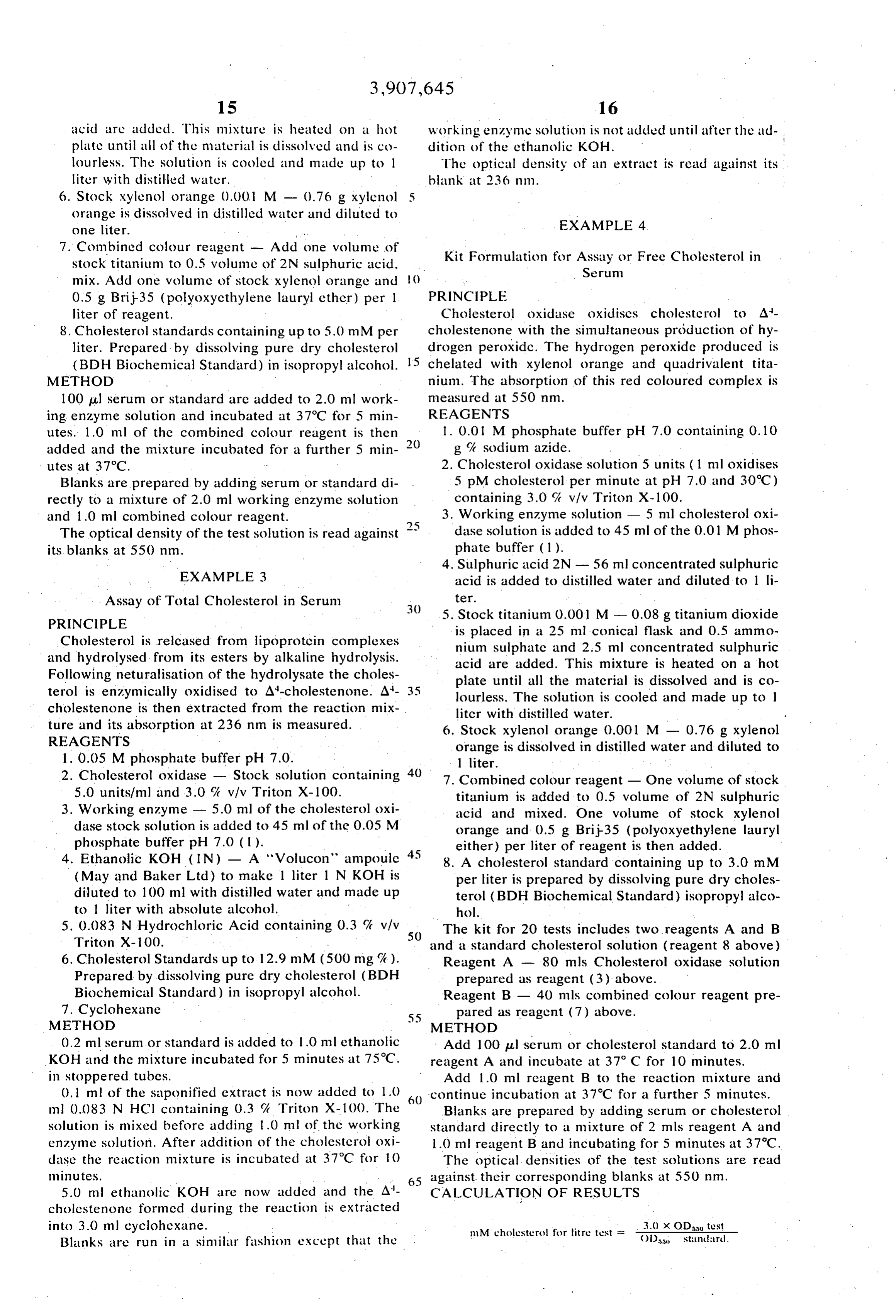
5. 0.083 NHydrochloric Acid containing 0.3% v/v 50 The kit for 20 tests includes two reagents A and B Triton X-100. and a standard cholesterol solution (reagent 8 above) 6. Cholesterol Standards up to 12.9 mM (500 mg%). Reagent A - 80 mls Cholesterol oxidase solution Prepared by dissolving pure dry cholesterol (BDH prepared as reagent (3) above. Biochemical Standard) in isopropyl alcohol. Reagent B - 40 mls combined colour reagent pre 7. Cyclohexane 55 pared as reagent (7) above. METHOD METHOD 0.2 ml serum or standard is added to 1.0 ml ethanolic - Add 100 ul serum or cholesterol standard to 2.0 ml KOH and the mixture incubated for 5 minutes at 75°C. reagent A and incubate at 37 C for 10 minutes. in stoppered tubes. Add 1.0 ml reagent B to the reaction mixture and 0.1 ml of the saponified extract is now added to 1.0 60 continue incubation at 37°C for a further 5 minutes. m 0.083 NHCl containing 0.3% Triton X-100. The Blanks are prepared by adding serum or cholesterol solution is mixed before adding 1.0 ml of the working standard directly to a mixture of 2 mls reagent A and enzyme solution. After addition of the cholesterol oxi 1.0 ml reagent B and incubating for 5 minutes at 37°C. dase the reaction mixture is incubated at 37°C for 10 The optical densities of the test solutions are read
65 against their corresponding blanks at 550 nm.
5.0 ml ethanolic KOH are now added and the A CALCULATION OF RESULTS cholestenone formed during the reaction is extracted into 3.0 ml cyclohexane. nM cholestrol for litre test - OD stincrl. Blanks are run in a similar fashion except that the
Page 10
EXAMPLHE 5 preparation derived from Nocadia species NCIB
Kit Formulation for Assay of Total Cholesterol in said enzyme preparation having cholesterol oxidase ac Serum tivity capable of oxidizing cholesterol to A' choleste
PRINCIPLE none and hydrogen peroxide and determining the Cholesterol is released from lipoprotein complexes amount of cholesterol present in said liquid by measur and hydrolysed from its esters by alkaline hydrolysis. ing the amount in which a product of the cholesterol Following neutralisation of the hydrolysate the choles oxidase reaction is formed or the amount in which oxy terol is enzymically oxidised to A-cholestenone and its gen is used in the cholesterol oxidase reaction. absorption at 236 nm is measured. () 4. A method according to claim 1 and wherein said REAGENTS enzyme preparation is derived from a Nocardia species. 1. 0.05 M phosphate buffer pH 7.0 5. A method according to claim 4 in which said en 2. Cholesterol oxidase - Stock solution containing zyme preparation has a cholesterol oxidase specific ac 5.0 units/ml and 3.0% w/v Triton X-100. tivity of at least 1 unit per 5 mg of protein nitrogen and 3. Working enzyme - 5.0 ml of the cholesterol oxi 5 a potency of at least 10 units ml when in liquid form dase stock solution is added to 45 ml of the 0.05 M and the amount of hydrogen peroxide produced is mea phosphate buffer pH 7.0 (1). sured by a fluorimetric method.
4. Ethanolic KOH (1N) - "Volucon' ampoule 6. A method according to claim 4 in which said en (May & Baker Limited) to make 1 liter 1 N KOH zyme preparation has a cholesterol oxidase specific is diluted to 100 ml with distilled water and made activity of at least l unit per 5 mg of protein nitrogen up to 1 liter with Absolute Alcohol. and a potency of at least 10 units/ml when in liquid 5. 0.083 N Hydrochloric Acid containing 0.3% w/v. form and the amount of hydrogen peroxide produced Triton X-100. - is measured colorimetrically.
6. Cholesterol Standard up to 12.9 mM (500 mg%) 7. A method according to claim 4 in which the prepared by dissolving pure dry cholesterol (BDH amount of hydrogen peroxide produced is measured by Biochemical Standard) in isopropyl alcohol. a system which comprises a chromogenic reagent or re 7. Cyclohexane. agents capable of undergoing a colour change in the A kit for 20 tests includes two reagents A and B and presence of hydrogen peroxide, said amount of hydro standard Cholesterol solutions (reagent 6 above) gen peroxide being measured by colorimetrically mea Reagent A - Cholesterol oxidase - 80 ml working 30 suring the colour change of the chromogenic reagent or enzyme (reagent 3). reagents.
Reagent B - 80 mls. 0.083 N hydrochloric Acid con 8. A method according to claim 7 in which said liquid taining 0.3% v/v Triton X-100. is serum or another biological fluid. Ethanolic KOH and cyclohexane are provided by the 35 9. A method according to claim 8 in which saponified user, as the former is unstable and both are required in serum or other biological fluid is incubated with said relatively large volumes. enzyme preparation to measure total cholesterol. MHETHOD 10. A method according to claim 3 in which said en 0.2 ml serum or standard is added to 1.0 ml ethanolic zyme preparation has a cholesterol oxidase specific ac KOH and the mixtuc incubated for 5 minutes at 75 in 40 tivity of at least 1 unit per 50 pug of protein nitrogen and stoppered tubes. a potency of at least 0.5 unit ml when in liquid form. 0.1 ml of the saponified extract is now added to 1.0 11. A method according to claim 3 carried out as an ml (0.083 NHCl containing 0.3% Triton X-100 (Rea individual test on a single sample.
gent A). The solution is mixed before adding 1.0 of the 12. A method according to claim 3 in which a plural working enzyme solution (Reagent B). After addition 45 ity of samples are tested on an automated basis. of the cholesterol oxidase the reaction mixture is incu 13. Akit for use in assaying for cholesterol in a liquid bated at 37 for 10 minutes. comprising in association 5.0 ml ethanolic KOH are now added and the A a. an enzyme preparation which is derived from No cholestenone formed during the reaction is extracted cardia species NCIB 10554 (NRRL 5635) or NCIB
! 0555 (NRRL 5636), which has a cholesterol oxi
Blanks are run in a similar fashion except that the dase specific activity of at least 1 unit per 5 mg of working enzyme solution is not added until after the ad protein nitrogen and is capable of oxidizing choles dition of the ethanolic KOH. terol into 66 -cholestenone and hydrogen perox The optical density of the extracts is read against ide, and
b. at least one reagent which is capable of being used
I claim: in the determination of the amount in which hydro 1. A method of assaying for cholesterol in a liquid gen peroxide is formed in the cholesterol oxidase which comprises incubating said liquid with an enzyme reaction.
preparation capable of oxidising cholesterol into A'- (b)14.comprises
A kit according to claim 13 in which component at least one reagent capable of taking cholestenone and hydrogen peroxide and determining 60 the amount of cholesterol present in said liquid by mea part in a reaction by means of which hydrogen peroxide suring the amount of hydrogen peroxide produced. can be determined fluorimetrically. 2. A method according to claim 1 in which said liquid 15. A kit according to claim 13 which includes in ad is serum or another biological fluid. dition at least one standard cholesterol solution. 3. A method of assaying for cholesterol in a liquid 65 16. A kit for use in assaying for cholesterol in a liquid which comprises incubating said liquid with an enzyme comprising in association (a) an enzyme preparation
Page 11
capable of oxidizing cholestero to A-cholestenone and 5 () ug of protein nitrogen. hydrogen peroxide; and (b) at least one reagent which 31. A method according to claim 1 where in the en is capable of being used in the determination of the zyme preparation has a catalase activity of less than amount of hydrogen peroxide produced. 10% of the cholesterol oxidase activity. 17. A Kit according to claim 16 wherein said enzyme 32. A kit according to claim 16 wherein the enzyme preparation is derived from a Nocardia species. preparation has a catalase activity of less than 10% of 18. A kit according to claim 17 in which enzyme the cholesterol oxidase activity. preparation (a) is in liquid form and has a potency of 33. A method according to claim 1 wherein the en at least () units/ml. zyme preparation has a catalase activity of less than 1%; 19. A kit according to claim 17 in which component of the cholesterol oxidase activity. (b) comprises at least one reagent capable of taking 34. A kit according to claim 16 wherein the enzyme: ; part in a reaction by means of which hydrogen peroxide preparation has a catalase activity of less than 1% of can be determined colorimetrically. the cholesterol oxidase activity. 20. A kit according to claim 17 in which said enzyme 35. A method according to claim 4 wherein the en preparation (a) has a cholesterol oxidase specific activ 5 Zyme preparation has a cholesterol oxidase specific ac ity of at least l unit per 50 pug of protein nitrogen and tivity of at least 1 unit per 50 pug of protein nitrogen and when in liquid form, has a potency of at least ().5 a potency of at least 0.5 units/ml. unit/ml. 36. A kit according to claim. 17 wherein the enzyme 21. A kit according to claim 17 in which component preparation has a cholesterol oxidase specific activity (a) is a freeze-dried enzyme preparation which upon of at least 1 unit per 50 pug of protein nitrogen and a po addition of an aqueous solvent and a suitable buffer tency of at least 0.5 units/ml. forms an aqueous preparation of the required potency. 37. A method according to claim 4 wherein the en 22. A kit according to claim 17 which contains each zyme preparation has a cholesterol oxidase specific ac component in an amount required for a defined num tivity of at least 1 unit per 28 pug of protein nitrogen, a ber of tests. 25 potency of 5 units/ml and contains 3% v/v Triton X 23. A kit according to claim 22 which contains a sin 100. .
gle amount of each component, the amount of each 38. A kit according to claim 17 wherein the enzyme component required for an individual test to be ex preparation has a cholesterol oxidase specific activity tracted from this single amount. of 1 unit per 28 pug of protein nitrogen, a potency of 5 24. A kit according to claim 22 which contains a sep units/ml and contains 3% v/v Triton X-100. arate amount of enzyme component (a) for each test. 39. A method according to claim 2 in which saponi 25. A kit according to claim 24, in which separate fied serum or other biological fluid is incubated with amounts of enzyme component (a) which correspond said enzyme preparation to measure total cholesterol. to that amount required for a single test are provided 40. A method according to claim t in which said en in freeze dried or concentrated form in individual vials zyme preparation has a cholesterol oxidase specific ac to be reconstituted with buffer before each test. tivity of at least 1 unit per 5 mg of protein nitrogen and 26. A kit according to claim 13 for the assay of total a potency of at least 10 units/ml when in liquid form cholesterol in serum which contains in addition to com and the amount of hydrogen peroxide produced is mea ponents (a) and (b) at least one acid reagent capable sured by a fluorimetric method. - of neutralising saponified serum. 41. A method according to claim 1 in which said en 27. A method of assaying for cholesterol in a liquid zyme preparation has a cholesterol oxidase specific ac which comprises incubating said liquid with a choles tivity of at least 1 unit per 5 mg of protein nitrogen and terol oxidase capable of oxidizing cholesterol to A' cho a potency of at least 10 units/ml when in liquid form lestenone and hydrogen peroxide and having a potency and the amount of hydrogen peroxide produced is mea of at least 10 units/ml and determining the amount of 45 sured colorimetrically. .. . . cholesterol by measuring the amount in which A'- 42. A kit according to claim 16 in which enzyme cholestenone is formed or oxygen is consumed in the preparation (a) is in liquid form and has a potency of cholesterol oxidase reaction. at least 10 units/ml.
28. A kit for use in assaying for cholesterol in a liquid 43. A kit according to claim 16 in which the at least comprising in association 50 one reagent of component (b) is capable of taking part a. a cholesterol oxidase capable of oxidizing choles in a reaction by means of which hydrogen peroxide can terol to A cholestenone and hydrogen peroxide be determined colorimetrically.
and having a potency of at least 10 units/ml; and 44. A kit according to claim 16 in which component. b. at least one reagent which is capable of being used (a) is a freeze-dried enzyme preparation which upon in the determination of the amount in which A addition of an aqueous solvent and a suitable buffer cholestenone is formed or oxygen is consumed in forms an acqueous preparation of the required potency. the cholesterol oxidase reaction. 45. A kit according to claim 28 wherein said choles 29. A method according to claim 27 wherein the cho terol oxidase is derived from a Nocardia species. lesterol oxidase has a specific activity of at least 1 unit 46. A kit according to claim 28 wherein said choles per 50 pug of protein nitrogen. 60 terol oxidase is derived from Nocardia species NCIB 30. A kit according to claim 28 wherein the choles 10554 (NRRL 5635)ck orck NCIB 10555 (NRRL 5636). terol oxidase has a specific activity of at least 1 unit per ck ck ck
Provenance
- Collection
- Cited prior art
- Original PDF
- patentimages.storage.googleapis.com →
- Filed
- 1974-01-23
- Pages
- 11
- Method
- pdftotext (the PDF's own text layer) + pdftoppm 300dpi page scans
- Source
- Google Patents bibliographic record
- Granted
- 1975-09-23
- Inventors
- William Richmond; Nat Res Dev
- Transcribed from
- patentimages.storage.googleapis.com →