patent · US3775128
Silver halide emulsion containing a triazine as antifoggant
27 November 1973
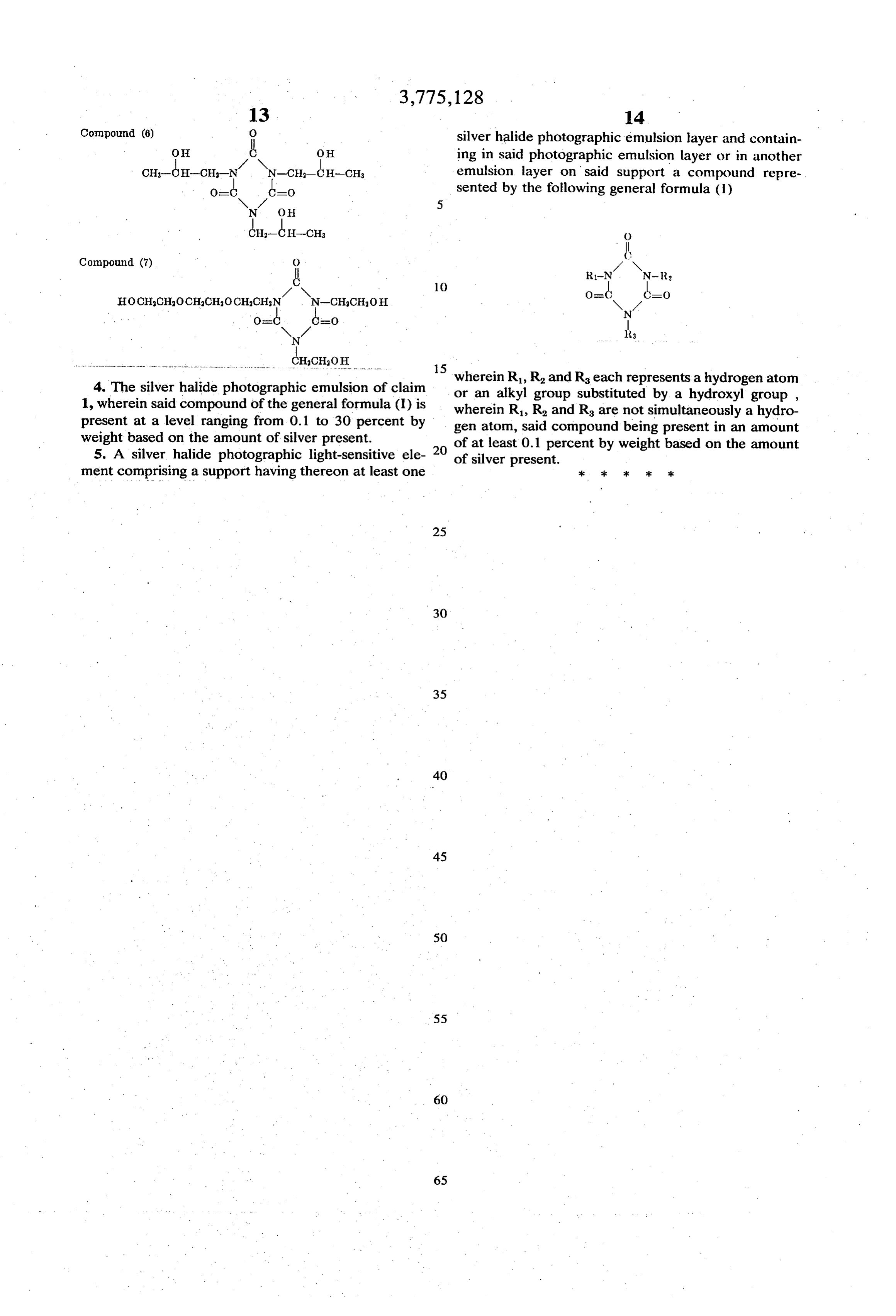
Page 1 — bibliographic record
United States Patent (19) (11) 3,775,128 Yamamoto et al. (45) Nov. 27, 1973
54) SILVER HALDE EMULSION CONTAINING Primary Examiner-Norman G. Torchin ATRAZINE AS ANTIFOGGANT Assistant Examiner-Won H. Louie, Jr. Attorney-Richard C. Sughrue et al.
75) Inventors: Nobuo Yamamoto; Yoshisato
Minagawa; Tohru Sueyoshi, all of
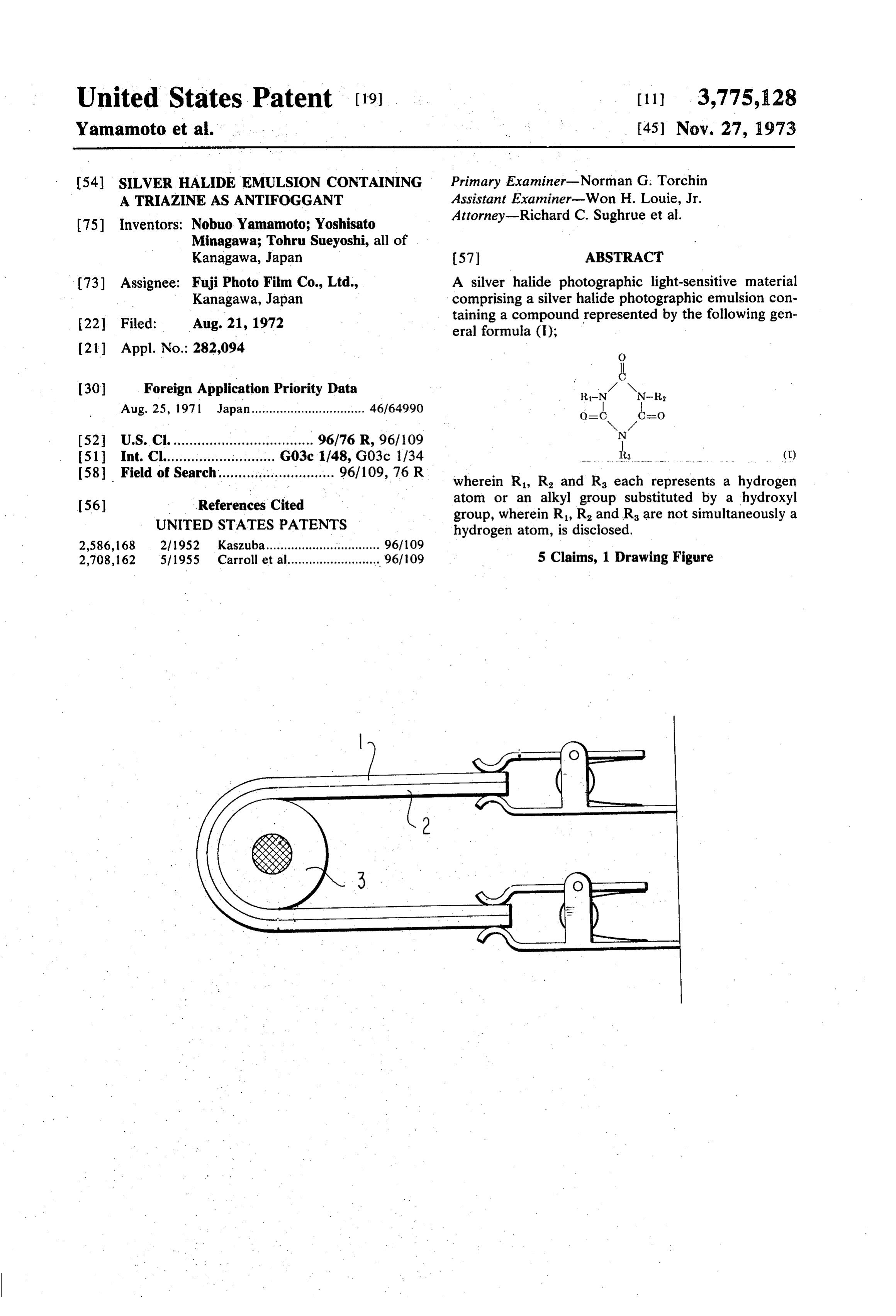
Kanagawa, Japan 57 ABSTRACT (73) Assignee: Fuji Photo Film Co., Ltd., A silver halide photographic light-sensitive material Kanagawa, Japan comprising a silver halide photographic emulsion con 22 Filed: Aug. 21, 1972 taining a compound represented by the following gen eral formula (I);
30 Foreign Application Priority Data R-N N-R Aug. 25, 1971 Japan................................ 46/64990 o-?,N / &=o
(58) Field of Search................... .......... 96/109, 76 R wherein R, R2 and Ra each represents a hydrogen 56) References Cited atom or an alkyl group substituted by a hydroxyl
UNITED STATES PATENTS
group, wherein R, R and Ra are not simultaneously a hydrogen atom, is disclosed.
2,586,168 2, 1952 Kaszuba..................... . . . . . . . . . . . 96/109 2,708, 162 5/1955 Carroll et al.......................... 96/109 5 Claims, 1 Drawing Figure
Page 2
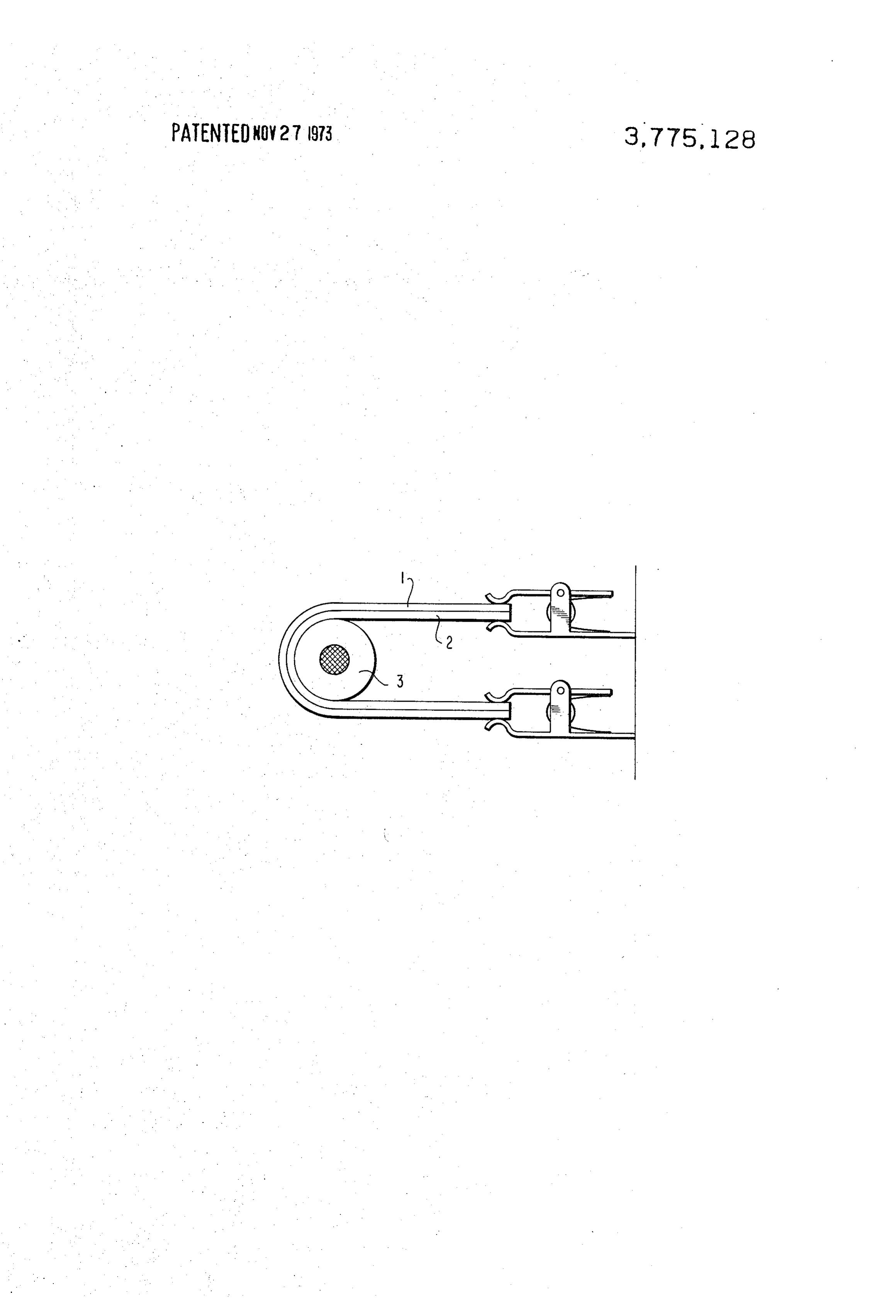
Drawing sheet — no readable text.
Page 3
SIVER HALDE EMULSION CONTAINING A some extent, or in that, although the curling tendency TRAZINE AS ANTIFOGGANT is suppressed to some extent, the surface of the coated BACKGROUND OF THE INVENTION material is too tacky resulting in adhesion to other sur faces have occurred.
1. Field of the Invention On the other hand, it has recently been observed The present invention relates to a silver halide light that, in the loading of a silver halide photographic light sensitive material. More particularly, it relates to a sil sensitive material in a camera, a printer or the like be ver halide photographic light-sensitive material fore the development processing, when the photo wherein fog formation and curling tendency are re graphic material is left with a curvature within a certain duced by an improvement in the physical properties 10 range for a long period of time, for example, with cur
vature as small as 3 to 10 mm in diameter for a period 2. Description of the Prior Art of 1 to 10 days, in such a condition that the silver halide In general, a silver halide photographic emulsion is emulsion surface faces toward the outside of the curva prepared using a high molecular weight material such ture, the formation of fog or desensitization will some as gelatin, polyvinyl alcohol, etc., as a protective col 15 times occur at the curved portion of the photographic loid and dispersing the crystals of silver iodide, silver material. This phenomenon is a newly found phenome bromide or silver chloride, or the mixed crystals non and is different from the previously known kink fog thereof in the protective colloid.
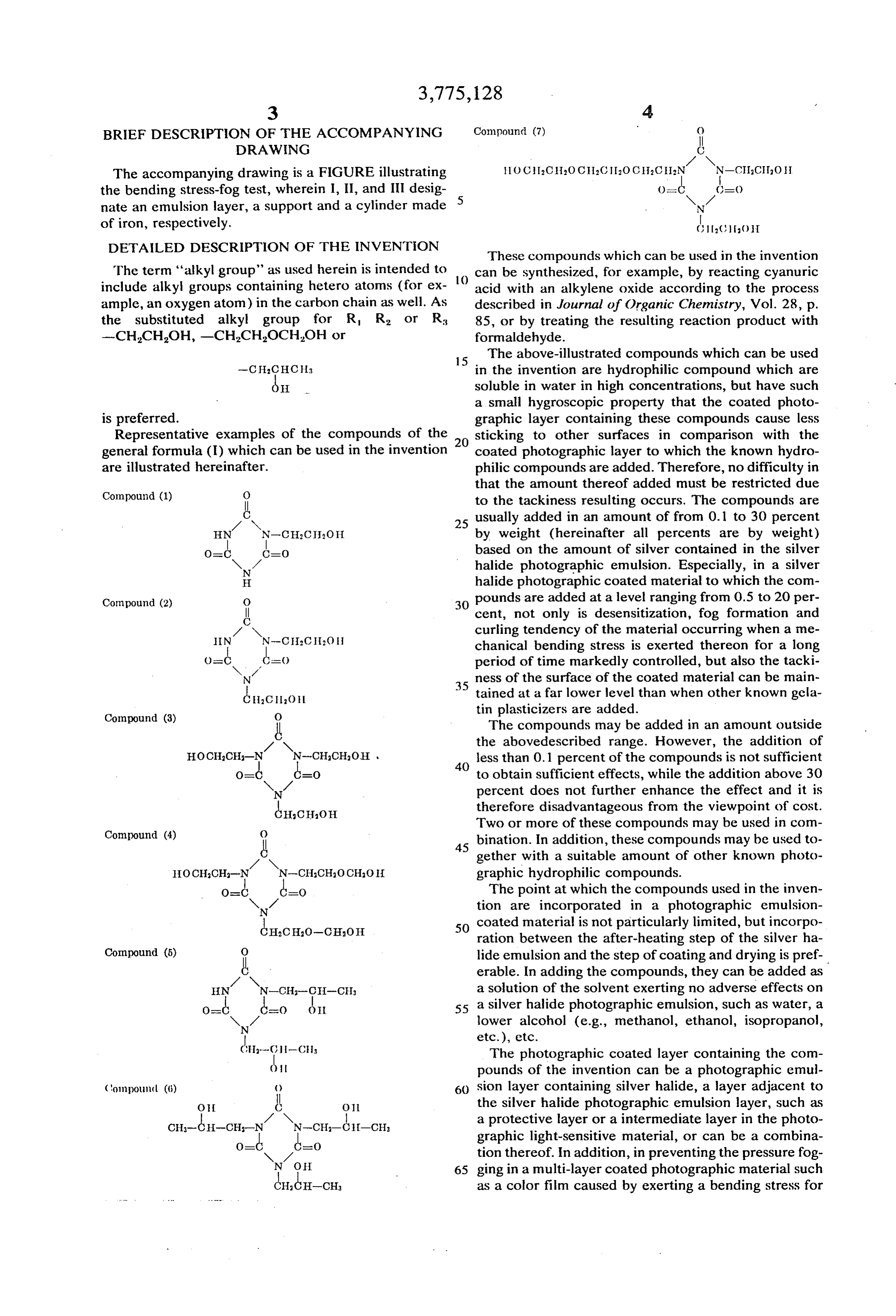
Photographic printing papers, dry plates, films, etc. or kink desensitization caused by bending the element sharply for a short period of time in that the former oc are prepared by applying such a silver halide photo 20 curs when a photographic light-sensitive material is graphic emulsion in the form of a thin film to a support such as a synthetic high polymer-laminated paper, kept in a kink or curved condition for a comparatively glass, cellulose ester, or synthetic high molecular film, long period of time. The deterioration in photographic e.g., polyethylene terephthalate, etc. properties caused by maintaining the silver halide In recent years, the amount of silver halide photo 25 emulsion-coated material in the above-described state graphic light-sensitive material used has been markedly will spoil the practical value of the photographic light increased, and the range of the use thereof tends to be sensitive material. However, an application of most of steadily broadened. Therefore, in the production of the the foregoing known methods which are considered to light-sensitive materials, it is required to design silver be effective for the general kink fog or kink desensiti halide photographic light-sensitive materials such that 30 zation has been determined to be quite ineffective for the properties thereof can be maintained stable under preventing the above-described newly found phenome various conditions of use. non, or is accompanied by a secondary adverse effect Silver halide emulsion-coated materials obtained by such as an increase in the tackiness of the surface of the applying the emulsion to various supports and drying as 35 coated material although some effects are obtained. described above are known to undergo an undesirable An object of this invention is to provide a method for photographic change referred to as "kink desensiti effectively controlling the curling of a silver halide pho zation' or “kink fog' when a mechanical stress is ex tographic layer applied to a support without degrading erted externally thereon momentarily or for a short the other physical and photographic properties thereof. time. In addition, it is also known that a silver halide 40 Another object of the invention is to provide a photographic emulsion layer applied to a hydrophobic method for preventing fog formation or desensitization support and dried as described tends to undergo crack which is caused by leaving the silver halide photo ing due to its brittleness under low humidity conditions graphic light-sensitive material for a long period of time or to curl due to the differences in planar contraction in a kinked or bent state, without degrading the other between the emulsion layer and the support. These un 45 physical and photographic properties thereof. desirable physical characteristics will cause various dif ficulties in the production of photographic light SUMMARY OF THE INVENTION sensitive materials, in photographic processing steps As the result of extensive investigations, it has been such as development, in handling such as in storage, on found projection, etc. As methods for improving these diffi 50 addingthat the above-stated object can be attained by to a silver halide photographic light-sensitive culties, it has been reported that it is effective, for ex ample, to add a certain heterocyclic compounds (Brit material a compound represented by the following gen eral formula (I);
ish Patent No. 738,618), alkyl phthalates (British Pa tent No. 738,637), alkyl esters (British Patent No.
738,639), or a certain kind of hydrophilic compounds 55
West German Patent OLS No. 1942,326) and the like to a silver halide photographic emulsion layer or a sup plementary layer.
However, in some of the above-described materials, 60 the defects in that the physical properties of the silver (I) halide photographic emulsion-coated materials when left under high temperature and high humidity are not sufficiently improved, that adverse effects on the pho tographic properties, such as fogging and desensiti 65 wherein R, R2 and Ra each represents a hydrogen atom zation are brought about, in that the curl-reducing ef or an alkyl group substituted by hydroxyl group, fect is poor although deterioration in photographic wherein R R2 and Ra are not simultaneously a hydro properties due to the mechanical stress is prevented to gen atom.
Page 4
BRIEF DESCRIPTION OF THE ACCOMPANYING Compound (7) s DRAWING C
The accompanying drawing is a FIGURE illustrating O CICHO CICIO CECHN N–CII:Cition the bending stress-fog test, wherein I, II, and III desig Os
nate an emulsion layer, a support and a cylinder made of iron, respectively. CC ()
DETALED DESCRIPTION OF THE INVENTION
These compounds which can be used in the invention
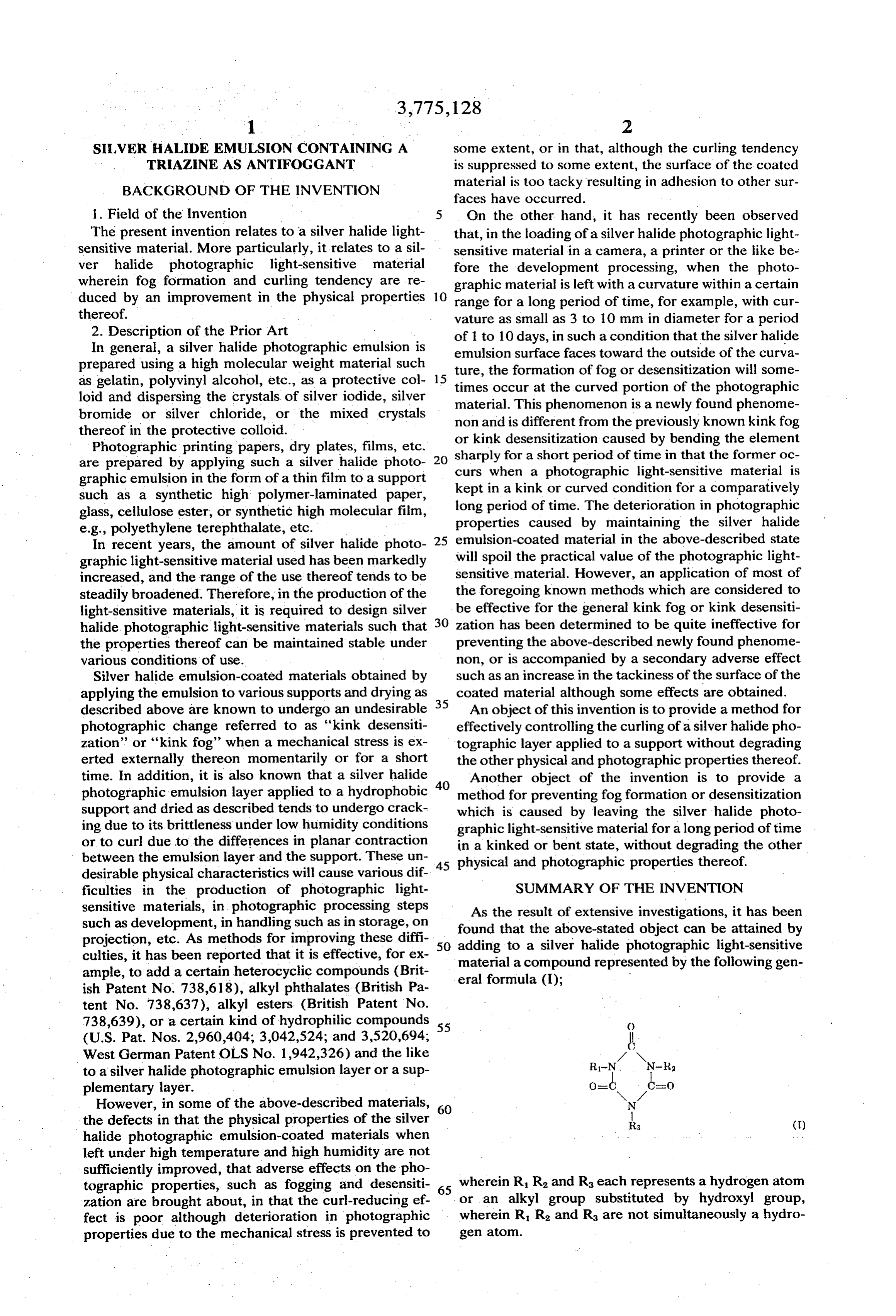
The term “alkyl group" as used herein is intended to can be synthesized, for example, by reacting cyanuric include alkyl groups containing hetero atoms (for ex acid with an alkylene oxide according to the process ample, an oxygen atom) in the carbon chain as well. As described in Journal of Organic Chemistry, Vol. 28, p. the substituted alkyl group for R. R. or Ra 85, or by treating the resulting reaction product with -CHCHOH, -CHCHOCHOH or formaldehyde.
15 The above-illustrated compounds which can be used -CH2CHCH3 in the invention are hydrophilic compound which are H soluble in water in high concentrations, but have such a small hygroscopic property that the coated photo is preferred. graphic layer containing these compounds cause less Representative examples of the compounds of the sticking to other surfaces in comparison with the general formula (I) which can be used in the invention coated photographic layer to which the known hydro are illustrated hereinafter. philic compounds are added. Therefore, no difficulty in that the amount thereof added must be restricted due
Compound (1) to the tackiness resulting occurs. The compounds are 25 usually added in an amount of from 0.1 to 30 percent
by weight (hereinafter all percents are by weight)
C=O based on the amount of silver contained in the silver
N halide photographic emulsion. Especially, in a silver
H halide photographic coated material to which the com
Compound (2) 30 pounds are added at a level ranging from 0.5 to 20 per cent, not only is desensitization, fog formation and
c N-CHCO curling tendency of the material occurring when a me chanical bending stress is exerted thereon for a long
period of time markedly controlled, but also the tacki ness of the surface of the coated material can be main discil, oil tained at a far lower level than when other known gela tin plasticizers are added.
sN The compounds may be added in an amount outside the abovedescribed range. However, the addition of
less than 0.1 percent of the compounds is not sufficient
O (=o to obtain sufficient effects, while the addition above 30 N / percent does not further enhance the effect and it is
&HCH-OH therefore disadvantageous from the viewpoint of cost.
Two or more of these compounds may be used in com 45 bination. In addition, these compounds may be used to
N gether with a suitable amount of other known photo
HOCHCH-N N-CHCHOCHOI graphic hydrophilic compounds.
O The point at which the compounds used in the inven
N tion are incorporated in a photographic emulsion chic HO-CHOH coated material is not particularly limited, but incorpo ration between the after-heating step of the silver ha
Compound (5) lide emulsion and the step of coating and drying is pref erable. In adding the compounds, they can be added as
HN N-CH-CH-CH a solution of the solvent exerting no adverse effects on O =d N /(=0 (II 55 a silver halide photographic emulsion, such as water, a lower alcohol (e.g., methanol, ethanol, isopropanol, etc.), etc.
dri-c -C The photographic coated layer containing the com () pounds of the invention can be a photographic emul
Compouncil () () 60 sion layer containing silver halide, a layer adjacent to O 2. O the silver halide photographic emulsion layer, such as CH-5 H-CH-N N-CH-) -CH a protective layer or a intermediate layer in the photo o-c =0 graphic light-sensitive material, or can be a combina tion thereof. In addition, in preventing the pressure fog
Y ?o 65 ging in a multi-layer coated photographic material such ch, s H-CH as a color film caused by exerting a bending stress for
Page 5
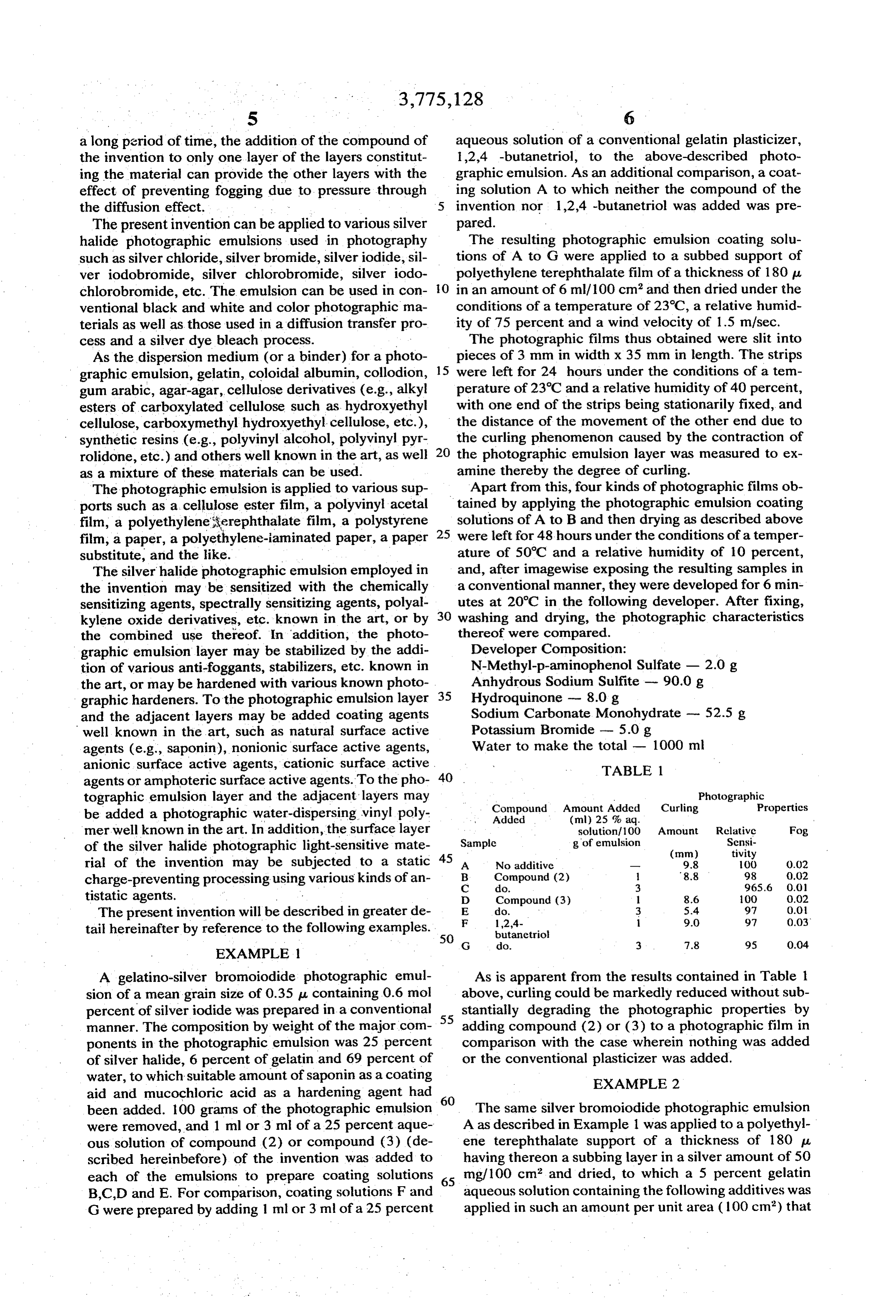
a long pariod of time, the addition of the compound of aqueous solution of a conventional gelatin plasticizer, the invention to only one layer of the layers constitut 1,2,4-butanetriol, to the above-described photo ing the material can provide the other layers with the graphic emulsion. As an additional comparison, a coat effect of preventing fogging due to pressure through ing solution A to which neither the compound of the the diffusion effect. invention nor 1,2,4-butanetriol was added was pre The present invention can be applied to various silver pared.
halide photographic emulsions used in photography The resulting photographic emulsion coating solu such as silver chloride, silver bromide, silver iodide, sil tions of A to G were applied to a subbed support of ver iodobromide, silver chlorobromide, silver iodo polyethylene terephthalate film of a thickness of 180 pu chlorobromide, etc. The emulsion can be used in con O in an amount of 6 ml/100 cm and then dried under the ventional black and white and color photographic ma conditions of a temperature of 23°C, a relative humid terials as well as those used in a diffusion transfer pro ity of 75 percent and a wind velocity of 1.5 m/sec. cess and a silver dye bleach process. The photographic films thus obtained were slit into As the dispersion medium (or a binder) for a photo pieces of 3 mm in width x 35 mm in length. The strips graphic emulsion, gelatin, coloidal albumin, collodion, 15 were left for 24 hours under the conditions of a tem gum arabic, agar-agar, cellulose derivatives (e.g., alkyl perature of 23°C and a relative humidity of 40 percent, esters of carboxylated cellulose such as hydroxyethyl with one end of the strips being stationarily fixed, and cellulose, carboxymethyl hydroxyethyl cellulose, etc.), the distance of the movement of the other end due to synthetic resins (e.g., polyvinyl alcohol, polyvinyl pyr the curling phenomenon caused by the contraction of rolidone, etc.) and others well known in the art, as well 20 the photographic emulsion layer was measured to ex as a mixture of these materials can be used. amine thereby the degree of curling. The photographic emulsion is applied to various sup Apart from this, four kinds of photographic films ob ports such as a cellulose ester film, a polyvinyl acetal tained by applying the photographic emulsion coating film, a polyethylene Serephthalate film, a polystyrene solutions of A to B and then drying as described above film, a paper, a polyethylene-iaminated paper, a paper 25 were left for 48 hours under the conditions of a temper substitute, and the like. ature of 50°C and a relative humidity of 10 percent, The silverhalide photographic emulsion employed in and, after imagewise exposing the resulting samples in the invention may be sensitized with the chemically a conventional manner, they were developed for 6 min sensitizing agents, spectrally sensitizing agents, polyal utes at 20°C in the following developer. After fixing, kylene oxide derivatives, etc. known in the art, or by 30 washing and drying, the photographic characteristics the combined use thereof. In addition, the photo thereof were compared.
graphic emulsion layer may be stabilized by the addi Developer Composition:
tion of various anti-foggants, stabilizers, etc. known in N-Methyl-p-aminophenol Sulfate - 2.0 g the art, or may be hardened with various known photo Anhydrous Sodium Sulfite - 90.0 g graphic hardeners. To the photographic emulsion layer 35 Hydroquinone - 8.0 g and the adjacent layers may be added coating agents Sodium Carbonate Monohydrate - 52.5g well known in the art, such as natural surface active Potassium Bromide - 5.0 g agents (e.g., saponin), nonionic surface active agents, Water to make the total - 1000 m anionic surface active agents, cationic surface active . TABLE 1 agents or amphoteric surface active agents. To the pho 40 tographic emulsion layer and the adjacent layers may Compound Amount Addicd Curling Photographic
Propertics be added a photographic water-dispersing vinyl poly Added (ml). 25% aq.
mer well known in the art. In addition, the surface layer Sample solution/100 Amount Relative Fog of the silver halide photographic light-sensitive mate g of emulsion
Sensi tivity rial of the invention may be subjected to a static 45 A No additive -- 9.8 100 O.O2 charge-preventing processing using various kinds of an B
Compound (2)
tistatic agents. D Compound (3) 1 8.6 100 0.02 The present invention will be described in greater de E
tail hereinafter by reference to the following examples. 50 butanetrio
G do. 3 7.8 95 O.04
A gelatino-silver bromoiodide photographic emul- - As is apparent from the results contained in Table 1 sion of a mean grain size of 0.35 u containing 0.6 mol above, curling could be markedly reduced without sub percent of silver iodide was prepared in a conventional 55 stantially degrading the photographic properties by manner. The composition by weight of the major com adding compound (2) or (3) to a photographic film in ponents in the photographic emulsion was 25 percent comparison with the case wherein nothing was added of silver halide, 6 percent of gelatin and 69 percent of or the conventional plasticizer was added. water, to which suitable amount of saponin as a coating EXAMPLE 2 aid and mucochloric acid as a hardening agent had 60 been added. 100 grams of the photographic emulsion The same silver bromoiodide photographic emulsion were removed, and 1 ml or 3 ml of a 25 percent aque A as described in Example 1 was applied to a polyethyl ous solution of compound (2) or compound (3) (de ene terephthalate support of a thickness of 180 pu scribed hereinbefore) of the invention was added to having thereon a subbing layer in a silver amount of 50 each of the emulsions to prepare coating solutions 65 mg/100 cm and dried, to which a 5 percent gelatin B,C,D and E. For comparison, coating solutions F and aqueous solution containing the following additives was G were prepared by adding 1 ml or 3 ml of a 25 percent applied in such an amount per unit area (100 cm) that
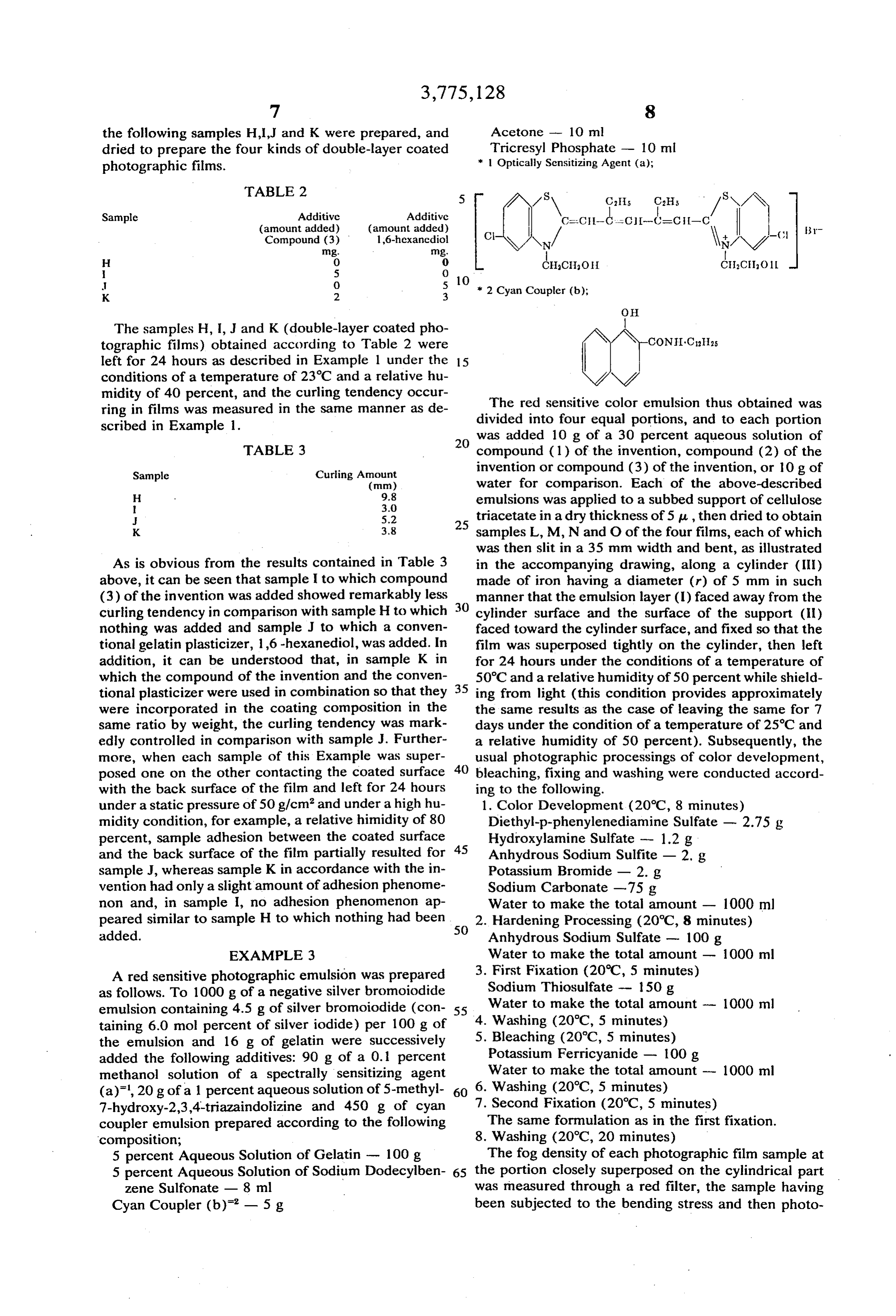
Page 6
the following samples H.I.J and K were prepared, and Acetone - 10 ml dried to prepare the four kinds of double-layer coated Tricresyl Phosphate - 10 ml photographic films. * 1 Optically Sensitizing Agent (a);
TABLE 2
Sample Additive Additive /sw C-C-C-C-C-C-C
(amount added) (amount added)
Compound (3)
CHCIO
The samples H, I, J and K (double-layer coated pho tographic films) obtained according to Table 2 were left for 24 hours as described in Example 1 under the 15 ^ conical conditions of a temperature of 23°C and a relative hu midity of 40 percent, and the curling tendency occur
The red sensitive color emulsion thus obtained was ring in films was measured in the same manner as de divided into four equal portions, and to each portion scribed in Example 1. was added 10 g of a 30 percent aqueous solution of TABLE 3 compound (1) of the invention, compound (2) of the Sample Curling Armount invention or compound (3) of the invention, or 10 g of (mm) water for comparison. Each of the above-described
3.0 emulsions was applied to a subbed support of cellulose
25 triacetate in a dry thickness of 5 u , then dried to obtain
K 38 samples L., M, N and O of the four films, each of which was then slit in a 35 mm width and bent, as illustrated
As is obvious from the results contained in Table 3 in the accompanying drawing, along a cylinder (III) above, it can be seen that sample I to which compound made of iron having a diameter (r) of 5 mm in such (3) of the invention was added showed remarkably less manner that the emulsion layer (I) faced away from the curling tendency in comparison with sample H to which 30 cylinder surface and the surface of the support (II) nothing was added and sample J to which a conven faced toward the cylinder surface, and fixed so that the tional gelatin plasticizer, 1,6-hexanediol, was added. In film was superposed tightly on the cylinder, then left addition, it can be understood that, in sample K in for 24 hours under the conditions of a temperature of which the compound of the invention and the conven 35 50°C and a relative humidity of 50 percent while shield tional plasticizer were used in combination so that they ing from light (this condition provides approximately were incorporated in the coating composition in the the same results as the case of leaving the same for 7 same ratio by weight, the curling tendency was mark days under the condition of a temperature of 25°C and edly controlled in comparison with sample J. Further a relative humidity of 50 percent). Subsequently, the more, when each sample of this Example was super usual photographic processings of color development, posed one on the other contacting the coated surface 40 bleaching, fixing and washing were conducted accord with the back surface of the film and left for 24 hours ing to the following.
under a static pressure of 50 g/cm and under a high hu 1. Color Development (20°C, 8 minutes) midity condition, for example, a relative himidity of 80 Diethyl-p-phenylenediamine Sulfate - 2.75 g percent, sample adhesion between the coated surface Hydroxylamine Sulfate - 1.2g and the back surface of the film partially resulted for 45Anhydrous Sodium Sulfite - 2, g sample J, whereas sample K in accordance with the in Potassium Bromide - 2.g vention had only a slight amount of adhesion phenome Sodium Carbonate -75 g non and, in sample I, no adhesion phenomenon ap Water to make the total amount - 1000 ml peared similar to sample H to which nothing had been 50 2. Hardening Processing (20°C, 8 minutes) added. Anhydrous Sodium Sulfate - 100 g EXAMPLE 3 Water to make the total amount - 1000 ml A red sensitive photographic emulsion was prepared 3. First Fixation (20°C, 5 minutes) as follows. To 1000 g of a negative silver bromoiodide Sodium Thiosulfate - 150 g emulsion containing 4.5 g of silver bromoiodide (con 55 Water to make the total amount - 1000 ml taining 6.0 mol percent of silver iodide) per 100 g of 4. Washing (20°C, 5 minutes) the emulsion and 16 g of gelatin were successively 5. Bleaching (20°C, 5 minutes) added the following additives: 90 g of a 0.1 percent Potassium Ferricyanide - 100 g methanol solution of a spectrally sensitizing agent Water to make the total amount - 1000 ml (a), 20g of a 1 percent aqueous solution of 5-methyl 60 6. Washing (20°C, 5 minutes) 7-hydroxy-2,3,4-triazaindolizine and 450 g of cyan 7. Second Fixation (20°C, 5 minutes) coupler emulsion prepared according to the following The same formulation as in the first fixation. composition; 8. Washing (20°C, 20 minutes) 5 percent Aqueous Solution of Gelatin - 100 g The fog density of each photographic film sample at 5 percent Aqueous Solution of Sodium Dodecylben 65 the portion closely superposed on the cylindrical part zene Sulfonate - 8 ml was measured through a red filter, the sample having Cyan Coupler (b) - 5 g been subjected to the bending stress and then photo
Page 7
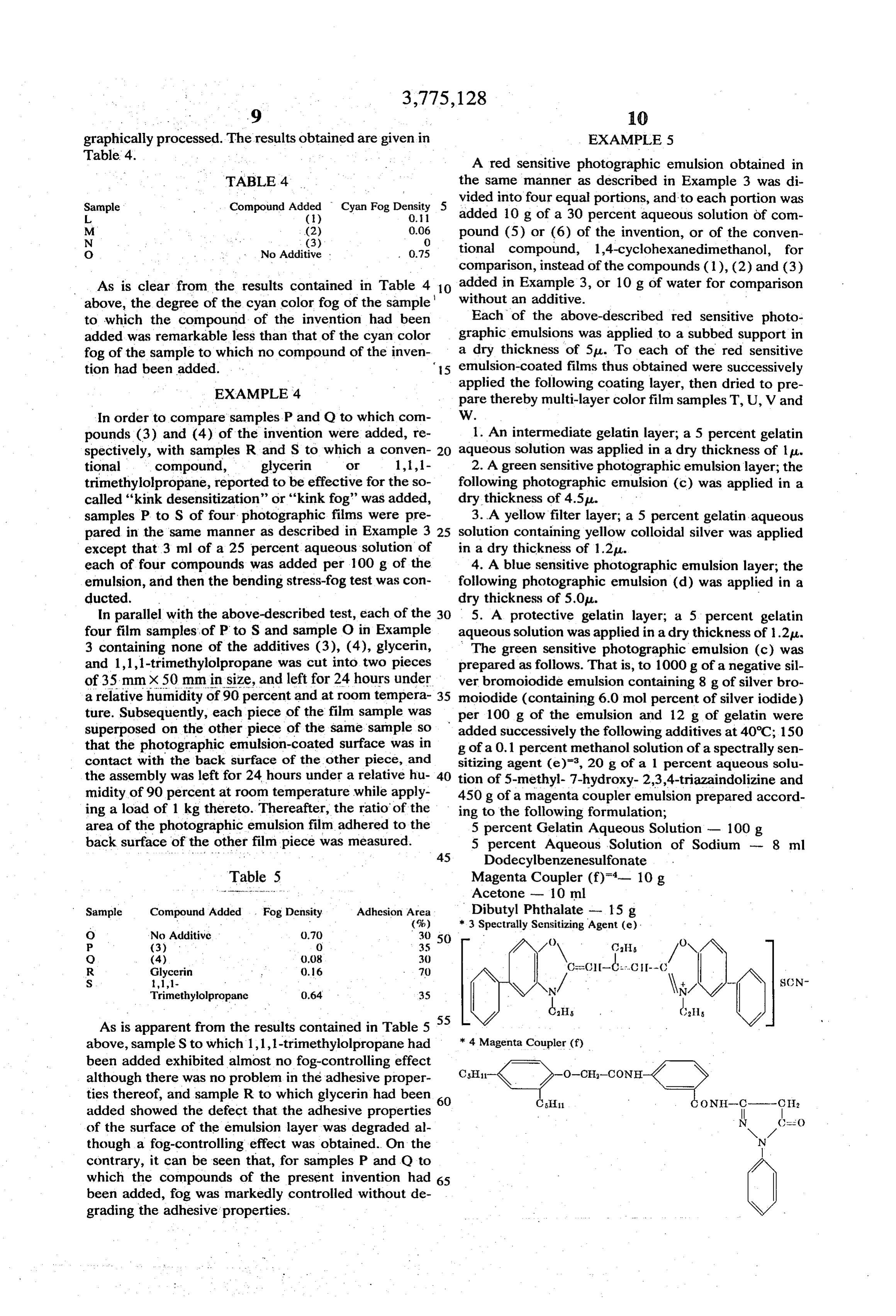
; 9 10 graphically processed. The results obtained are given in EXAMPLE 5 Table 4.
A red sensitive photographic emulsion obtained in
TABLE 4 the same manner as described in Example 3 was di
Sample Compound Added Cyan Fog Density 5 vided into four equal portions, and to each portion was L. (l) 0.1 added 10 g of a 30 percent aqueous solution of com
pound (5) or (6) of the invention, or of the conven
O No Additive 0.75 tional compound, 1,4-cyclohexanedimethanol, for comparison, instead of the compounds (1), (2) and (3)
As is clear from the results contained in Table 4 O added in Example 3, or 10 g of water for comparison without an additive.
above, the degree of the cyan color fog of the sample to which the compound of the invention had been Each of the above-described red sensitive photo added was remarkable less than that of the cyan color graphic emulsions was applied to a subbed support in fog of the sample to which no compound of the inven a dry thickness of 5u. To each of the red sensitive tion had been added. 15 emulsion-coated films thus obtained were successively
EXAMPLE 4
applied the following coating layer, then dried to pre pare thereby multi-layer color film samples T, U, V and
In order to compare samples P and Q to which con W.
pounds (3) and (4) of the invention were added, re 1. An intermediate gelatin layer; a 5 percent gelatin spectively, with samples R and S to which a conven 20 aqueous solution was applied in a dry thickness of lu. tional compound, glycerin Ot 1,1,1- 2. A green sensitive photographic emulsion layer; the trimethylolpropane, reported to be effective for the so following photographic emulsion (c) was applied in a called “kink desensitization' or "kink fog' was added, dry thickness of 4.5u.
samples P to S of four photographic films were pre 3. A yellow filter layer; a 5 percent gelatin aqueous pared in the same manner as described in Example 3 25 solution containing yellow colloidal silver was applied except that 3 ml of a 25 percent aqueous solution of in a dry thickness of 1.2.
each of four compounds was added per 100 g of the 4. A blue sensitive photographic emulsion layer; the emulsion, and then the bending stress-fog test was con following photographic emulsion (d) was applied in a ducted. dry thickness of 5.0pu. n parallel with the above-described test, each of the 30 5. A protective gelatin layer; a 5 percent gelatin four film samples of P to S and sample O in Example aqueous solution was applied in a dry thickness of 1.2p. 3 containing none of the additives (3), (4), glycerin, The green sensitive photographic emulsion (c) was and 1,1,1-trimethylolpropane was cut into two pieces prepared as follows. That is, to 1000 g of a negative sil of 35 mm x 50 mm in size, and left for 24 hours under 35 verbromoiodide emulsion containing 8 g of silver bro a relative humidity of 90 percent and at room tempera moiodide (containing 6.0 mol percent of silver iodide) ture. Subsequently, each piece of the film sample was per 100 g of the emulsion and 12 g of gelatin were superposed on the other piece of the same sample so added successively the following additives at 40°C; 150 that the photographic emulsion-coated surface was in g of a 0.1 percent methanol solution of a spectrally sen contact with the back surface of the other piece, and sitizing agent (e), 20 g of a 1 percent aqueous solu the assembly was left for 24 hours under a relative hu 40 tion of 5-methyl-7-hydroxy-2,3,4-triazaindolizine and midity of 90 percent at room temperature while apply 450 g of a magenta coupler emulsion prepared accord ing a load of 1 kg thereto. Thereafter, the ratio of the ing to the following formulation; area of the photographic emulsion film adhered to the 5 percent Gelatin Aqueous Solution - 100 g back surface of the other film piece was measured. 5 percent Aqueous Solution of Sodium - 8 ml 45 Dodecylbenzenesulfonate
Table 5 Magenta Coupler (f) - 10 g
Acetone - 10 ml
Sample Compound Added Fog Density Adhesion Area Dibutyl Phthalate - 15 g (%) * 3 Spectrally Sensitizing Agent (e)
O No Additive 0.70 30 50
P (3) () 35 -O CH O (4) 0.08 30
R Glycerin 0.16 70
Trimethylolpropane 0.64 35 N/ \/ SCN
As is apparent from the results contained in Table 5 55 above, sample S to which 1, 1 ,1-trimethylolpropane had * 4 Magenta Coupler (f) been added exhibited almost no fog-controlling effect although there was no problem in the adhesive proper ties thereof, and sample R to which glycerin had been 60 added showed the defect that the adhesive properties of the surface of the emulsion layer was degraded al
though a fog-controlling effect was obtained. On the contrary, it can be seen that, for samples P and Q to which the compounds of the present invention had 65 been added, fog was markedly controlled without de grading the adhesive properties.
Page 8
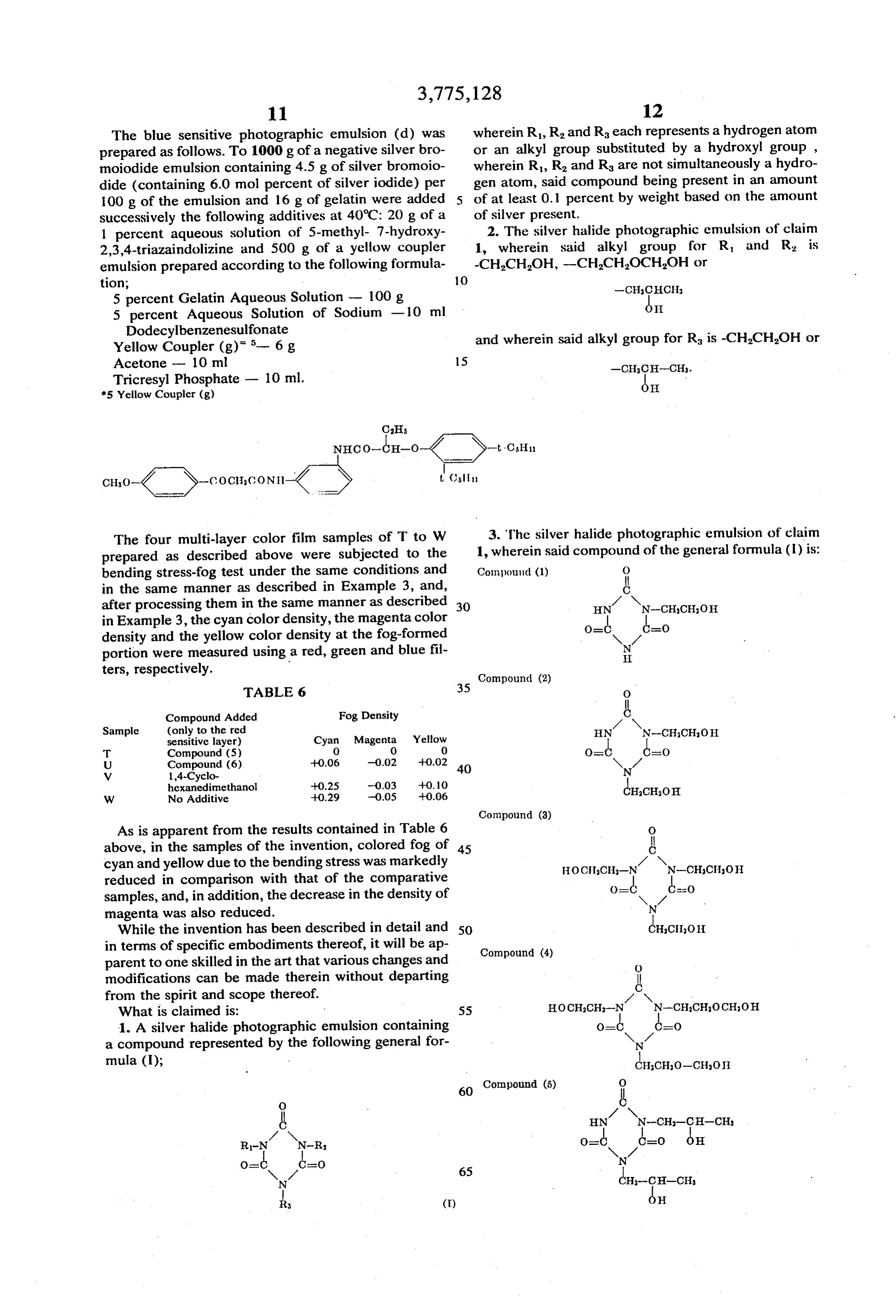
The blue sensitive photographic emulsion (d) was wherein R, R and Ra each represents a hydrogen atom prepared as follows. To 1000 g of a negative silver bro or an alkyl group substituted by a hydroxyl group , moiodide emulsion containing 4.5g of silver bromoio wherein R, R and Ra are not simultaneously a hydro dide (containing 6.0 mol percent of silver iodide) per gen atom, said compound being present in an amount 100 g of the emulsion and 16 g of gelatin were added of at least 0.1 percent by weight based on the amount successively the following additives at 40°C: 20 g of a of silver present.
1 percent aqueous solution of 5-methyl- 7-hydroxy 2. The silver halide photographic emulsion of claim 2,3,4-triazaindolizine and 500 g of a yellow coupler 1, wherein said alkyl group for R and R is emulsion prepared according to the following formula -CHCHOH, -CHCHOCHOH or tion; 10
5 percent Gelatin Aqueous Solution - 100 g II 5 percent Aqueous Solution of Sodium - 10 ml
Dodecylbenzenesulfonate and wherein said alkyl group for Ra is -CHCH-OH or Yellow Coupler (g) - 6 g
Tricresyl Phosphate - 10 ml. H *5 Yellow Coupler (g)
Cas
NHC O-H-O-( )--Chi ano-(D-coction () t C51
The four multi-layer color film samples of T to W 3. The silver halide photographic emulsion of claim prepared as described above were subjected to the 1, wherein said compound of the general formula () is: bending stress-fog test under the same conditions and Compound (1) O in the same manner as described in Example 3, and, l after processing them in the same manner as described 30 N-CHCHOH in Example 3, the cyan color density, the magenta color density and the yellow color density at the fog-formed portion were measured using a red, green and blue fil N
ters, respectively. Compound (2)
Compound Added Fog Density
Sample (only to the red sensitive layer) Cyan Magenta Yellow HN? Y-CHCH-OH T Compound (5) O O O Ot (-0
V 1,4-Cyclo 40 YNY
hexanedimethanol
No Additive
Compound (3)
As is apparent from the results contained in Table 6 above, in the samples of the invention, colored fog of 45 cyan and yellow due to the bending stress was markedly Hocil,CH-N? N N-CHCHOH reduced in comparison with that of the comparative o=& N / -o samples, and, in addition, the decrease in the density of magenta was also reduced.
While the invention has been described in detail and 50 CHCILo H in terms of specific embodiments thereof, it will be ap Compound (4) parent to one skilled in the art that various changes and modifications can be made therein without departing from the spirit and scope thereof. N What is claimed is: 55 HOCHCH-N N-CHCHO CH-OH 1. A silver halide photographic emulsion containing o=&N / -o a compound represented by the following general for mula (I); chCHO -CHO
Page 9
silver halide photographic emulsion layer and contain
OH OH ing in said photographic emulsion layer or in another CH-CH-CH-N? Y-CH-CH-CH, emulsion layer on said support a compound repre o=&N / -o sented by the following general formula (I)
wherein R, R2 and Rs each represents a hydrogen atom 4. The silver halide photographic emulsion of claim or an alkyl group substituted by a hydroxyl group , 1, wherein said compound of the general formula (I) is wherein R, R and Rs are not simultaneously a hydro present at a level ranging from 0.1 to 30 percent by gen atom, said compound being present in an amount weight based on the amount of silver present. of at least 0.1 percent by weight based on the amount
5. A silver halide photographic light-sensitive ele of silver present.
ment comprising a support having thereon at least one sk xk ck ck sk
Provenance
- Collection
- Cited prior art
- Original PDF
- patentimages.storage.googleapis.com →
- Filed
- 1972-08-21
- Pages
- 9
- Method
- pdftotext (the PDF's own text layer) + pdftoppm 300dpi page scans
- Source
- Google Patents bibliographic record
- Granted
- 1973-11-27
- Inventors
- N Yamamoto; Y Minagawa; T Sueyoshi; Fuji Photo Film Co Ltd
- Transcribed from
- patentimages.storage.googleapis.com →