patent · US3767542
Reduction of electrolytic cell voltage by anode vibration
23 October 1973
Page 1 — bibliographic record
United States Patent (19) [11] 3,767,542 Carlson (45 Oct. 23, 1973 54) REDUCTION OF ELECTROLYTIC CELL 2,919,235 2/1959 Roller................................. 2041273 VOLTAGE BY ANODE WIBRATION FOREIGN PATENTS OR APPLICATIONS 75 Inventor: Richard C. Carlson, Euclid, Ohio 1,284,288 10, 1970 U.S.S.R............................... 2041273 73 Assignee: Diamond Shamrock Corporation, 1,111,392 2/1956 France.................................. 204/99 Cleveland, Ohio OTHER PUBLICATIONS 22 Filed: Oct. 4, 1971 Modern Electroplating by Lowenheim, 2nd Ed., 1963,
Primary Examiner-Howard S. Williams
Assistant Examiner. R. L. Andrews
Attorney-Roy Davis et al.
(51 Int. Cl............................................... CO1b 7106 58) Field of Search...................... 204/261,273,98, 57) ABSTRACT 204/128, 162 S, 163 S, 129 The operating voltage of an electrolytic cell in which gaseous evolution occurs at the anode is reduced by 56 References Cited applying high speed mechanical vibration to the an UNITED STATES PATENTS ode.
3,580,833 571971 Cooper................................. 204/99 2 Claims, 1 Drawing Figure
Page 2
Drawing sheet — no readable text.
Page 3
REDUCTION OF ELECTROLYTIC CELL rate of production is such that considerable quantities VOLTAGE BY ANODE WEBRATION of gas are evolved and rapid decomposition of the elec BACKGROUND OF THE INVENTION trolyte occurs at the anodic surface. These conditions of high current density have become increasingly com
A variety of electrochemical reactions is known 5 mon-place in recent years with the advent of dimen wherein electrical current is passed through an aqueous sionally stable anodes that are not subject to the usual electrolyte between an anode and an opposed cathode, decomposition and attrition of, for example, graphite at the current being such as to result in the generation of increased current densities.
a gas or gasses at the anodic surface. Electrowinning of The action to which the anode is subjected is stated metals from aqueous solution, the electrolysis of water 10 as being "high speed mechanical vibration'. As sug and the production of chlorine, caustic and the chemi gested by this phrase, together with the word "di cal compounds thereof are but a few examples of such reactions. As the applied anode current density in these rectly,' it is intended that the anode itself, especially processes is increased, the rate of production and the bly at a rate face the working
thereof, be caused to vibrate, prefera excess of 6,000, especially in excess of amount of gaseous evolution increase, as does the oper 15 9,000 vibrations per minute ating cell voltage. At least initially, this increase in volt may be considered ultrasonic and up to speeds which
age is, for all practical purposes, in direct relation to second). The vibrations are applied directly to the the increase in current density. However, it has been anode and/or its supporting and connecting framework noted at the higher current densities desirable in order up to and including the current lead in (busbar). Vibra to increase the production rate of a given electrolytic 20 tions applied to other of the cell components, such as cell that the voltage begins to increase at a rate greater the cell supports or sidewalls, or to the electrolyte have than theoretical, resulting in an increase in power con been found to have substantially no effect. sumption per unit of product.
Attempts have been made to counteract this undesir ofThe means for inducing the mechanical vibration is able rate of increase in voltage. For example, following obviouslyorimportant 25 little no consequence to the invention, although from a practical standpoint. It has the suggestion of certain prior art, the electrolyte has been found that in order to be effective the vibrations been subjected to ultrasonic vibrations with, unfortu must be continually applied, that is, upon cessation of nately, no detectable effect. the vibrations the operating voltage immediately in STATEMENT OF THE INVENTION 30 creases to its prior, excessive, value. For this reason the Therefore it is an object of the present invention to vibrating means should be chosen for its durability and provide a method for reducing the operating voltage of simplicity of operation and maintenance. Typical of an electrochemical cell, which method is especially ef such are those vibrators in which compressed air is fective when the cell is operated at relatively high cur used to impart unbalanced rotation to balls or rollers rent densities. 35 which in turn induce vibrations in members in contact This and further objects of the present invention will therewith.
become apparent to those skilled in the art from the Illustrative of the present invention is its effect upon specification and claims which follow. the electrolysis of an aqueous alkali metal halide solu In a method for conducting an electrolytic reaction tion in a cell employing a dimensionally stable anode wherein, upon passing an electric current through an 40 and a flowing mercury cathode. The cell used is a hori aqueous electrolyte between an anode and an opposed zontal-type mercury cell employing an anode sus cathode, gaseous evolution occurs at the anode, the im pended above a steel cathode base plate, the assembly provement has now been found which consists essen being enclosed to contain the electrolyte and products tially of reducing the operating voltage by directly sub of electrolysis. The dimensionally stable anode is con jecting the anode to high speed mechanical vibrations. 45 structed primarily of titanium, is supported by an anode DESCRIPTION OF THE DRAWING frame and is connected to a copper busbar. An anode riser leads from the busbar connection to the interior
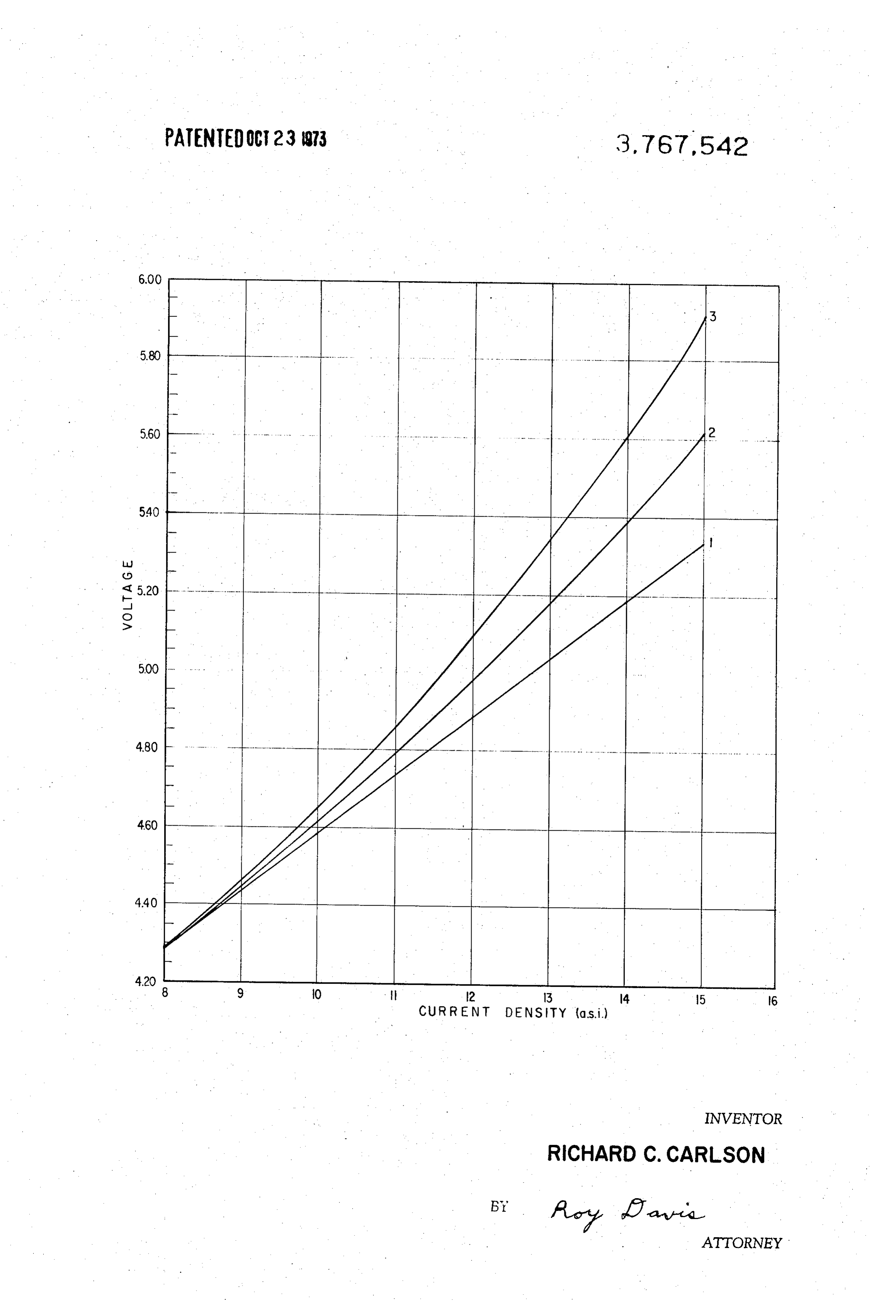
The FIGURE is a graph illustrating the improved per of the cell, the active working face of the anode consist formance of the present invention. ing of a plurality of elongated rod-like elements posi 50 tioned in a plane parallel to the flowing mercury sur
DESCRIPTION OF THE PREFERRED face and connected by welding through secondary con EMBODIMENTS ductors to the anode riser. The surface of these tita As described above, the invention is applicable to nium rods is coated with an electrically-conductive those electrochemical reactions wherein an electric electrocatalytically active material, in this case a tita current is passed through an aqueous electrolyte at a 55 nium dioxide-ruthenium oxide deposit. The anode voltage sufficient to achieve the desired reaction and cathode gap is established at 0.136 inch. A 305 grams/- result in the evolution of a gas or gasses at the anodic liter sodium chloride solution is employed as the elec surface. Generally the gas evolved either is desired trolyte at an average cell temperature of 76°C. product (e.g., chlorine) or is required for a subsequent 60 The Figure shows the relationship between applied chemical reaction resulting in the desired product (e.g., anode current density and the operating cell voltage at chlorine reacting to chlorate). However, the invention the above-described conditions. The first line (1) functions equally as well where the gas evolved is an charts the theoretical straight line relationship between unavoidable by-product, the desired reaction occurring voltage and current density for the given conditions. predominantly at the cathodic surface (e.g., oxygen at 65 Line 3 is a plot of the anode current density versus the the anode in electrowinning). actual cell voltage obtained, measured from anode face The advantage of the instant invention is most to mercury. Line 2 is again a plot of the measured volt marked at relatively high current densities wherein the age at the various current densities, all conditions being
Page 4
the same as those of Line 3 with the exception that me I claim:
chanical vibration is employed. 1. An improvement in the method of electrolyzing Vibration is effected by placing a commercially alkali metal halide solutions by passing a current be available compressed air-driven vibrator (Vibrolator tween an anode and an opposed cathode, said current Model BDR-16, Martin Engineering Co.) directly on being sufficient to cause gaseous evolution at the an the anode busbar. The vibrator operates within the ode, which improvement consists essentially of causing range of 9,000-11,000 vibrations per minute. The loca said anode to vibrate rapidly and continuously by the tion of the vibrator on the copper busbar is a matter of direct application of mechanical force to the anode convenience, attachment to the anode per se and the structure.
anode frame having been found to give equivalent re 10 2. In a method of electrolyzing an aqueous alkali sults.
The substantial reduction in voltage obtained by the metal halide by passing current through said aqueous application of vibrational force is readily seen from the halide between an anode and an opposed cathode at an attached figure, reductions of up to 300 millivolts hav anode current density of greater than 8 amperes per ing been observed. 15 square inch, the improvement which consists essen While the invention has been described with refer tially of reducing the operating voltage by causing said ence to certain preferred embodiments thereof, it is not anode to vibrate continuously at a rate of from 6,000 to be so limited since changes and alterations may be vibrations per minute up to ultrasonic by the direct ap made therein while remaining within the scope of the plication of mechanical force to the anode structure. appended claims. 20 ck sk k sk
Provenance
- Collection
- Cited prior art
- Original PDF
- patentimages.storage.googleapis.com →
- Filed
- 1971-10-04
- Pages
- 4
- Method
- pdftotext (the PDF's own text layer) + pdftoppm 300dpi page scans
- Source
- Google Patents bibliographic record
- Granted
- 1973-10-23
- Inventors
- R Carlson; Diamond Shamrock Corp
- Transcribed from
- patentimages.storage.googleapis.com →