patent · US3726762
Blood storage method
10 April 1973
Page 1
April 10, 1973 H. K. PUHARCH 3,726,762
BLOOD STORAGE METHOD
Original Filled Dec. 26, 1967 4. Sheets-Sheet 1
an onm que us aus sun aus amas F.G. 6
No u mu amo m ms as mo )
2 F G. 2 nventor 2ZZ-GZZZZZZZZZZZZZZZZZZZZZZZZZ HENRY K. PUHARICH
AT TORNEYS
Page 2
Drawing sheet — no readable text.
Page 3
April 10, 1973 H. K. PUHARCH 3,726,762
BLOOD STORAGE METHOD
Original Filled Dec. 26, 1967 4. Sheets-Sheet 3 tws we unus a seas a mua as ume tie ---
INVENTOR
HENRY K. PUHARICH
Page 4
Drawing sheet — no readable text.
Page 5
United States Patent Office Patented Apr.3,726,762
is an important characteristic and a general overall re 3,726,762 duction in coagulating ability may lead to dangerous
BLOOD STORAGE METHOD
Henry K. Puharich, Ossining, N.Y., assigng to Intelectron bleeding conditions elsewhere in the body. This is par Corporation, New York, N.Y. ticularly undesirable where, as is the case with the utiliza Continuation of abandoned application Ser. No. 693,283, tion of an artificial organ or element, the tendency for Dec. 26, 1967. This application May 19, 1971, Ser. coagulation or thrombus formation is a strictly local No. 144,996 condition. In such cases, it is far superior to counteract Int, C. A61k 17/00 a local condition with a local therapeutic effect.
U.S. C. 195-1.8 2 Claims SUMMARY OF INVENTION
It is a function of the method and means of the inven
ABSTRACT OF THE DISCLOSURE tion to simulate the natural, electrically repelling condi The present invention is directed principally to the elec tion of the blood cells and vessels, both in artificial organ trodynamic control of blood coagulation and of thrombus implants, and in normal and abnormal blood vessels. Thus, formation in natural organs and artificial organ implants, the invention is in part directed to a method for electrical for humans and animals. The invention provides for the charging of certain natural and/or artificial materials as net negative electrical charging of the walls of a natural sociated with the body of a human or animal subject in or artificial organ or element of the cardiovascular System, order to maintain the desired electrical potential which and of the blood cells within such organ or element. The prevents thrombus formation in natural or artificial or maintenance of such a net negative charge provides for a 20 gans or elements of the cardiovascular system. The inven tion is also directed in part to means used to maintain the mutual repulsion of the blood cells from themselves and desired from the natural or artificial vascular surface, So that electrical charges.
clotting and thrombus formation is avoided without utili A significant aspect of the invention resides in the pro zation of anticoagulant chemical agents, as has been neces vision of a method and means for effecting electrical en sary heretofore with implanted artificial elements, for ergization of blood and its containing vessel in such a example. The invention also is useful in the elimination of way that there is imparted to the individual blood cells a net negative charge, which causes the cells to mutually existing thrombus formations, and is indicated to have a repel, and there is also imparted to the wall of the vessel variety of advantageous observed and subjectively re a net negative surface charge, which causes the negatively ported therapeutic results, presumably derived from 30 charged blood cells to be repelled from the vessel wall. cleansing” of the cardiovascular system. A feature of the When this is accomplished, coagulation of the blood is invention is the manner and means for effecting the de sired net negative charge. The invention is indicated to prevented by the mutual repelling action in the cells and have utility in the treatment of humans and animals. It thrombus formation is prevented by repelling of the cells also has indicated usefulness in the preservation of blood by the vessel wall.
in storage. In the body of a human or animal subject, the desired electrical charging of the blood cells and vessels is ef
This application is a continuation of Ser. No. 693,283, fected by imparting to the body an alternating current filed Dec. 26, 1967, now abandoned. electrical signal, which is of a character such as to desir ably affect the blood vessels of the body. Where the
BACKGROUND OF INVENTION 40 electrical stimulation of the body is effected by an ex It has been previously indicated that maintenance of a ternal circuit, coupled with the skin of the subject, the 0.4 volt negative potential (referenced to the hydrogen electrical stimulation ideally is achieved with a relatively high frequency (20-40 kHz.), amplitude modulated car electrode, E at pH 7.0 at 25 C.) between blood and rier signal. This is advantageously applied through a sig its containing wall prevents clotting and thrombus for nal generating circuit capacitatively coupled with the body mation. Conversely, if the potential falls below 0.4 volt 45 of negative, or goes positive in sign, blood coagulation and ratedtheinsubject, and having sufficient inductance incorpo the circuit to be able to be in substantial circuit thrombus formation tend to occur.
It is known that, in a healthy cardiovascular system, resonance with the body for the carrier frequency signal blood cells normally carry net negative electrical charges, 50 employed. For therapeutic treatment of living subjects, the carrier signal advantageously is audio modulated and the interior surfaces (endothelia) of blood vessels also within normally carry net negative charges. Accordingly, electri and thisa frequency band with of around 20 to 2,000 kHz. cal repulsion forces normally keep blood cells from co modulatedmodulated signal is advantageously amplitude . in a generally triangular envelope.
agulating or depositing on vascular endothelium, thereby Where the subject has been fitted with an external arti preventing thrombus formation. ficial organ or element, the energizing circuit may be cou In the event of a breakdown of normal body functions, pled directly with the artificial organ or element, particu such as to result in a loss or partial loss of the necessary net negative charges, and perhaps because of other com larly as in the instance of the temporary utilization of an plex reasons, undesirable coagulation and thrombus for ject. artificial heart, which is located externally of the sub mations (i.e., thrombin and/or fibrin deposits) may occur 60 the localWhere the artificial organ or element is implanted, in the human body. Moreover, in connection with the im use of anenergization thereof may be effected through the implanted radio receiver, which is activated by plantation or temporary utilization of artificial organs or and responds to the capacitatively coupled generating cir elements of the cardiovascular system, extensive experi ence with humans and animals has established that there cuit and applies its output directly to the implanted organ is a significant tendency for thrombus formation to occur 65 or element, on the walls of the artificial element. In order to avoid In accordance with a further aspect of the invention, the rapid closing off of the blood passages in such an whole blood extracted for storage and subsequent use, artificial organ, or in appropriate cases to minimize throm can be maintained in a useable condition for significantly bus formation in an unhealthy natural cardiovascular sys increased periods of time by initially placing the blood in a vessel capable of retaining a negative charge on its inner tem, it has been customary to utilize anticoagulant chemi Wall when subjected to an AC energization, and then main cal agents. These agents are not entirely satisfactory, how taining the ever, because the normal coagulating property of the blood during the storage stored blood period.under the necessary energization
Page 6
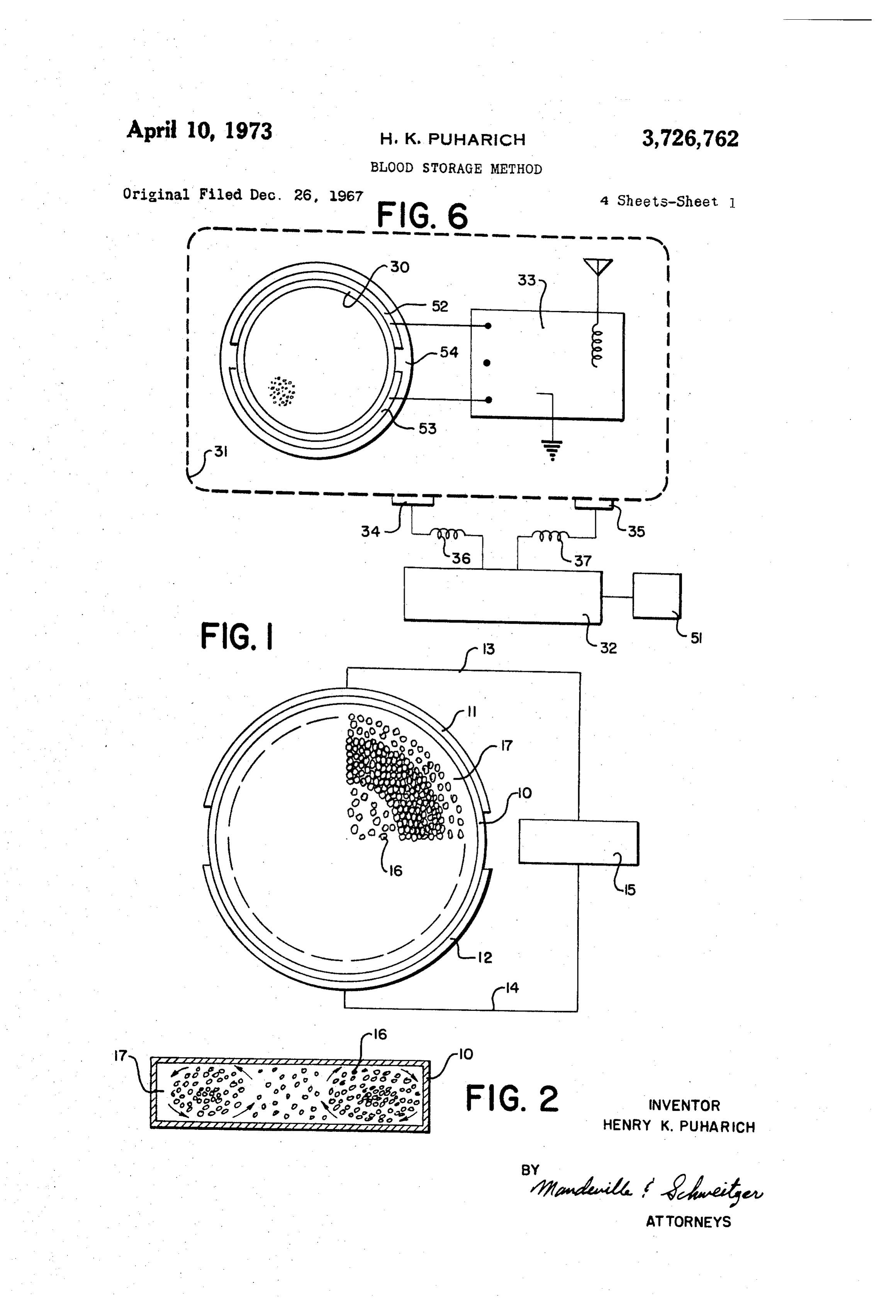
For a more complete understanding of the invention, placed in contact with opposed surface areas of the cylin reference should be made to the following detailed discrip drical side wall of the vessel 10, and these electrodes are tion and to the accompanying drawings. connected through suitable conductors 13, 14 to a signal DESCRIPTION OF DRAWINGS generating source 15.
When an alternating current signal is impressed upon
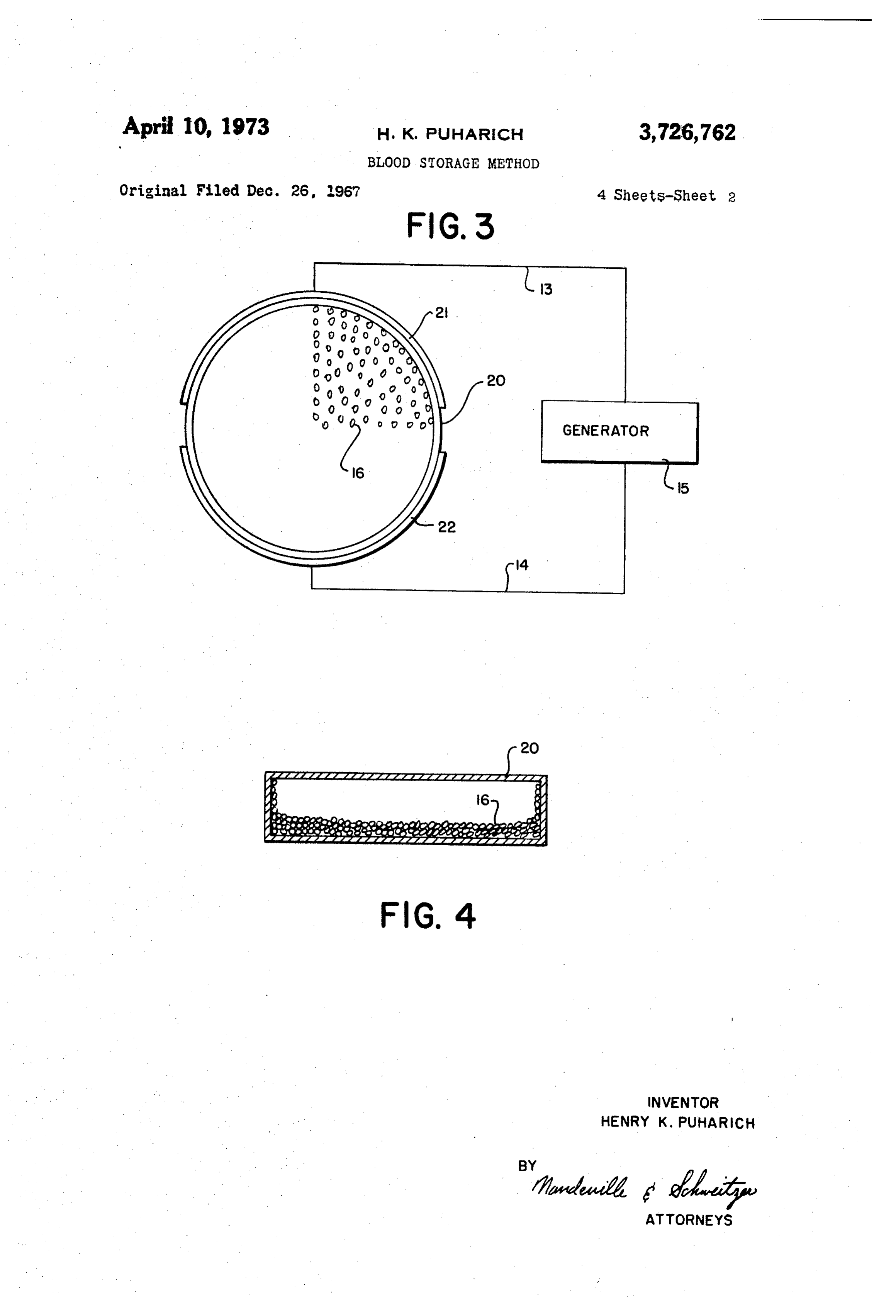
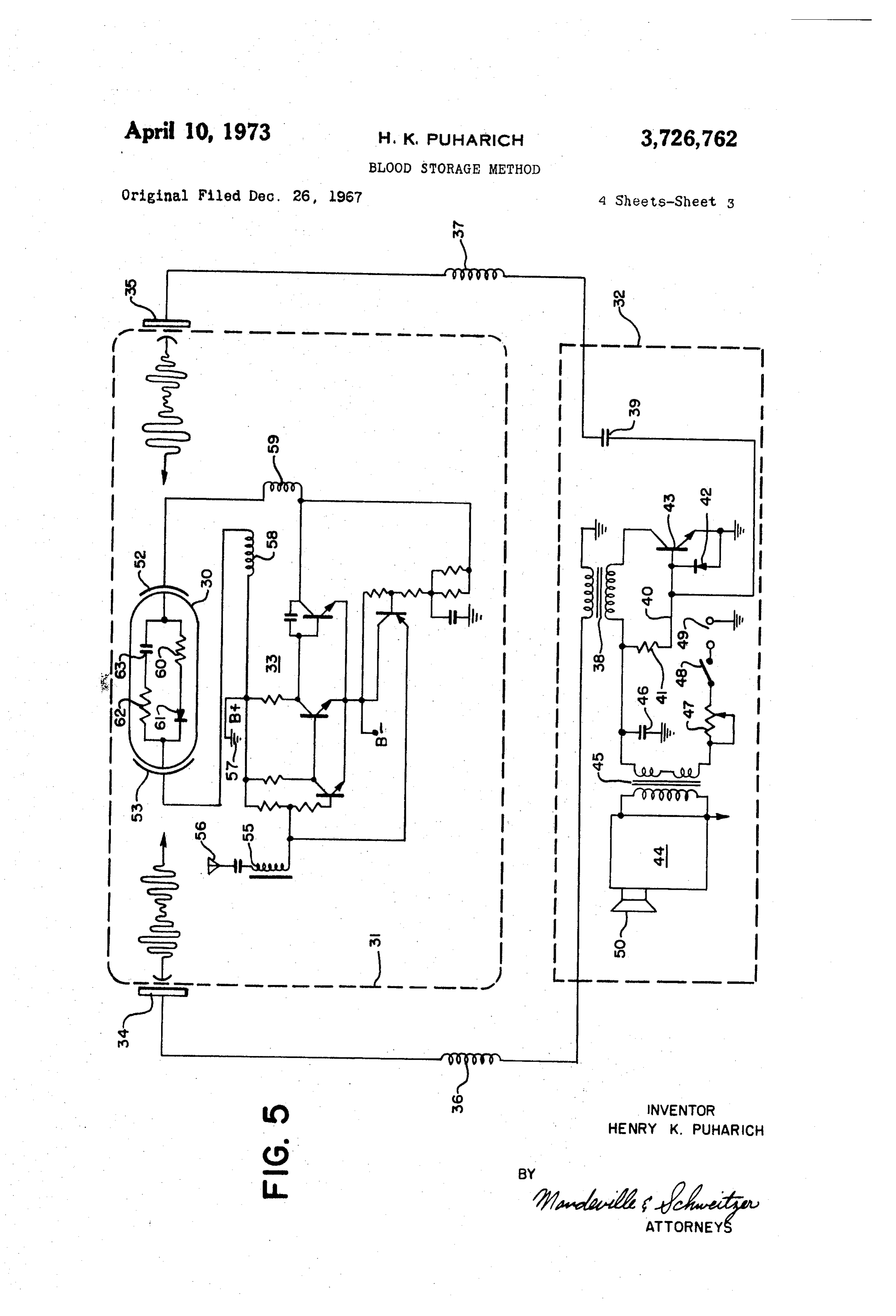
FIGS. 1 and 2 are simplified representative cross sec the cellulose nitrate vessel 10, sufficient to establish a net tional views of a blood-containing vessel, constituted and negative surface charge of at least 0.4 volt, typically ac energized in accordance with the invention, to illustrate companied by a charge on the individual blood cells 16 of the effect thereof on the contained blood. on the order of 2.0x10⁸ coulombs per cell, the blood FIGS. 3 and 4 are simplified representative cross sec 0 cells are observed immediately to be activated. In a cylin tional views of a blood-containing vessel physically sim drical vessel of the indicated proportions, the blood cells ilar to that of FIGS. 1 and 2 and similarly energized, but begin streaming in a generally toroidal motion. Thus ac constituted of a material not suitable for the purposes of tivated, the blood cells remain in suspension for many the invention, illustrating the effect thereof on the con hours without sedimentation or clotting. tained blood. 5 As is clearly indicated in FIGS. 1 and 2, a barrier zone FIG. 5 is a schematic representation of an advantageous 17 is formed in the vessel 10, between the negatively form of energizing circuit, for use in practicing the in charged inner wall surfaces and the blood cells, such that vention in connection with the treatment of human and the walls of the vessel remain entirely free of blood cells animal subjects. and thrombi.
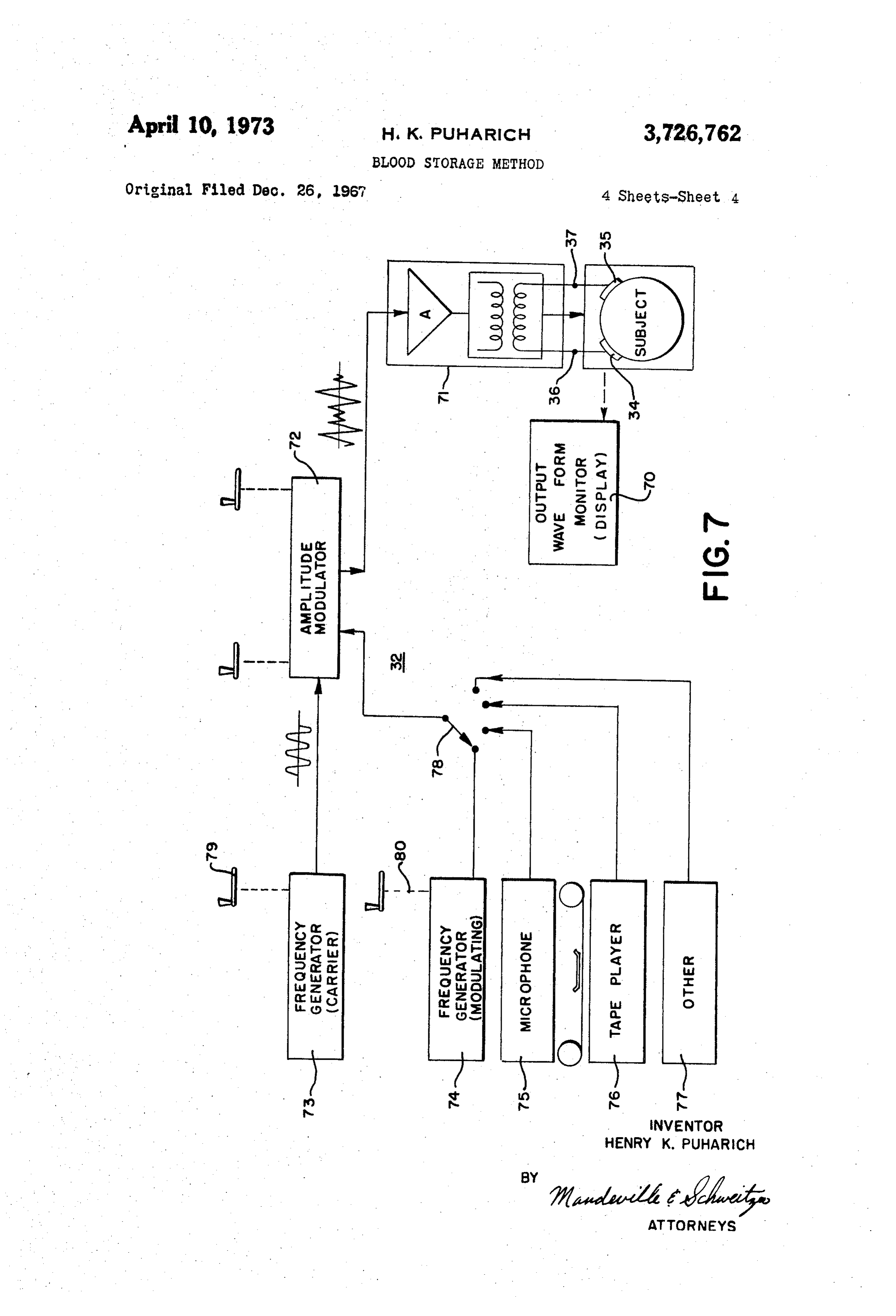
FIG. 6 is a greatly simplified representation of the 20 Chambers constructed utilizing sections of animal ar circuit arrangement of FIG. 5. teries and veins, placed in the electrical field substantially FIG. 7 is a simplified, representative illustration of a as indicated in FIGS. 1 and 2, show the same effects as desirable form of clinical apparatus useful in carrying out just described for the cellulose nitrate vessel 10. treatments in accordance with the invention. In contrast to the above, repeating the procedure out One of the significant, underlying principles, on which 25 lined in connection with the cellulose nitrate 10 of FIGS. the present invention is based is the knowledge, previous 1 and 2, but using a vessel 20 formed of glass, as shown ly established, that a negative electrical charge on blood in FIGS. 3 and 4, none of the desirable effects of the in cells and on the wall of the blood-containing vessel will, vention were achieved. Notwithstanding the maintenance if maintained at an adequate level, prevent or at least sig of a similar alternating current energization through elec nificantly inhibit coagulation and thrombus formation. 30 trodes 21-22, placed on the surface of the glass, the blood The significant advance of the present invention resides cells remained stationary in the suspending fluid and tended in the establishment of a procedure and a means by which to deposit on the glass walls of the vessel. Typically, the such electrical charge relationship may be achieved in a blood cells will sediment out of the fluid in about thirty live human or animal subject, not only with natural or minutes, in spite of continuous alternating current elec gans and elements, but also in conjunction with the use 35 trical charging.
of artificial organs and elements. Referring now more particularly to FIGS. 5 and 6, In accordance with the invention, an alternating cur illustrating a specific system in accordance with the in rent electrical signal is imparted to a blood-containing vention for electrically energizing an implanted organ or vessel, at least the inner surface characteristics of which 40 element 30, within the body 31 of a human or animal are such as to be unidirectionally charged by the alternat subject, the system is shown to comprise a primary ener ing current signal to the desired negative voltage level. gizing unit 32 and a secondary energizing unit 33. The The blood cells also assume a desired negative charge, such primary energizing unit 32 is located externally of the that the desired repelling forces are established, as above body and, where the organ or element to be energized is described. Fortuitously, the endothelia of the natural blood located outside of the body (as with a temporary pros vessels (which normally carry a net negative charge in the 45 thetic) or in a suitable location within the body, it may natural, healthy state) are of a character to assume a nega be sufficient to utilize only the primary energizer 32. In tive charge upon energization by an alternating current other cases, as where the component 30 is an implanted signal. However, where artificial organs and elements are artificial heart, for example, it may also be necessary utilized, it is important to utilize materials which will as to utilize the secondary energizer 33, which is essentially sume the desired net negative surface charge of approxi a broad band receiver-amplifier of the signals imparted mately 0.4 volt or greater, in the presence of biological by the primary energizer 32.
fluids such as blood. A wide variety of materials may be The energizing system 32 incorporates certain of the selected for this purpose, and relatively simple experi advantageous features described in a copending appli mentation will establish the charge acceptance character cation Ser. No. 633,035, filed Apr. 24, 1967, by Henry istics of a given material. Among the materials found to 55 K. Puharich and Joseph L. Lawrence, and also certain be suitable from a charge acceptance standpoint are a advantageous features described in an earlier application metal, titanium, semi-conducting material, silicon, and a Ser. No. 446,267, filed Apr. 7, 1965, by the same in dielectric material, cellulose nitrate. Cellulose nitrate was ventors. Reference to these applications may be made for found to be a particularly desirable all-around material. further details.
On the other hand, certain common materials, which have 60 The output of the primary energizing system 32 in a positive charge acceptability are entirely undesirable for cludes a pair of electrodes 34, 35, which are capacitatively the purposes of the invention. Surprisingly, glass, which coupled with the body of the subject. Typically, the elec has been extensively used for the storage of blood, for trodes 34, 35 are covered with a dielectric material and example, is one of these unacceptable materials. are placed against the skin of the subject. In series with By way of illustrating the basic principles of the inven 65 the capacitative electrodes 34, 35 are large inductances 36, tion, reference may be had to FIGS. 1-4. In FIGS. 1 and 37, advantageously in the range of 2 to 70 millihenries 2 there is illustrated a closed vessel 10 of cylindrical cross and being adjustable within that range for the accommoda section, in which is retained a quantity of whole blood. tion of a wide variety of subjects. One of the inductances The cylindrical cross-section of the vessel 10 is somewhat 36 is connected through the secondary of a transformer representative of the cross-section of a natural blood ves 38 to ground. The other industance 37 is connected sel, for example. In the illustration, the vessel 10 is formed through a capacitor of about 0.01 microfarad 39 to a of a material, such as cellulose nitrate, having a desired point on a conductor 40 joining one side of a 220K ohm level of negative charge acceptance when energized by an resistor 41, the positive terminal of a diode 42 and the alternating current signal. base of a transistor 43, suitable a 2N3053. The emitter As shown in FIG. 1, a pair of electrodes 11 and 12 are 75 of the transistor and the negative terminal of the diode
Page 7
are connected to ground. The collector of the transistor
and the other terminal of the resistor 41 are connected to and imparts it to the organ or element 30. The output opposite terminals of the primary transformer 38. This circuit of the receiver 33 is arranged to be in L-C series circuit, once energized and periodically pulsed, will resonance by proper selection of output circuit induct oscillate at a frequency, herein referred to as the carrier ances 58, 59 with reference to the capacitance of the frequency, which is substantially in a circuit resonant electrode couplings 52, 53 to the implanted element or organ. 30.
relation with the body of the subject, for maximum effectiveness of the power input, as described in more 30For and explanatory reference only, the organ or element its contained blood may be considered to have detail in the above mentioned copending applications. equivalent
Desirably, the inductances 36, 37 are selected, with O in FIG. 5. circuit characteristics somewhat as represented respect to a given subject, to provide a carrier signal at sentation, a In the hypothesized equivalent circuit repre 4.7K ohm resistor 60, in series with a diode a frequency on the order of about 20 kHz. to about 40 61, is connected in parallel with a 220 ohm resistor 62, kHz. By so designing and constructing the circuit that the in series with a 0.2 inductances 36, 37 are the primary determinants of re not wish to be boundmicrofarad in any capacitor 63. While I do way by this suggested equi
Sonant frequency, in relation to the capacitance of the 15 valent circuit, it does appear to approximate coupled electrodes 34, 35, the resonant frequency may be characteristics of a blood-filled organ or vessel the actual energized kept rather constant notwithstanding momentary changes in accordance with the invention.
in circuit capacitance due to physiological and other Using a system and method according to the invention, changes in the body of the subject. a series of controlled experiments was conducted at New Amplitude modulation of the carrier signal is derived from a modulating source, generally designated by the 20 York University Medical Center, New York City, by the Cardiovascular Experimental Surgery Team, of the De numeral 44, the output of which is the primary of a trans partment of Surgery. In a first series, prosthetic tubes former 45. One terminal of the transformer secondary is connected to the oscillating circuit, and also is con formed of cellulose nitrate were inserted in the inferior vena cava of several dogs, but without electrical energiza nected through a 0.01 microfarad capacitor 46 to ground. 25 tion according to the invention. No anticoagulant chemi The other terminal of the secondary is connected through cals were utilized. It was found that the prosthetic tubes a power level potentiometer 47 and a power switch 48 clotted up within a period of about one hour. to a suitable power source 49, typically of about 8 volts. In a similar series of experiments, in which the pros In one advantageous form of the invention, the input to the modulating source 44 is a microphone 50, which 30 thetic tubes were energized by a high frequency carrier signal modulated in the desired manner previously indi may be positioned to monitor the heart beat of the sub cated, the prosthetic tubes remained free of clotting and ject. This provides an especially desirable form of modula thrombus tion of the carrier signal, because it is synchronized with terminated.formations all day, until the experiments were The extent of the experiments indicated that heart activity. Where it is not feasible to monitor the heart beat of the subject, or in instances of blood storage 35 the freedom from clotting and thrombus formation could or the like which does not involve the presence of a live have been continued indefinitely. In another series of ex periments performed under the auspices and by the medi
Subject, the carrier signal modulation may be imparted cal by means of a programmed signal generator, as generally pumpteam indicated above, an artificial left ventricle assist was inserted in the left ventricle of the heart of a designated by the reference numeral 51 in FIG. 5. The dog, arranged to bypass the normal functions of the programmed generator 51 is adapted to impart a selected 40 heart. The implanted assist pump was provided with an modulating frequency in an overall band width of from about 20 to about 2,000 Hz. The amplitude of the modu No anticoagulant chemicalsnitrate interior lining of cellulose lacquer and electrodes.
were administered to the dog lating signal is varied in cycles of about one second, from and about 10% to about 80% modulation. The modulating periodnoofelectrical stimulation was provided. Within a about three minutes the implanted assist pump frequency can be cyclically varied also, if desired. 45
In the typical arrangement illustrated in FIGS. 5 and had clotted up solid and was unable to function. A second 6, in which the external energizing system is coupled to experiment, similar to the first except that the assist pump the body of the subject with a capacitance of from about was energized (directly from a signal generator) by a modulated carrier signal as before described. The ex 0.1 to about 0.2 microfarad, the desired voltage level across periment was continued for one hour and then terminated the electrodes is on the order of 4 to 8 volts (about 6 to 50 by intent. All cardiovascular dynamics of the dog were 10, peak to peak), which results in an applied current on normal during and at the end of the one hour period. the order of 2 to 4 milliamperes (RMS).
Where the organ or element to be energized is so dis of After termination of the experiment, the interior surfaces posed within the body 31 as to make desirable the use of the pump were inspected and found to be perfectly the implanted receiver-amplifier 33, the system is arranged 55 clear. The time extent of the experiment was deemed suffi So that the modulated carrier signal, imparted to the cient kept to indicate that the implanted organ could have body through the coupling electrodes 34, 35, is amplified been free of clots and thrombus formation for an in by the receiver 33 and imparted thereby to electrodes 52, definite period.
In additional experiments, it has been shown that exist 53 placed on opposite sides of the implanted organ or vessel 30. A suitable insulating material 54 is provided 60 ing thrombi can be dissolved safely within a few hours about the electrodes and the organ or element 30, in order by energizing the organ or vessel in which a thrombus to isolate the energized region from the remainder of the formation has developed, in accordance with the teach body. ings of the invention as hereinbefore stated. In part, this The implanted receiver-amplifier 33 advantageously may result from the fact that further thrombus formation includes a ferrite coil antenna 55, the high end of which 65 in affected area is prevented, accommodating dissolution is placed in contact with the interior tissues of the body, of the existing thrombus by natural body actions. In addi as at 56. The "B+" terminal of the receiver, designated by tion, it has been established that the audio frequency modulating envelope of the high frequency carrier sig the numeral 57, is also grounded to the body tissues, in a nal induces piezoelectric vibrations in the blood cells and body region spaced from the antenna 55.
Energization of the receiver-amplifier 33 is controlled 70 blood fluid which often can be audibly detected. This by the power potentiometer 47 of the transmitter unit vibratory action may assist in the natural dissolution of 32 at a level such that at least a minimum bias voltage thrombus formations of biological “debris.”and otherwise tend to free the vessel is imposed to activate the receiver. At or above such According to recognized current medical practice, minimum operating levels, typically about 1.4 volts bias voltage, the receiver amplifies the modulated carrier signal 75 cardiovascular techniques successfully applied to dogs is expected to be applicable to human subjects. This tends
Page 8
to be borne out in the present instance by experimental amplitude modulator 72 are a carrier frequency generator evidence developed using cross sectional samples of human 73, on the one hand, and a plurality of selectively utiliz blood vessels. able modulating inputs 74–77, on the other hand. The Because of the ability of the new procedure to effect modulating inputs are used one at a time, according to dissolution of existing clots and thrombus formations, ad the setting of a selector switch 78. . vantageous therapeutic effects can be achieved through As indicated, the carrier frequency generator 73 is the treatment of non-operative patients suffering from provided with an adjustment 79 for regulation of the car impairment of the cardiovascular system through the ac rier signal frequency, desirably within the optimum range cumulation of deposits. Perhaps also the piezoelectric of 20 to 40 kHz. The modulating frequency generator 74 stimulation of the blood vessels brings about a desirable O likewise is provided with an adjustment facility 80, desir result. For such patients, a course of treatment, involving ably for regulating the modulating frequency between periodic energization and stimulation of areas of the about 20 to about 2,000 Hz. The microphone input 75 cardiovascular system, may be particularly desirable. may be utilized to monitor body functions of the subject There are diseased conditions in humans, as for ex (such as heartbeat) and to provide modulation in accord ample, those associated with diabetes, where peripheral 15 ance therewith.
arteriolar circulation becomes impaired, with consequent The modulator input 76 is a tape deck, which may be sludging of blood, blood sedimentation, blood cell ad programmed to provide a variety of complex sequences hesion to vascular walls, and eventually thrombus forma of modulation, as may be determined to be desirable for tion and blockage of circulation. The periodic treatment a given patient and/or a given condition, for example. of such patients, as by application of the electrodes 34, 20 In all of its various specific applications, whether in 35 (FIG. 5) to selected areas with appropriately pro conjunction with the implantation or temporary external grammed energization, can prevent or significantly miti utilization of artificial organs and elements or in conjunc gate the undesirable and dangerous clinical effects. tion with a course of therapeutic treatments for post-oper There are also conditions in humans, in which the ative and/or non-operative patients, the procedure of the central nervous system shows degenerative changes due 25 invention is based upon the concept of imparting a nega to poor blood circulation. A typical example of such a the tive charge of an effective level to the blood cells and to condition is found in old age, with associated symptoms of walls of the containing vessel, whether it be natural senility. Experiments have been carried out with human vention or artificial. A particularly significant aspect of the in patients showing such symptoms of senility as emotional rent energizing resides in the realization that an alternating cur: source is required in order to achieve the instability, irritability, loss of memory for recent events, 30 necessary net negative temporal and spacial disorientation, instability of bal taining vessel walls. Through charges on the blood cells and con ance, and various confusional mental states. Such patients, extensive experimentation, after two to four weeks of programmed treatment (as it has been established that an audio frequency, amplitude described in copending application Ser. No. 633,035) suited modulated high frequency carrier signal is most ideally show remarkable improvement in those symptoms out for achieving the results sought for by the process lined for senility. It is believed that such therapeutic forms invention, of the although it is not indicated that all other of alternating current electrical energization are effects are the result of improved blood circulation and inoperative, and I therefore do not necessarily limit the an improvement in the structural condition of blood vessels, brought about by the restoration of the normal 40 described. It is to tobe energization scope of claims in the specific manner borne in mind, however, that, when negative charge relationships on blood cells and endo dealing with the human body in particular, it is especially thelia of the blood vessels. desirable to maintain current, voltage and the power in In post-operative patients, there is always a significant puts at the lowest practicable level, and the specific mode risk of post-operative thrombus formation in some parts of energization herein described appears to be optimum of the venous system. In such cases, the breaking off of a portion of a thrombus formation, and its release into the 45 for this purpose.
vascular system, can endanger life if the emboli block theA recognition further significant aspect of the invention resides in that, in connection with the use of an an artery vital to an organism such as the lungs, brain or artificial element or organ to be incorporated in the cardio heart. Accordingly, the procedure of the invention may be vascular utilized to advantage as part of a post-operative series of a kindsystem, the material thereof be selected to be of treatments. In such treatments, energization by the pri 50 posed to anwhich will accept a negative charge when ex alternating current electrical field. This en mary energizing unit 32 would typically be applied to known danger areas, such as leg veins, to prevent throm ables the artificial prosthetic to behave in a manner similar to the natural blood vessel endothelium.
bus formations therein and/or to accommodate safe dis The extraordinary ability of the processing system of solution of existing thrombi. 55 the invention to prevent clotting and thrombus formation One of the commonest causes of death is the sudden when using artificial elements or organs can be especially formation of a blood clot in an artery supplying a vital significant in connection with the use of external kidney organ. In patients where there is any advance medical in dialysis machines, heart-lung machines, and the like. In dication that such a catastrophic event is probable or this respect, while clotting and thrombus formation pres likely, electrical stimulation of the suspected vascular sys tem in accordance with the invention can serve as an effec 60 ently can be minimized through the use of anticoagulant tive preventative measure. chemicals injected into the blood stream, these chemicals For any of the circumstances involving the periodic affect the blood system as a whole and can result in treatment of subjects, it may be advantageous to utilize a dangerous other bleeding or other undesirable conditions in portions of the body. In contrast, the effect of the clinical treatment apparatus, such as is shown diagram matically in FIG. 7. In the FIG. 7 arrangement, there is 65 electrical stimulation in accordance with the invention provided a primary energizing unit 32 having provision about can be localized in the area in which it is needed (in and for interchangeably adjustable series inductances 36, 37 cates that the prosthetic). Moreover, experience to date indi and coupling electrodes 34, 35 adapted for application on invention isvascular energization in accordance with the the subject, at areas selected by the physician. Desirably, where in theincapable body, as of causing bleeding conditions else can occur through improper use a display monitor 70 is provided, enabling the treating 70 physician to ascertain the precise form of energization of anticoagulant chemicals or in people otherwise having a susceptibility to hemophilia, for example.
being imparted to the subject. - The invention is also useful to advantage where it is In the illustration of FIG. 7, the primary energizer unit desired to reduce the coagulation rate of a contained body 32 includes an output amplifier section 71 fed by an am plitude modulating control section 72. The inputs to the 75 of blood, Thus, the procedure of the invention has in
Page 9
creased coagulation time by in vitro tests, by a factor of
It should be understood that the specific forms of the three to four times. This compares more or less equiva invention herein illustrated are intended to be representa lently to the increase derived from the use of anticoagul tive only, as certain changes may be made without de lant chemicals, but of course does not involve the inherent parting from the clear teachings of the disclosure. Accord dangers associated with such chemicals. ingly, reference should be made to the following appended An especially significant utilization of the principles of claims in determining the full scope of the invention. the invention is realized in connection with the storage of I claim:
whole blood. Conventionally, whole blood stored under 1. The method of storing blood, which comprises the best of conditions has a shelf life of approximately (a) placing the blood in a closed storage container 26 days, and enormous quantities of such stored blood whose inner wall surfaces, at least, are formed of must be discarded because of deterioration. In accordance O a material capable of developing and retaining a neg with the present invention, by storing whole blood in ves ative electrical charge at the blood/wall interface sels formed of a material suitable for accepting a negative when energized by an alternating current signal, and charge, and maintaining a continuous alternating current (b) energizing the closed container and the contained electrical charge as herein described, the shelf life of the 5 blood by an alternating current electrical signal and whole blood can be doubled. This can greatly increase the establishing an alternating current electrical field effective supply of stored whole blood by reducing losses thereacross, whereby to charge the cells of the blood through deterioration. and the entire inner wall surfaces of the container Depending upon the specific application intended, the with a negative charge sufficient to cause mutual re signal generator may be coupled to the organ or element 20 pelling of the cells and repelling of the cells from to be energized in a variety of ways, within the purview all the inner surfaces of the container. of the invention. Where, for example, the organ or ele 2. The method of activating blood within a closed con ment is a temporary prosthetic, located externally of the tainer capable of accepting a negative charge when ener body or directly accessible within the body, the electrodes gized by an alternating current source, which comprises 34, 35 may be directly coupled to the prosthetic. In cer 25 (a) establishing an alternating current field of prede tain other cases, involving a natural or possibly even a termined characteristics across said walls to develop prosthetic organ or element which is embedded within the a negative charge at the entire blood/wall interface; body, it is practicable to couple the electrodes to the skin (b) said alternating current field being of a frequency of the subject and rely upon the transmission character in excess of about 20 kHz., which is amplitude mod istics of the surrounding body tissue and fluids to effect 30 ulated between 10 and 80% modulation by an audio the desired energization of the organ or element. In still frequency signal;
other cases, a broad band receiver-amplifier is implanted (c) the cycle of amplitude modulation from between within the body and its output electrodes are coupled to 10 and 80% being of a generally triangular envelope the organ or element to be energized. The electrodes 34, having a cycle on the order of one second. 35 of the primary energizer are coupled to the body of 35 the subject but are operative to activate the receiver-am References (Cited plifier, rather than the organ or element directly. The UNITED STATES PATENTS receiver-amplifier is designed to reproduce the inputs of the primary energizer and apply a corresponding ener 3,503,850 3/1970 Dibelius ------------ 23-258.5 gization to the desired organ or element. 40 OTHER REFERENCES In all of its forms, the method and apparatus of the Mirkovitch, Cleveland Clinic Quarterly, vol. 30, pp. invention is operative to establish a desired level of nega 241-252, October 1963.
tive charge on blood cells and on the containing walls therefor, with both natural and artificial blood contain ment vessels. The result is to effect a mutual repelling 45 RICHARD L. HUFF, Primary Examiner action which prevents or significantly inhibits clotting and U.S. C. X.R. thrombus formation. 128-422; 317-3
Provenance
- Collection
- Cited prior art
- Original PDF
- patentimages.storage.googleapis.com →
- Filed
- 1971-05-19
- Pages
- 9
- Method
- pdftotext (the PDF's own text layer) + pdftoppm 300dpi page scans
- Source
- Google Patents bibliographic record
- Granted
- 1973-04-10
- Inventors
- H Puharich; Intelectron Corp
- Transcribed from
- patentimages.storage.googleapis.com →