patent · US3538908
Gas-fueled heating element and control
10 November 1970
Page 1
United States Patent (1113,538,908 (72) Inventors Sanford A. Weil; 2,870,828 1/1959 Hess............................. 126/39 William R. Staats, and Jack M. Reid, 2,921, 176 1/1960 Scofield........................ 431/268X Chicago, Illinois Primary Examiner-Edward G. Favors (21) Appl. No. 805,475 Attorney-Molinare, Allegretti, Newitt & Witcoff
(73) Assignee Institute of Gas Technology a non-profit corporation of Illinois
ABSTRACT: An apparatus and method for heating a work load by oxidation of hydrogen wherein the heat input is con 54 GAS-FUE LED HEATINGELEMENT AND tinuously controllable from zero to maximum and the area of CONTROL heating surface is independently continuously controllable. 6 Claims, 3Drawing Figs. The apparatus is made of a base for supporting and heating a 52 U.S.C. ...................................................... 126/39, load, the underside of the base being coated with an oxidation
catalyst which is capable of initiating the oxidation of 51) nt. Cli........................................................ F24 c 3100 hydrogen in a proper hydrogen-air mixture, a conduit formed 50 Field of Search............................................ 431/268, beneath said base for conducting said hydrogen-air mixture
into contacting relationship with said catalyst-coated surface, means for admitting said hydrogen-air mixture into said con 56) References Cited duit and means for removing exhaust gases from said conduit, UNITED STATES PATENTS and adjusting means for the continuous adjustment of the clearance within said conduit to thereby control the size of the 2,493,266 1/1950. Schmitt........................ 431/268 area of the base which is being heated.
Page 2
Drawing sheet — no readable text.
Page 3
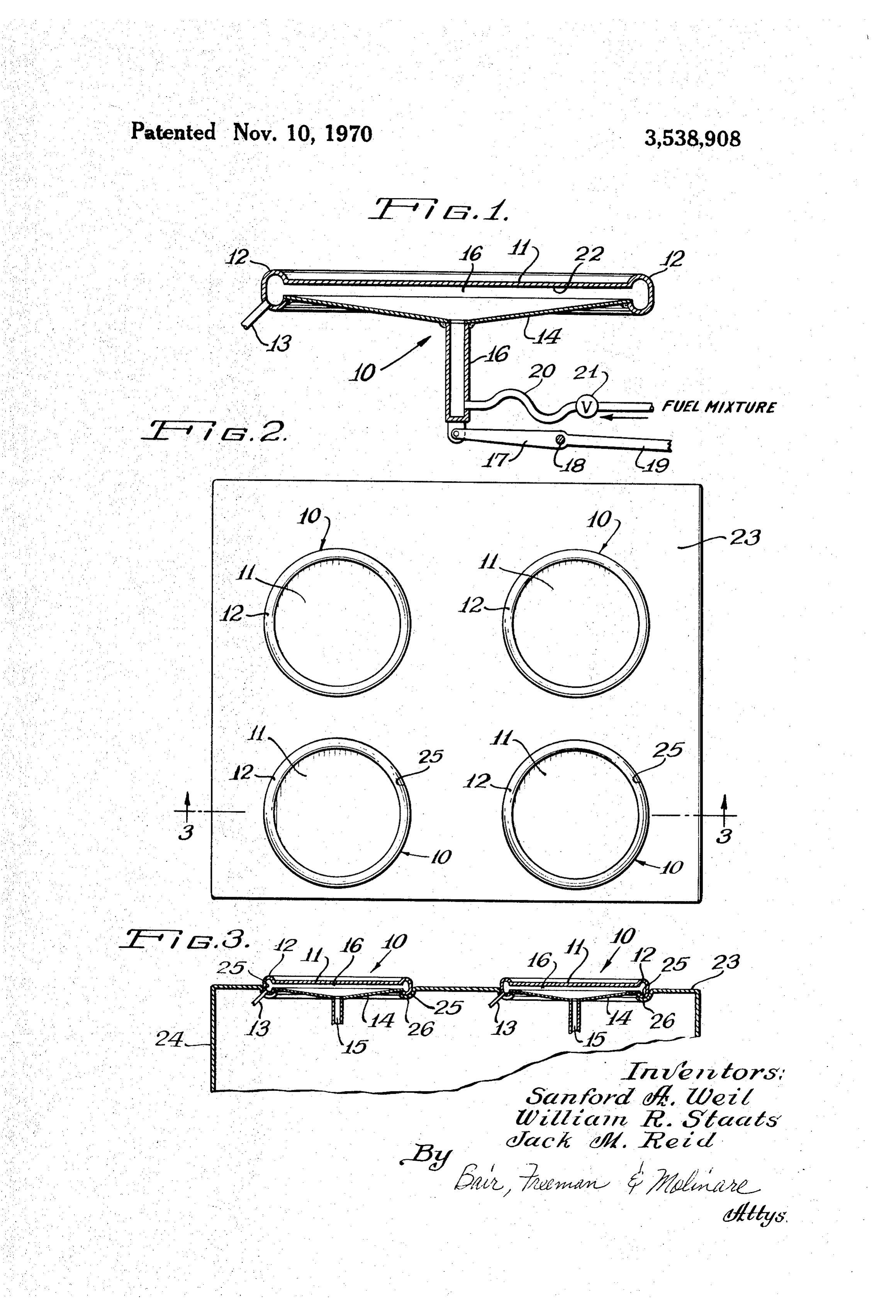
GAs-FUELEDHEATINGELEMENT AND CONTROL FIG, 1 shows a vertical section view of the gas-burning device of the invention;
BACKGROUND OF THE INVENTION FIG. 2 shows a plan view of a kitchen range having mounted The present invention relates to a novel apparatus and on top thereof four gas-burning devices of the present inven method for heating a load by a gas-fueled heating element. tion; and
Heretofore, home appliances such as the kitchen ranges are FIG. 3 is a partial elevation view, in section, showing the of two types: the electric resistance type and the gas-burning range of FIG. 2.
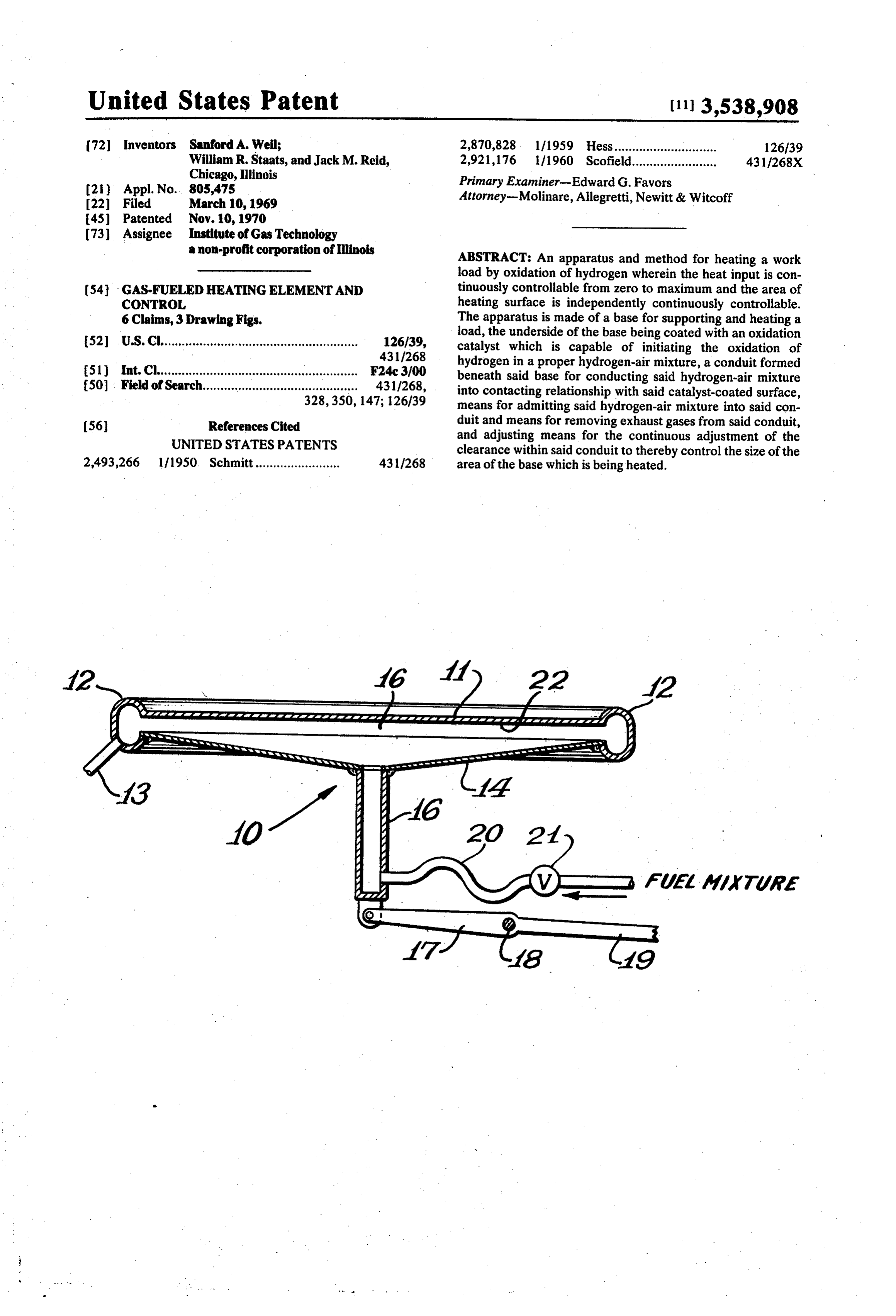
type. These heating appliances possess certain disadvantages. generally Referring to FIG. 1, a gas-burning device of the invention is In the first place, the conventional prior art gas burner usually 10 surface 11shown at 10. The device 10 has a fixed top heating which may be of any suitable geometry, Preferably, burns natural gas which is largely methane. Such gas burners heating surface 11 is rounded for easy accommodation of con require some source of energy to initiate combustion, and this ventional pots and pans. At the outer periphery of top heating is usually provided by way of a pilot flame. Such pilot burner surface 11, and connected thereto, is a ringlike channel 12, may be a source of trouble. Moreover, the prior art gas bur which serves the dual function of supporting the device 10 on ners usually cannot be adjusted to reduce the heat input to an 15 range top and to collect exhaust extremely low point because the resultant small flame would apassageway gases therefrom. An exhaust 13 is connected to and in communication with be very unstable. Although it is possible to continuously con channel 12 for trol the heat input to an electric resistance type of heating ele flexible memberpassing exhaust gases out of the device 10. A ment by means of a rheostat, such continuous control would below the heating 14 is attached to channel 12 and located be expensive and inefficient due to the power loss in the con 20 and heating surfacesurface 11. Flexible member 14, channel 12 trol rheostat. Therefore, it is conventional practice with 15 form an enclosed space orwithconduit 11, together a gas inlet passageway 16. Gas inlet respect to an electric resistance heating element to vary the passageway 15 is connected to a pinion mechanism imput thereto by selectively applying different, fixed levels of has a pivot 18 and a handle 19. By raising or lowering7handle which voltage available from the power supply source. Two or more resistance elements are also used to selectively obtain dif 25 19, the gas inlet passageway 15 and flexible member 14 can be ferent heat input levels. However, in most of the electric re lowered or raised, respectively. In this manner, the space or sistance heating ranges, only stepwise control of heat input is clearance between heating surface 11 and flexible member 4 provided. can be increased or decreased.
Thus, there is a need for a kitchen range which is capable of Gas inlet passageway 15 is connected to and in communica burning gaseous fuel, which is self-igniting without the use of a 30 tion with a flexible gas line 20 and a flow control valve 2. The pilot flame or matches, whose heat input can be continuously hydrogen-oxygen mixture may be supplied, for example, from adjusted from nearly zero to the maximum capacity of the a source of hydrogen and the hydrogen is mixed with air or burner, and whose heating surface area can be independently other oxygen-containing gases after it has been withdrawn continuously adjusted. from the source. The source of hydrogen and means for mix It is, accordingly, an object of the present invention to pro 35 ing hydrogen with an oxygen-containing gas are not shown. vide a novel gas range which is self-igniting, whose heat input The underside 22 of heating surface 11 is coated with a can be continuously adjusted over a wide range from nearly layer of a suitable oxidation catalyst for the hydrogen-oxygen zero to the maximum capacity of the range, and whose heating mixture. Such catalysts are known to those skilled in the art surface area can be independently continuously adjusted to and they include, for example, high specific surface area suit particular needs. 40 platinum. The method for applying the catalyst to the surface It is another object of the present invention to provide a gas 22 is also well known. When the hydrogen-oxygen mixture burning range which is safe, efficient and inexpensive to comes into contact the the catalyst-coated surface 22, the operate. hydrogen becomes oxidized by the oxygen without the need Further objects of the invention can be gathered from the for a flame. In this manner, the heat of reaction for the oxida following description. 45 tion of the hydrogen is released for heating the heating surface
SUMMARY OF THE INVENTION
11 and the load placed on top thereof.
As indicated above, the conduit 16 or the clearance
In accordance with the present invention, we provide a gas between flexible member 14 and heating surface 11 may be burning device, for use in a range, which is made of a base for adjusted by operation of the pinion mechanism 17. In prac supporting a load to be heated, the underside of the base being 50 tice, we have found that the maximum suitable spacing coated with an oxidation catalyst which is capable of initiating distance between the fixed heating surface 11 and the flexible the oxidation of hydrogen in a proper mixture of hydrogen and member 14 is abouts of an inch. Therefore, the device of the oxygen, a conduit formed beneath the base for conducting the present invention makes it possible to provide for the continu hydrogen-oxygen mixture into contacting relationship with ous control of the useful heating area on the heating surface the catalyst coated surface, means for admitting the hydrogen 55 11 with no more than % inch vertical adjustment of the gas oxygen mixture into the conduit and means for removing ex inlet passageway 15 by operation of the pinion mechanism 17. haust gases from the conduit, and adjusting means for the ad Flexible member 14 may be made of any material which justment of the clearance within said conduit to thereby con possesses the requisite ability to withstand heat and the proper trol the size of the area of the base which is being heated by structural and resilient characteristics. For example, a sheet of the oxidation of hydrogen therein. 60 springlike steel would be suitable. If flexible member 14 is The gas-burning device of the invention is capable of auto made of a metal, it is preferable that the outside surface area matically igniting a proper mixture of hydrogen and oxygen of member 14 be insulated to reduce heat losses. without the use of a pilot flame or other ignition means, such Referring to FIG. 2, there is shown in a plan view, the top of as matches. The gas-fueled device of the invention is capable a kitchen range equipped with four devices of the present in of handling heat inputs in a wide range from a level which is 65 vention. The gas-burning device 10 may be so accommodated substantially zero to a level which represents the maximum on the kitchen range top 23 so that the heating surface 11 is capacity of the device. In addition, the size of the area on the substantially in the same plane as the range top 23. This is base of the device which is being heated can be continuously more clearly shown in FIG. 3.
controlled, e.g., to suit the physical size of the load to be FIG.3 is a partial section view of the kitchen range of FIG.2 heated. 70 along a line 3-3. In FIG. 3, a kitchen range is generally shown at 24. Range 24 has a top surface 23 for accommodating the
BRIEF DESCRIPTION OF THE DRAWING AND THE gas-burning devices 10. Range top 23 has openings 25thereon PREFERREDEMBODIMENTS774-780 for receiving the gas-burning device 10. Openings 25 are of a The invention will now be further described with reference size sufficient to receive the gas-burning devices. 10. At the to the drawing, in which: 75 outer periphery of opening 25, a portion of range top 23 is
Page 4
bent downwardly to form an annular recess 26 for receiving the spirit and scope of the invention as described hereinabove and retaining channel 12 on the gas-burning devices. A slot and as defined in the appended claims, according to the de may be provided on the annular recess 26 for passing gas ex mand upon haust 13 therethrough. It may be noted that in both FIGS. 2 We claim:
and 3, the controls for the gas flow controlling valve 21 and 1. A device for heating a load by the oxidation of a fuel gas the lever or handle 19 for the pinion mechanism 17 are not comprising: a base for supporting and heating said load, the shown, molten underside of said base being coated with an oxidation catalyst From the above, it can be gathered that the gas-burning which is capable of initiating the oxidation of said fuel gas in device of the present invention is capable of utilizing the latent the presence of oxygen; a flexible member disposed below said heat in a gaseous fuel such a hydrogen without the need for a O base and is substantially parallel thereto; means for collecting pilot flame or other ignition means. In addition, the heat input and removing exhaust gases located at the periphery of said to the device can be varied within the maximum possible conduit base and said flexible member and joined therewith to form a range since the oxidation of the fuel gas, e.g. hydrogen, by ox therebetween; means for admitting and controlling ygen in the presence of the catalyst can take place nearly the fuel gas and oxygen into said device; and means for con without regard to the amount of fuel gas mixture fed into the 15 trolling the clearance between said base and said flexible device. In this manner, the heat input and output of the device member.2. A device according to claim 1 wherein said fuel gas is can be continuously varied between the levels of nearly zero hydrogen to the maximum capacity of the device. Furthermore, the size platinum. and said catalyst is a high specific surface area of the portion of the heating surface area which will be heated 20 3. A device according to claim 2 wherein said means for by the oxidation of the fuel gas can be controlled by varying controlling said clearance is a pinion means connected to said the configuration of space between the heating surface and flexible member, the flexible member. For example, a decrease in the clearance 5. A device according to claim 2 wherein said means for col between the heating surface and the flexible member will lecting and removing exhaust gases is a ringlike channel cause an increase in the velocity of gases therethrough which 25 member adapted to support said device within a recessed will result in the oxidation of a part of the fuel gas further away opening on a kitchen range.
from the center of the heating surface. 6. A device according to claim 5 wherein said base is sub The invention has been described in detail with reference to particular and preferred seven-sixteenths inch it will be un stantially in the same plane as the top of said kitchen range. derstood that variations and modifications can be made within 30
Provenance
- Collection
- Cited prior art
- Original PDF
- patentimages.storage.googleapis.com →
- Filed
- 1969-03-10
- Pages
- 4
- Method
- pdftotext (the PDF's own text layer) + pdftoppm 300dpi page scans
- Source
- Google Patents bibliographic record
- Granted
- 1970-11-10
- Inventors
- Sanford A Weil; William R Staats; Jack M Reid; GTI Energy
- Transcribed from
- patentimages.storage.googleapis.com →