patent · US3174915
Air supported solar still
23 March 1965
Page 1
Drawing sheet — no readable text.
Page 2
United States Patent Office 3,174,915 Patented Mar. 23, 1965 i. 2.
3,174.915 embodiment of this invention also provides a prefabri
AR SUPPORTE SOLAR STLE, cated envelope for the aforementioned stills comprising Frank Edward Edin, Winington, e., assignor to E. . a transmitting-condensing surface and an absorbing layer. da Pont de Nenours and (Company, Wilmington, Bell, This prefabricated envelope can be supplied in roll form a corporation of Delaware 5 and cut at the site of use to make stills of any desired area. Filed Jeriy 16, 1962, Ser. No. 2: 942 The solar stills of this invention comprise an inflated, E. Caiaa. (C. 262-234) flexible, substantially transparent arched canopy having
This invention relates to stilis and more particularly an arc length of about 1.01 to 1.2, and preferably to single-effect stills which operate by the absorption of about 1.01 to 1.1 times the chord thereof, means running solar energy. This invention also relates to a prefab O along the edges of said canopy to hold said canopy and collect distillate condensing on the inner surface thereof ricated assembly for use in Such stills. and disposed beneath said canopy a loose non-woven Because of the need to turn to sea water or other black fabric. In a preferred embodiment of this inven saline water as a source of fresh water, increasing em tion, the aforementioned canopy and fabric are a part phasis has been placed in recent years on solar distilla of a prefabricated assembly which comprises a flexible, tion. Solar stills which operate by the absorption (as 15 usually open ended, envelope the top layer of which is contrasted with reflection) of solar energy generally comprise a roof or canopy through which solar radiation velope a loosetransparent substantially and disposed within Said en non-woven black fabric, said fabric being passes and a radiation-absorptive surface beneath the free from the top layer of the envelope and at least a aforementioned canopy which converts the Solar radi major portion thereof being free from the bottom layer ation to heat which is conducted directly to the liquid 20 of the envelope.
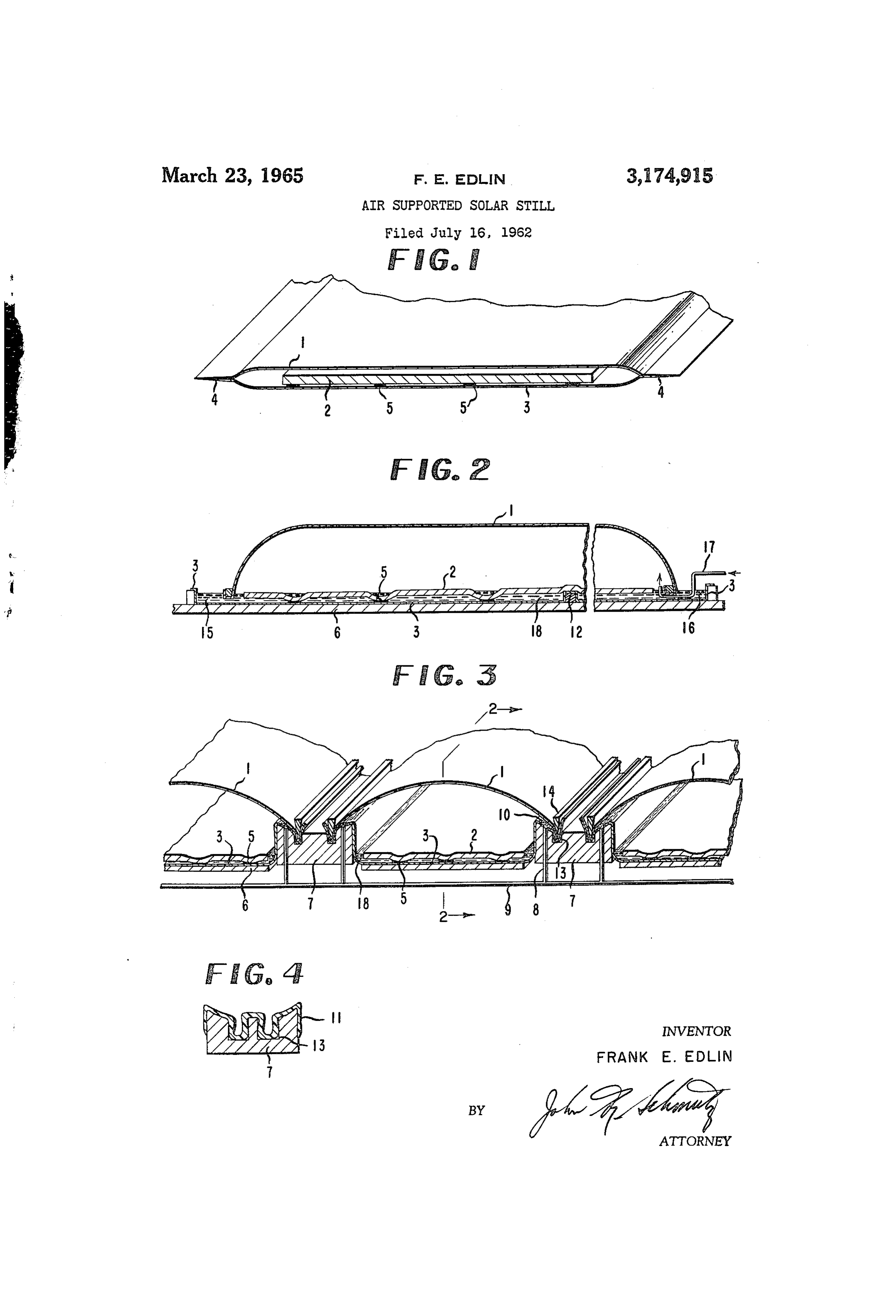
being distilled. The distillate may condense on the inner Preferred embodiments of this invention are illustrated surface of the roof or canopy through which the Solar in the accompanying drawing wherein:
radiation passes or it may condense on another cooled FIGURE 1 is an oblique cross-sectional view of the surface. preferred prefabricated envelopes used in the solar stills Two approaches have ben made to absorption-type of this invention.
solar stills. First, relatively compact multi-effect stills, FIGURE 2 is a cross-sectional side elevation of the that is, stills that re-use the heat vaporization of the liquid solar still along lines 2-2 in FIGURE 3. distilled, have ben constructed. Although these stilis FIGURE 3 is an oblique cross-sectional view of a have comparatively high output per unit area, the total solar still of this invention containing several bays or output of such stills is relatively small. Attempts to 30 individual solar stills.
make large multi-effect stilis have resulted in prohibitive FIGURE 4 is a cross-sectional end elevation of a pre ly high construction costs. Also, multi-effect stills are ferred holding and collecting means used in the solar comparatively difficult and costly to operate. stills.
Second, large single-effect stills, that is, stills that do Canopy is formed from a flexible sheet material which not re-use the heat of vaporization of the liquid distilled, 3 5 must be strong, impervious to water and air, weather have been constructed. Such stills usually have either a resistant and substantially transparent to solar radiation. rigid or supported flexible canopy through which Solar Although the transparent canopy need not be completely radiation passes and, usually, on which the distillate con transparent to all solar radiation, that is, it may not be denses. Although such large single-effect stills are transparent to ultraviolet radiation, some of the long cheaper to construct and operate than multi-effect stills 40 of comparable size, they have several disadvantages. wave-length infrared radiation or some visible radiation, First, such stills often fail mechanically. For example, it should be substantially transparent to the total incident if the canopy through which solar radiation passes and solar energy. Thus "substantially transparent' is used herein to refer to materials which transmit at least about on which the distillate condenses is thin enough to be economical and permit high transmission of Solar radi 45 70% of the incident Solar radiation which strikes the material at or near normal incidence. Materials which ation, hail, wind or the like often puncture or break the fulfil these qualifications are, for example, films of poly canopy. Also, for example, if the canopy is flexible vinyl fluoride; polytetrafluoroethylene; copolymers of and supported on a rigid framework, the motion of tetrafluoroethylene with, for example, hexafluoropropene, the canopy causes mechanical failure at the Supports. monochlorotrifluoroethylene, vinylidene chloride, vinyl Furthermore, conventional construction and fabrication fluoride and the like; polyesters such as polyethylene ter techniques often limit the size of such stills. Also, such ephthalate; polyethylene; polyvinyl butyral; polyvinyl large stills often present undesirable air foils and, for chloride; copolymers of vinyl chloride with, for example, example, in high winds the still may be torn from its styrene, acrylonitrile, vinylidene chloride, vinyl acetate supports and blown away. In addition, such single-effect and the like and homopolymers and copolymers of vinyl stills often make ineffective use of solar radiation. For idene chloride. Laminated films can also be used. In example, such stills are often constructed so that a con addition, coated fabrics fulfilling the aforementioned siderable portion of the canopy through which solar qualifications, for example, open scrim glass fabrics coated radiation is transmitted is at Such an angle to the incident and impregnated with polytetrafluoroethylene, can be used. radiation that the radiation is reflected rather than trans mitted. 60 Films of fluorinated hydrocarbon polymers are preferred Furthermore, the efficiency of both single and multi because they have excellent solar-radiation transmission effect stills often greatly decreases with time. For ex characteristics and resistance to hydrolysis and photo ample, Salt and other organic and inorganic Solids in degradation. Films of polyvinyl fluoride are particularly the material being distilled precipitate on absorbing sur preferred because they have outstanding transmissibility faces causing these surfaces to reflect rather than absorb 65 to Solar radiation, excellent weatherability and a combina solar radiation. tion of high tensile strength, flexibility and toughness. This invention provides an efficient single-effect solar Even after prolonged use, films of polyvinyl fluoride do still which efficiently utilizes solar radiation, which is not Scale or become opaque and do not become brittle resistant to mechanical failure, which is inexpensive, or fail mechanically. Furthermore, as discussed herein which does not provide an undesirable air foil and which 70 after, films of polyvinyl fluoride can be easily modified to does not decrease in efficiency with tine. One preferred make the surface thereof wettable.
Page 3
The thicknesses of the canopy a usually range from Such as carding and crosslapping fibers. In order to give about 1 to 8 mills. Very thick canopies, for example, the fabric 2 sufficient body to retain its shape in the solar 100 mils or more thick are usually avoided because they stills, it can be loosely needle punched or, for example, are expensive, they somewhat reduce the transmission lightly sprayed with a binder such as, for example, a of solar energy, they are often stiff and inflexible and are 5 Solution of polychlorobutadiene.
often more subject to mechanical damage. The minimum The form of the fibers is not critical. They can be thickness of the canopy 1 is largely governed by the straight or crimped stapie fibers, continuous filaments, strength of the films. The length and width of the canopy yarns or the like. Staple fibers having a denier of about are governed largely by the desired distilling area of 0.5 to 5 and a length on the order of 1 to 6 inches are the still. Canopy must be from about 3 to 15 feet wide O usually used. One convenient method of making the and is preferably from about 30 to 500 feet long. How fibers black is to incorporate, for example, 1 to 5% of ever, for example, stills thousands of feet long are very finely divided carbon black in the fiber polymer be feasible. fore spinning.
Preferably, the inner condensing surface of the canopy As mentioned hereinbefore, the loose, nonwoven, black is made wettable. "Wettable' as used herein refers to fabric 2 and canopy used in the solar stills of this in a surface on which water or other liquid being distilled vention are preferably provided in a prefabricated en condenses as a film rather than collecting in droplets which velope such as that shown in FIGURE 1, the bottom Substantially increase reflection, rather than transmission, layer 3 of which becomes the bottom or sealing layer 3 of incident solar radiation. A still having a canopy in the still. Optionally, however, each of these elements with a wettable inner surface will produce 10 to 25% 20 can be provided separately and incorporated in the still. more distillate than a corresponding still having a canopy The advantage of providing canopy , non-woven fabric A, the inner surface of which is not wettable, 2 and sealing layer 3 as a single prefabricated assembly The inner surface of canopy can be made wettable, is that a single inflatable envelope of any practical length for example, by coating the surface to be modified with can be provided as a unitary structure which can be rolled a thin coating of colloidal or near colloidal silica, drying up and shipped to the place of installation and there cut the coating and simultaneously or subsequently heating into the desired length and installed with a minimum of and pressing the silica particles into the surface of the construction and fabrication at the site of use. Further film, for example, in a calender. Preferably, an organic more, by providing a unitary envelope, leaks and the like solvent which partially solubilizes the surface being modi do not develop along the edge of the still should the fied is added to the aqueous dispersion of silica to facili 30 canopy 5 partially pull away from the means by which tate embedding and adhering the particles of silica to the it is held.
Surface. A thin wettable coating, for example, of cross The preferred prefabricated envelope can be prepared, linked polyvinyl alcohol can also be applied to the inner for example, by inserting the non-woven fabric 2 between surface of canopy 1. two layers of film ( and 3), then sealing the edges 4 The inner surface of canopy can also be roughened thereof or by placing the fabric on one-half of a sheet to make it wettable. Usually, in order to be wettable, of film and folding the uncovered portion of the film the inner surface of canopy it should have at least 50 Over and Sealing one edge of the envelope. Suitable and preferably at least 200 irregularities or undulations per methods for sealing the envelope include pressing edges linear inch. The inner surface of canopy can be rough 40 thereof at a temperature Sufficient to fuse the surfaces ened, for example, by sanding the surface with sandpaper, to be joined, then cooling the joint under pressure or, for by Sandblasting with wet sand, or by embossing undula example, applying thereto a suitable adhesive such as, for tions into the surface, for example, with a calender. The example, Solutions of linear polyesters and organic poly irregularities or undulations can be, for example, on the isocyanates, epoxy resin adhesives or the like. The en order of 0.5 to 0.75 mil deep. If irregularities or un velope can also be extruded as a large tube, fabric 2 fas dulations at a frequency of about from 1000 to 4000 per tened at Spaced points on the outer surface thereof, then inch are made on the inner surface of canopy , long the tube turned inside out.
wavelength radiation reemitted by the still is reflected by Preferably, non-woven fabric 2 within the envelope is canopy without substantially reducing the transmission Somewhat narrower than the inner width of the envelope of incident solar radiation. This reflection of reemitted So that the fabric 2 does not extend upward along the radiation increases the efficiency of the stills by increasing 50 holding and collecting means 7 in the inside of the still. the temperature within the still. The bottom layer 3 of the envelope can and preferably Loose, non-woven black fabric 2, which serves as a is made of the same material as the top layer . Alter. radiation absorbing layer, can be composed of almost nately, however, a film of a different polymeric material any fibers which are resistant to degradation by sunlight can be used for the bottom layer 3. Any of the poly and the material being distilled and can be colored black. 55 meric materials mentioned above which can be used for Such fibers are, for example, fibers of polyacrylonitrile, the top layer , which becomes canopy 1 of the still, are polyesters such as polyethylene terephthalate, polyester Suitable for the bottom layer 3, which becomes lower amides, polyamides such as polyhexamethylene adipa Sealing layer 3 of the still.
mide, homopolymers and copolymers of vinyl chloride Non-Woven fabric 2 is usually bonded at space points and vinylidene chloride, glass, cotton and the like. Poly 60 5, for example, with adhesives such as those mentioned acrylonitrile fibers are particularly preferred. Since salt above which can be used to seal the edges of the envelope. water is usually distilled in the stills of this invention, fibers Alternately, however, non-woven fabric 2 need not be in the non-woven fabrics are not only subjected to ultra adhered to either surface of the envelope, in which case violet light and deterioration therefrom but also to strong Weights such as pieces of coal or rock are usually dis saline solutions containing, for example, 10% or greater tributed on the fabric after the envelope is installed to of salt. During prolonged exposure to such conditions, prevent the fabric being displaced by the liquid being non-woven batts of polyacrylonitrile fibers do not degrade distilled. Preferably, the fabric should not be bonded to or mat and the fibers therein do not weaken, embrittle or the entire bottom layer 3 of the envelope since this pre hydrolyze. Vents the fabric from floating on top of the liquid being For the reason discussed hereinafter, the non-woven distilled.
fabric 2 of fibers should be loose and open. Usually, Considering the construction and installation of the non-woven fabrics having a density of about from 0.001 Solar stills of this invention in more detail, first, a suitable to 0.03 oz./in.3 are used. Preferably, fabric 2 weighs Substantially level site is chosen and, preferably with long about 1 to 5 oz./sq. yd. and is about 0.2 to 0.5 inch thick. Stilis, graded toward the end thereof from which residue Such fabrics can be prepared by conventional techniques and distillate are removed. Typically, a grading of /2
Page 4
to 2% is used. Particularly with small stills not having eter/chord ratio. Usually, the pressure of the air within many repeating still units, it is sometimes desirable to the envelope must be at least about 0.15 inch of water lay an insulating material 6 under the still. Suitable in gauge; otherwise, the canopy a will flap in the wind, tear sulating materials are, for example, expanded mica, saw and possibly blow away. The upper limit on the pres dust, dry sand, wood shavings, paper pulp, cork, straw sure within the still is governed largely by the strength and the like. Next, holding and collecting means 7 are of canopy 1. Usually inflation pressures of 0.20 to 0.35 laid on the surface prepared for the still. These holding inch of water gauge are preferred. means can be made from concrete, steel, wood, extruded in operation solar radiation transmitted through can plastics or the like. However, they should be heavy opy , strikes unwoven fabric 2 where it is converted enough to prevent the holding means from rising off the O into heat. This heat is transferred by conduction and ground when the still is inflated or bolted to the ground. convection to material being distilled 13 which evapo Pipes 8 coupled to header 9 can be provided for with rates and collects on the inner surface of canopy which drawing distillate from the collecting troughs 10 in hold is cooled by air moving over the outer surface thereof. ing and collecting means 7. The condensate then runs off into troughs () where it is A preferred type of holding and collecting means 7 15 withdrawn, for example, near the lower end of the still has a polymeric insert 1 as shown in FIGURE 4. This by pipes 8 connected to header 9. During operation, the polymeric insert prevents the canopy 1 and sealing layer temperature of the air within the still rises to a tempera 3 from chafing against the holding and collecting means 7. ture on the order of 120 to 160 F.
The distance between the holding and collecting means The liquid being distilled 8 within the still is usually 7 and the height thereof is determined by the width of 20 maintained about 1 to 5 inches deep, and preferably about canopy 1 or, if the preferred prefabricated envelope is from 2 to 4 inches deep. The loose, non-woven black used, the inner width of the envelope. The distance fabric 2 preferably either completely floats on the sur between the holding and collecting means 7 must be such face of the liquid being distilled 18 or floats on the sur that when canopy is inflated the ratio of the arc length face thereof between spaced points where it is held to of the inflated canopy to the chord of the canopy is the sealing layer 3. Wet fibers in the floating fabric 2 about 1.01 to 1.2 and preferably 1.01 to 1.1. "Arc project from the liquid being distilled, increase the sur length' refers to the distance measured along surface of face area of the liquid being distilled 18 and enhance canopy between points at which canopy is held in evaporation. The loose non-woven structure of the fab holding and collecting means 7. The chord of the canopy ric 2 allows salts and other organic and inorganic solid is the shortest distance between the points where cano 30 materials to fall down to the bottom of the still as they py is held in holding and collecting means 7, that is, are precipitated thereby leaving the non-woven fabric 2 the chord of the arch of canopy . If the ratio of the black and uncoated. Non-woven fabric 2 is also much arc length to chord of canopy is less than 1.01, distillate more absorbent than, for example, a sheet or film of black collecting on the inner surface of canopy refluxes rather polymeric material.
than running down the inner surface of canopy into the 35 The stills of this invention have outstanding efficiency. collecting troughs 10 in holding and collecting means 7. Stills capable of evaporating 0.1 or higher gallon of If this ratio is greater than about 1.2, canopy forms water per day per square foot of surface of liquid being an undesirable air foil and, air, moving across the ground distilled can be made. These stilis can be constructed over canopy , draws the center of canopy upward easily, conveniently and cheaply from readily obtainable and may rip canopy from the still. Also, when the 40 materials. The stills, particularly those having a poly ratio of the diameter of the canopy 1 to the chord thereof vinyl fluoride canopy and a non-woven fabric 2 of is greater than 1.2, the efficiency of the still is reduced polyacrylonitrile, will operate many years with little main because solar radiation, particularly in the latter part of tenance. The stills can be constructed of any size in the day, strikes a large portion of the canopy at a single bays or in multiple bays as shown in FIGURE 3. small angle of incidence and a considerable amount of The stills are resistant to tearing and puncture because the solar radiation is reflected rather than transmitted - the canopy gives rather than punctures when hail or through canopy . other objects fall thereon. Because the canopy is in With long stills, after the holding and collecting means flated rather than mechanically supported, there are few 7 have been installed, dams 2 are often placed between points where the canopy can chafe or wear. Also, and perpendicular to holding and collecting means 7 at because of their air-foil, the stills will withstand even gale intervals along the length of the still. Such dams insure force winds without blowing away. In addition, the that the level of the water or other material being distilled loose non-woven fabric 2 in the stills of this invention in long stills is substantially constant along the length prevents objectionable deposits of salt and other solids. of the still. The following examples illustrate the utility of this in Next, the lower sealing layer 3, the non-woven fabric 5 5 vention.
2 and canopy are inserted in and between the holding EXAMPLE I and collecting means 7. If the preferred prefabricated Preparation of prefabricated envelope assembly envelope is used, the edges of the envelope are merely inserted in grooves i3 in the holding and collecting means A 3-mil, 96-inch wide polyvinyl fluoride film is first 7 and Suitable gaskets or wedges 14 inserted therein to 60 made wettable on one surface. This is done by passing pinch the edges of the canopy and lower sealing layer the film through embossed calender rolls heated to 130° 3 in grooves 3. Wedges 14 in grooves 13 also provide C. The embossing pattern consists of parallel 60 a continuous grip, that is, provide an even tension, along grooves at a frequency of 1400 lines per inch and having the length of the still thus minimizing localized stresses a depth of about 0.66 mil.
which result in mechanical failure. The ends of the Next, a non-woven, loosely needled batt of 2 denier, canopy and Sealing layer 3 are conveniently fixed be 3-inch, black polyacrylonitrile fibers in aggregate about low the level of the liquid being distilled as shown in 0.25 inch thick, weighing about 3 ounces per square yard FIGURE 2 and about 83 inches wide is prepared. The batt is lightly The material to be distilled, usually salt water, is fed sprayed with an adhesive of black polychlorobutadiene through feed trough 15 and into the envelope. The 70 to give the resulting fabric 2 added body. Spots 34 inch liquid to be distilled rising in feed trough 5 and exit in diameter of adhesive 5 are applied to a second sheet trough 6 at the outlet of the still completely seals the of polyvinyl fluoride on about 12 inch centers, square still. Next, an inflating medium, usually air, is fed into pitch. The adhesive comprises 20 parts by weight of a the envelope by a suitable means, for example, pipe 27. linear terephthalic acid/sebacic acid/ethylene glycol poly This inflates the canopy a to its predetermined diam ester, 80 parts of chloroform and 2 parts of the reaction
Page 5
? 9 product of 1,1,1-trimethylol propane and tolylene diiso of the still causing solar radiation to be reflected rather cyanate. The non-woven fabric 2 of polyacrylonitrile than absorbed.
fibers is then laid on and pressed into the adhesive and EXAMPLE II heated for about 2 minutes at a temperature of about Three solar stills similar to that described in Example 220 F. Next, the edges 4 of the film of polyvinyl flu 5 I are constructed as described in that example. In the oride bearing the non-woven fabric are coated with a first still the inner surface of canopy 1 is not modified; layer of the aforementioned adhesive and the aforemen otherwise, the still is the same as the still described in tioned film of polyvinyl fluoride with the wettable sur Example I. In the second and third stills unmodified face is laid thereon, wettable surface down. The edges 4 of the resulting envelope are pressed and the resulting 0 films of polyethylene terephthalate and polyethylene, respectively, are substituted for the polyvinyl fluoride s structure again heated to about 220 F. for about 2 min films used for the canopy 1 and sealing layer 3 in the utes to complete the bonding of the envelope. still of Example I. On an average summer day in Dela Construction of still ware, the first still having an unmodified polyvinyl fluoride canopy has an output of about 0.07 gallon per
A flat area is graded to a /2 degree slope in one di 15 square foot per day. The stills with the polyethylene rection and level in the other direction. Holding and terephthalate and polyethylene have outputs of about : collecting means 7 similar to those shown in FEGURE 4 0.07 and 0.06 gallon per square foot per day, respectively. are constructed of concrete capped with a polyethylene If the inner surface of the canopies 1 of the stills de insert 1 and placed on the graded area. About an 83 scribed in this example are made wettable with silica inch spacing between inside faces of the holding and particles as previously described, the output of the stills collecting means 7 is used. The height of the lip of is increased about 20%.
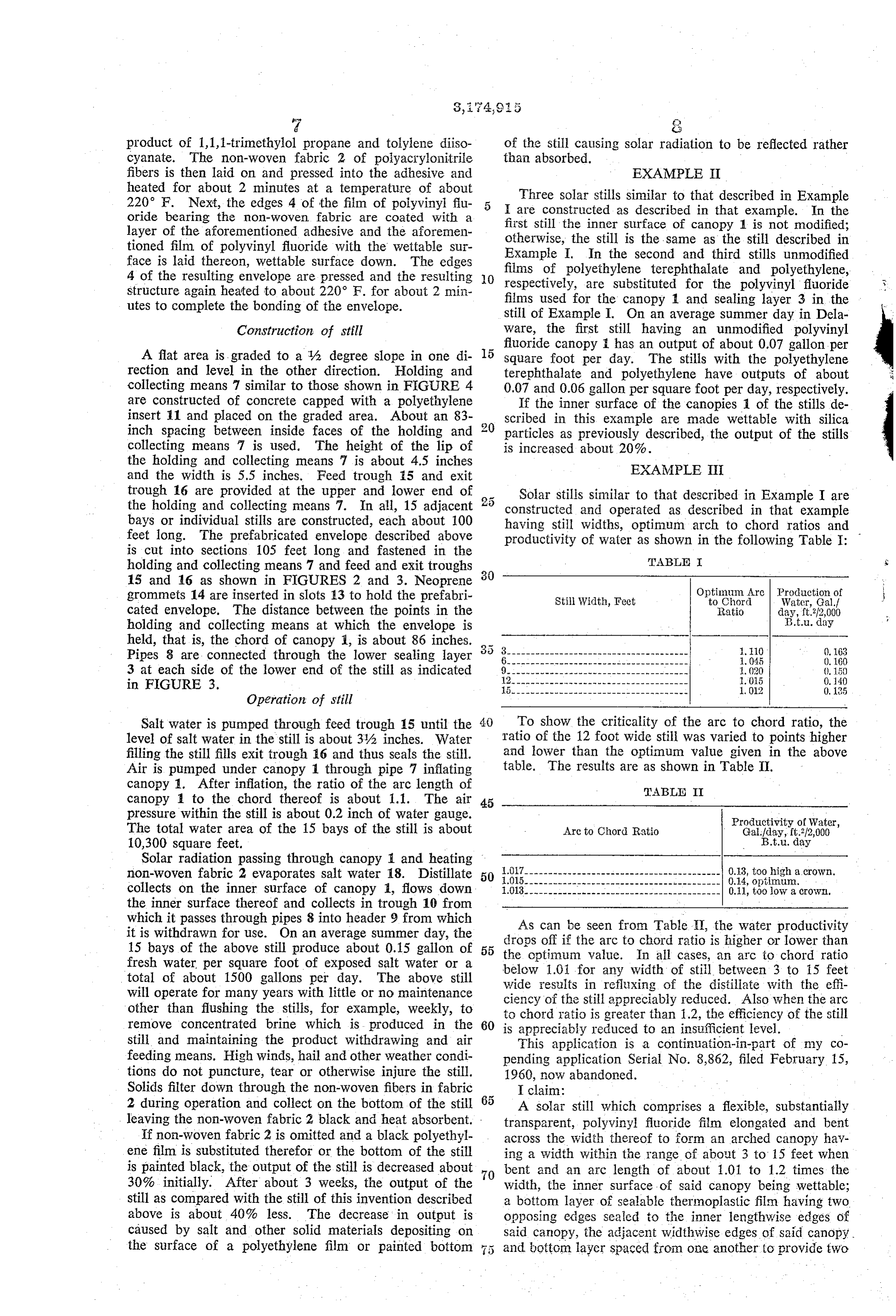
the holding and collecting means 7 is about 4.5 inches and the width is 5.5 inches. Feed trough 5 and exit EXAMPLE III trough 16 are provided at the upper and lower end of 25 Solar stilis similar to that described in Example I are the holding and collecting means 7. In all, 15 adjacent constructed and operated as described in that example bays or individual stills are constructed, each about 100 having still widths, optimum arch to chord ratios and feet long. The prefabricated envelope described above productivity of water as shown in the following Table I: is cut into sections 105 feet long and fastened in the TABLE I holding and collecting means 7 and feed and exit troughs 30 15 and 16 as shown in FIGURES 2 and 3. Neoprene grommets 14 are inserted in slots 13 to hold the prefabri Optimum Arc Production of Still Width, Feet to Chord Water, Galf cated envelope. The distance between the points in the Ratio day, ft.212,000 holding and collecting means at which the envelope is B.t.u. day held, that is, the chord of canopy 1, is about 86 inches. 0. 0.63 Pipes 8 are connected through the lower sealing layer 1.045 0.60 3 at each side of the lower end of the still as indicated . (20 0.50 in FIGURE 3. 1.015 0.40
Operation of still
Salt water is pumped through feed trough 15 until the 40 To show the criticality of the arc to chord ratio, the level of salt water in the still is about 3% inches. Water Tatio of the 12 foot wide still was varied to points higher filling the still fills exit trough 6 and thus seals the still. and lower than the optimum value given in the above Air is pumped under canopy 1 through pipe 7 inflating table. The results are as shown in Table II. canopy . After inflation, the ratio of the arc length of TABLE II canopy to the chord thereof is about 1.1. The air 45 pressure within the still is about 0.2 inch of water gauge. Productivity of water, The total water area of the 15 bays of the still is about Arc to Chord Ratio Galifolay, ft.212,000 10,300 square feet. B.t.u. day Solar radiation passing through canopy and heating non-woven fabric 2 evaporates salt water 18. Distillate 50 I.017----------------------------------------- 0.13, too high a crown. 1.015------------ - - - - - - - - - - - - - - - - - - - - - - - - - - - - - 0.14, optimum.
collects on the inner surface of canopy , flows down 1.018. ---------------------------------------- 0.1, too low a crown. the inner surface thereof and collects in trough 10 from which it passes through pipes 8 into header 9 from which As can be seen from Table I, the water productivity it is withdrawn for use. On an average summer day, the drops off if the arc to chord ratio is higher or lower than 15 bays of the above still produce about 0.15 gallon of 55 the optimum value. In all cases, an arc to chord ratio fresh water per square foot of exposed salt water or a below 1.01 for any width of still between 3 to 15 feet total of about 1500 gallons per day. The above still will operate for many years with little or no maintenance wide results in refluxing of the distiliate with the effi ciency of the still appreciably reduced. Also when the arc other than flushing the stills, for example, weekly, to to chord ratio is greater than 1.2, the efficiency of the still remove concentrated brine which is produced in the 60 is appreciably reduced to an insufficient level. still and maintaining the product withdrawing and air This application is a continuation-in-part of my co feeding means. High winds, hail and other weather condi pending application Serial No. 8,862, filed February 15, tions do not puncture, tear or otherwise injure the still. 1960, now abandoned.
Solids filter down through the non-woven fibers in fabric I claim:
2 during operation and collect on the bottom of the still 65 A solar still which comprises a flexible, substantially leaving the non-woven fabric 2 black and heat absorbent. transparent, polyvinyl fluoride film elongated and bent If non-woven fabric 2 is omitted and a black polyethyl across the width thereof to form an arched canopy hav ene film is substituted therefor or the bottom of the still ing a width within the range of about 3 to 15 feet when is painted black, the output of the still is decreased about 70 bent and an arc length of about 1.01 to 1.2 times the 30% initially. After about 3 weeks, the output of the width, the inner surface of said canopy being wettable; still as compared with the still of this invention described a bottom layer of sealable thermoplastic film having two above is about 40% less. The decrease in output is opposing edges sealed to the inner lengthwise edges of caused by salt and other solid materials depositing on said canopy, the adjacent widthwise edges of said canopy. the surface of a polyethylene film or painted bottom and bottom layer spaced from one another to provide two
Page 6
openings to the still and which allows the water being dis References Cited by the Examiner tilled to enter at one end and exit at the other end, said UNITED STATES PATENTS Water being distilled forming an air seal between the can 2,402,737 6/46 Delano.
opy and bottom layer at the open ends; canopy inflation means inserted through one open end of the still to sup 5 2,412,466 12/46 Miller.
port said canopy by air at a pressure of at least 0.15 inch of water gauge; means running along the sealed edges of OTHER REFERENCES Said canopy and bottom layer to hold said canopy and “Symposium on Saline Water Conversion,” Publication capable of shaping troughs from the bottom layer parallel and adjacent each longitudinal edge thereof to collect 0 568, National Academy of Sciences, National Research distillate condensing on the inner surface of the canopy; Council, Washington, D.C., 1958, pages 118-119. 'Solar Energy Research,' Daniels et al., University of distillate collection means inserted through one open end Wisconsin Press, Madison, Wisconsin, 1955, pages 111 of the still to withdraw the distillate from said collection troughs; and a non-woven black fabric of polyacryloni 113.
trile fibers having a density of about from 0.001 to 0.03 5
NORMANYUDKOFF, Primary Examiner.
oZ./in. disposed beneath said canopy, spot bonded to
Said bottom layer and floating on the water being distilled. GEORGE D. MITCHELL, Examiner.
Provenance
- Collection
- Cited prior art
- Original PDF
- patentimages.storage.googleapis.com →
- Filed
- 1962-07-16
- Pages
- 6
- Method
- pdftotext (the PDF's own text layer) + pdftoppm 300dpi page scans
- Source
- Google Patents bibliographic record
- Granted
- 1965-03-23
- Inventors
- Edlin Frank Edward; EI Du Pont de Nemours and Co
- Transcribed from
- patentimages.storage.googleapis.com →