patent · US2787354
Magnetic particle clutch containing an additive
2 April 1957
Page 1
Drawing sheet — no readable text.
Page 2
United States Patent Office 2,787,354 Patented Apr. 2, 1957
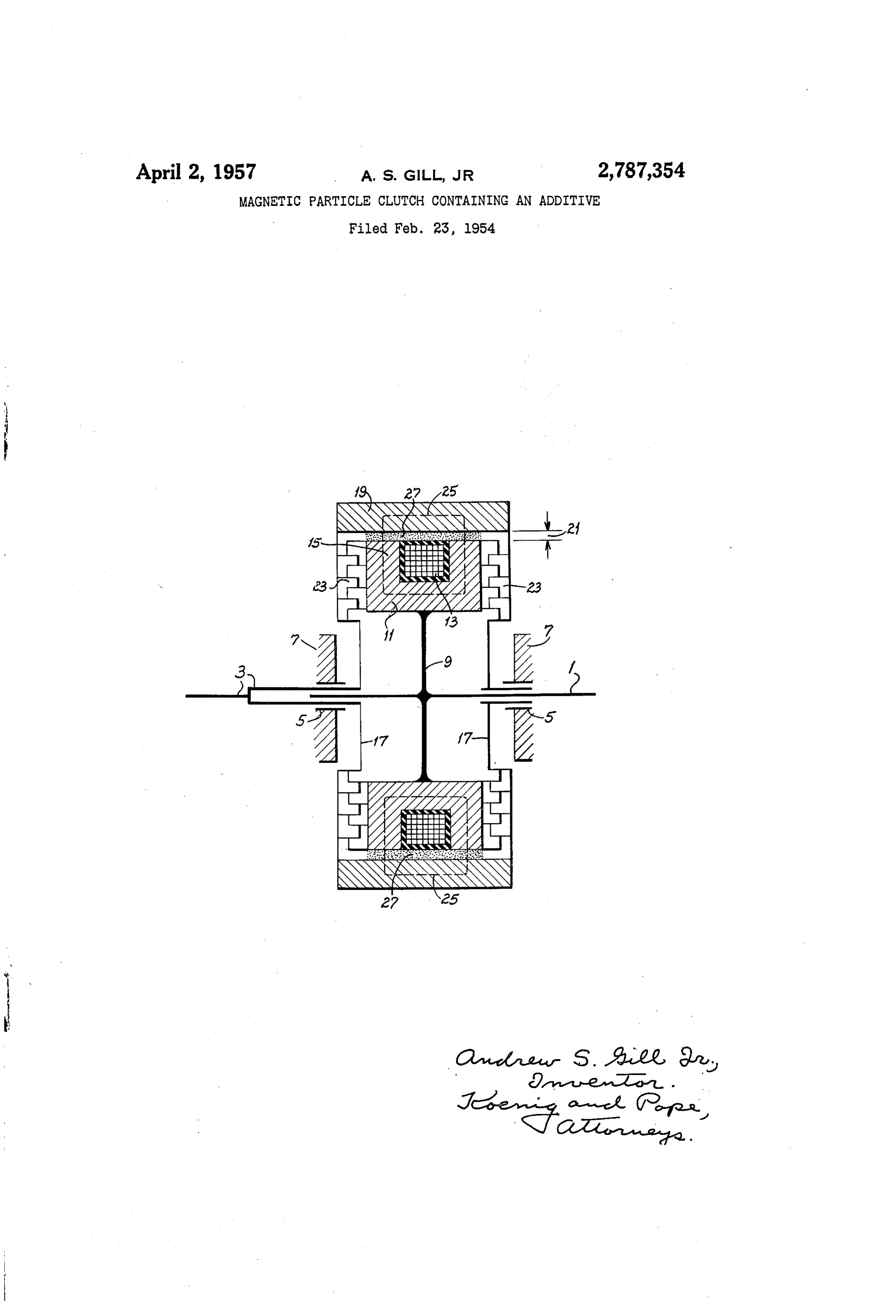
By exciting the annular field coil 13 through a suitable circuit (not shown), there will be generated a toroidal flux 2,787,354. fleld, as diagrammatically indicated at 25. This magnetic MAGNETIC PARTICLE CUTCH CONTAINING 5 netic surrounds
AN ADDITIVE
field the coil 13 and interlinks the ferromage members - and 19. The magnetomotive force in
Andrew S. Gil, Jr., Maple Heights, Ohio, assignor to the field is in a proportion to the ampere turns of the coil 13. When the coil is deemergized, the field sub
Eaton Manufacturing. Company, Cleveland, Ohio, a stantially disappears, except for small amounts of residual. corporation of Ohio magnetism that may remain.
Application February 23, 1954, Serial No. 411,814 10 In the space between members. E1 and 19 is carried a 10 Claims. (Cl 192-21.5). magnetic mixture 27 which is traversed by the field. 25 of coil 13. The result, as is known in the art, is to stiffen or increase the reactive shear forces in the mixture. 27 in some proportion to the strength of the magnetic field.
This invention relates to magnetic couplings useful as 5 This clutches, brakes and the like, and more particularly to or without results in the member 1. driving the member 3, with a magnetic coupling of this type. incorporating in its partial excitations slip, depending upon the field strength. At magnetic gap a mixture in dry form of finely divided slip occur with heating of coil 3, various degrees of rotary li magnetizable material and an additive. in the mixture, but with sufficient. Among the several objects of the invention may be 20 excitation the driving and driven members become locked noted the provision of a magnetic coupling incorporating together and synchronized in their movements. The ferromagnetic base of the mixture 27 may be in its gap a magnetic mixture containing a ferromagnetic composed of a finely divided ferromagnetic material suchi: component with a suitable additive adapted to provide as finely divided comparatively high torque transmission with compara alloy, as set forth, (preferably powdered) iron or iron. for example, in United States Patent tively low drag and break-away, torque; the provision of 25 2,519,449.
a coupling of the class described wherein said additive bonyl-E iron.In Swedish the category of powdered iron are Car powdered iron or powdered elec will cause the mixture to withstand, without deterioration, trolytic iren. Preferable, however, are ferronagnetic such high local temperatures as are prone to Gccur in materials which are less corrodible, for example, finely. magnetic clutch mixtures: when operating under certain divided. (preferably conditions; and the provision of a coupling of the class-de 30 materials set forth inpowdered) stainless steel or the other scribed in which both wear and so-called torque fading Serial No. 334,019, filed January 29, of the application William S. Goff, are minimized. Other objects and features will be in Couplings, now abandoned. The materialsforreferred 1953, Magnetic
part apparent and in part pointed out hereinafter. in this paragraph will hereinafter be referred to as those The invention accordingly comprises the elements and in a first category.
combinations of elements, features. of construction, and 35 As disclosed in the patent application of Ralph L. arrangements of parts which will be exemplified in the Jaeschke, Serial No. 393, 180, filed November 19, 1953, for structures, hereinafter described, and the scope of which Magnetic Couplings, there may be added to the finely will be indicated in the following claims. divided ferromagnetic material, finely divided (prefer The single: figure of the accompanying, drawing, which ably powdered) additives. Such as aluminum oxide, in connection with the specification illustrates various 40 chromic oxide or barium carbonate. The addition of one possible embodiments of the invention, is a diagrammatic or more of these agents (preferably aluminum oxide). is. axial section of a typical clutch incorporating the inven important in certain high-capacity designs of the present: tion.
Referring to the drawing, there is shown a driving invention but is optional in others. The materials. re ferred to in this paragraph will hereinafter be referred member 1. and a relatively rotary driven member 3, sup 45 to as those in a second category. ported coaxially in suitable bearings 5 in a frame 7. The My invention comprises combining with the above driving and driven relationship between members 1 and 3 may be interchanged. Moreover, the driven member mentioned first category finely divided ferromagnetic materials in the (with or without the above-mentioned finely may be nonrotary so as to function as a brake, instead of 50 divided additives in the second category) one or more what is generally referred to as a clutch, when neither of of the following five the members 1 or 3 is stationary. It is also to be under materials; columbiumfinely divided (preferably powdered) carbide, titanium carbide, tungsten stood that the nonrotary member, without completely, ro carbide, tantalum carbide and cobalt oxide. These five tating, may rock to some degree in its bearings to apply materials will hereinafter be referred to as those in a torque to suitable scales to measure force, so that the third category. I have found that the employment of device may function as a dynamometer. any one or more of the five additives in the third cate A supporting spider 9 is carried on the driving mem gory provides a mixture adapted to withstand high op ber a for a ferromagnetic (iron, for example) field mem erating temperatures, without introducing excessive drag ber 15, which carries an annular field coil 3 flanked by and polar members 5. The members 15 are diagram 60 time break-away torque upon release, while at the same matically illustrated and may have uninterrupted outer. mission under lockeda driving providing for wide range of desired torque trans conditions and without fading annular surfaces; or, if desired, they may be formed as of torque during the lifetime of the apparatus. These polar teeth, as is known. Attached to the driven membermaterials also inhibit wear on the coupling, brake or clutch 3 is a casing 17 which supports a ferromagnetic (iron, for example) inductor drum 19, separated from the field 65 parts. That is to say, in the form in which they existin. the mixtures contemplated herein, wear is minimized.
member 11 by a magnetic gap indicated at 21. The A satisfactory mixture is constituted by one in which, radial dimension of this gap is minimized as much as taking the amount by weight of a ferromagnetic mate possible, being on the order of 42-/8 inch in ordinary rial in the practice. Annular labyrinth seals are diagrammatically any one orfirst more category as 100 parts, the total weight of of the additives of the group in the third shown at 23, which seal off the gap 21 from the bearings 70 category consisting of columbium carbide, titanium car 5. The inside and outside relationship of the members bide, tungsten carbide, tantalum carbide or cobalt oxide 11 and 9 may be interchanged. is from approximately 2 part to 7 parts.
Page 3
If one of the materials constituted by the group in the 4. A magnetic coupling made according to claim 2, second category including aluminum oxide, chromic oxide wherein the parts by weight of the additive adapted to or barium carbonate is to be included in the mixture as reduce wear range from approximately /2 to 7 parts for above set forth, the parts by weight of any one or more each 100 parts of the ferromagnetic material, and the of these materials to be added range from approximately 5 parts by weight of said other additive adapted to reduce 4 part to 4 parts for each 100 parts of ferromagnetic break-away torque range from approximately 4 to 4 material. parts for each 100 parts of the ferromagnetic material. A satisfactory particle size for any of the finely di 5. In a magnetic coupling characterized by relatively vided materials in each of the three categories mentioned rotatable members spaced from one another by a mag netic gap and having means for generating a flux field is one which will just pass a 200-mesh screen, but it is O interlinking to be understood that this is variable and may range from the members through the gap; a finely di what will just pass a 50-mesh screen, down to particle vided coupling material in said gap comprising a major portion by weight of a ferromagnetic alloy which is sub sizes of 4 microns in diameter.
I have found that a mixture of powdered magnetic stantially noncorrodible at elevated temperatures, and a stainless steel (from the first category), powdered tita minor portion by weight of finely divided titanium carbide. nium carbide (from the third category) and powdered 6. In a magnetic coupling characterized by relatively aluminum oxide (from the second category) is at pres rotatable members spaced from one another by a mag ent considered to be the optimum and preferred, par netic gap and having means for generating a flux field ticularly in the construction of automobile clutches. The interlinking the members through the gap; a finely di proportions of these may be within the ranges above. 20 vided coupling material in said gap comprising 100 parts specified. As already made clear, the stainless steel by weight of a ferromagnetic alloy which is substantially powder component in this mixture is preferable to pow noncorrodible at elevated temperatures, and a minor por dered iron, because of its ability better to withstand cor tion by weight of finely divided titanium carbide, the rosion, including oxidation at elevated temperatures. The parts by weight of said titanium carbide ranging from titanium carbide powder is preferable because it best in 25 approximately /2 to 7.
hibits wear. The addition of the aluminum oxide powder 7. In a magnetic coupling characterized by relatively minimizes breakaway torque. rotatable members spaced from one another by a mag It has been found that the improvements set forth in netic gap and having means for generating a flux field said Jaeschke application Serial No. 393,180 provide mix interlinking the members through the gap; a finely di tures which are preferable in so-called heavy-duty de 30 vided coupling material in said gap comprising a major signs and applications of magnetic fluid clutches. Mag portion by weight of a ferromagnetic alloy which is sub netic fluid clutches which employ only a ferromagnetic stantially noncorrodible at elevated temperatures, a minor powder with a so-called lubricant are preferable for light portion by weight of finely divided titanium carbide and duty operation. The magnetic fluid clutches most bene a minor portion by weight of finely divided aluminum fited by the mixtures set forth herein are preferable for 35 oxide.
intermediate duty. It is to be understood, however, that amount 8. A coupling made according to claim 7, wherein the this statement is not to be taken as restrictive. by weight of the ferromagnetic alloy is 100 parts, In view of the above, it will be seen that the several the amount by weight of said titanium carbide ranges objects of the invention are achieved and other advan from approximately 2 to 7 parts, and the amount by tageous results attained. 40 weight of said aluminum oxide ranges from approximately As various changes could be made in the elements above 4 to 4 parts.
described without departing from the scope of the inven 9. In a magnetic coupling characterized by relatively tion, it is intended that all matter contained in the above rotatable members spaced from one another by a mag description or shown in the accompanying drawing shall netic gap and having means for generating a flux field be interpreted as illustrative and not in a limiting sense. 45 interlinking the members through the gap; a finely divided coupling material in said gap comprising a major por claim:
1. In a magnetic coupling characterized by relatively tion by weight of finely divided magnetic stainless steel rotatable members spaced from one another by a mag and minor portions by weight of finely divided titanium netic gap and having means for generating a flux field carbide and aluminum oxide.
interlinking the members through the gap; a finely di 10. A coupling made according to claim 9, wherein vided coupling material in said gap comprising a finely the amount by weight of the stainless steel is 100 parts, divided ferromagnetic material selected from the group the amount by weight of said titanium carbide ranges consisting of iron and a ferromagnetic alloy, and a minor from approximately 2 to 7 parts, and the amount by portion by weight of a finely divided additive adapted 55 weight of said aluminum oxide ranges from approximately to minimize wear, said additive being selected from the 4 to 4 parts.
group consisting of columbium carbide, titanium carbide, tungsten carbide, tantalum carbide and cobalt oxide. References Cited in the file of this patent 2. A magnetic coupling made according to claim 1, UNITED STATES PATENTS including a minor portion by weight of another finely 2,452,530 Snock ------------------ Oct. 26, 1948 divided additive selected from the group consisting of 60 aluminum oxide, chromic oxide and barium carbonate OTHER REFERENCES adapted to reduce break-away torque. Investigation of Magnetic Mixtures for Clutch Applica 3. A magnetic coupling made according to claim 1, tion, AIEE Transactions, vol. 72, part III, 1953, pages wherein the parts by weight of said additive range from 88–92.
approximately y2 to 7 parts for each 100 parts of the Induced Fibration of Suspensions, Journal of Applied ferromagnetic material. W Physics, vol. 20, December 1949, pages 1137-1140.
Provenance
- Collection
- Cited prior art
- Original PDF
- patentimages.storage.googleapis.com →
- Filed
- 1954-02-23
- Pages
- 3
- Method
- pdftotext (the PDF's own text layer) + pdftoppm 300dpi page scans
- Source
- Google Patents bibliographic record
- Granted
- 1957-04-02
- Inventors
- Jr Andrew S Gill; Eaton Manufacturing Co
- Transcribed from
- patentimages.storage.googleapis.com →