patent · US2743223
Organic compound bond rupturing process
24 April 1956
Page 1 — bibliographic record
United States Patent Office Patented Apr.2,743,223
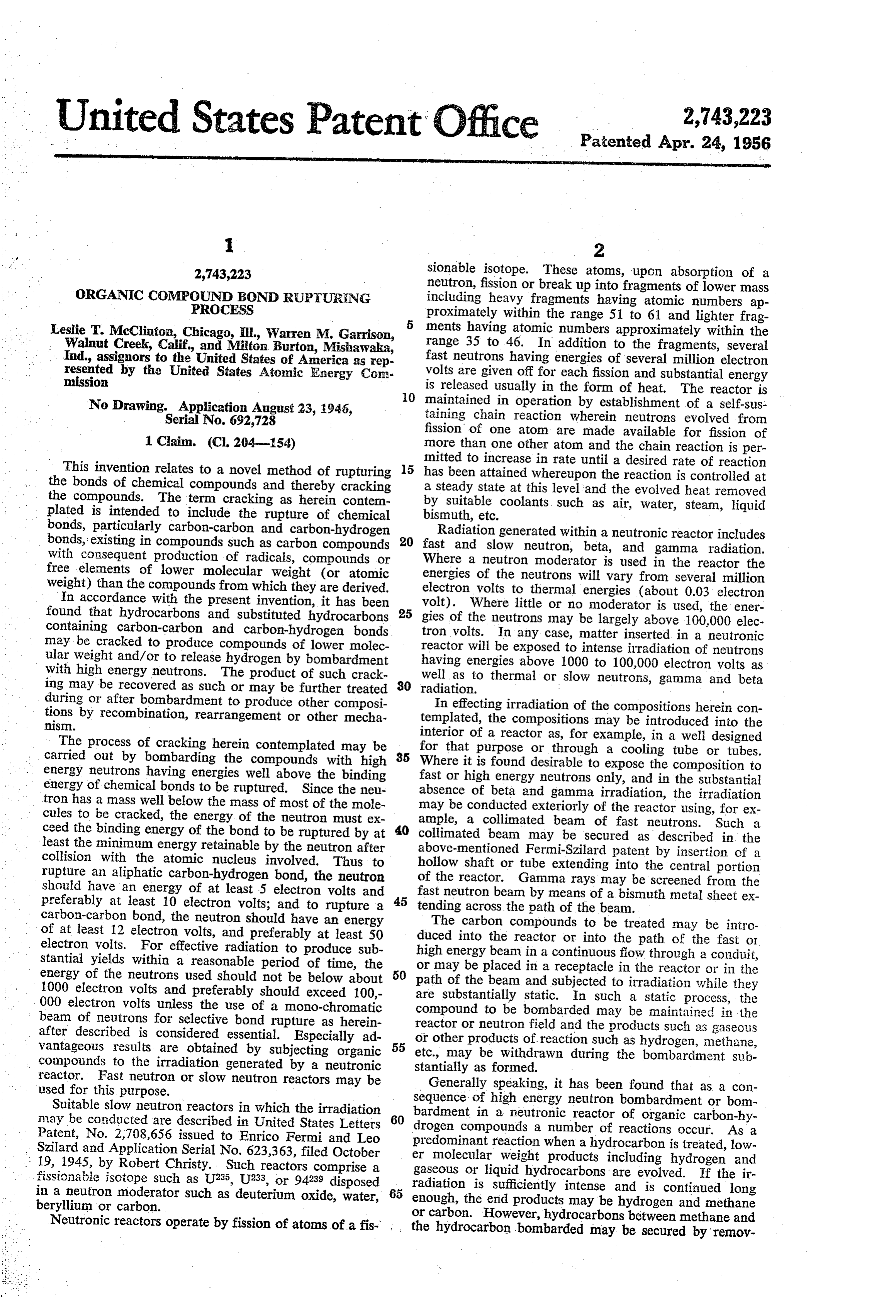
2,743,223 sionable isotope. These atoms, upon absorption of a neutron, fission or break up into fragments of lower mass
ORGANIC COMPOUND BOND RUSPTURING including heavy fragments having atomic numbers ap PROCESS proximately within the range 51 to 61 and lighter frag 5 ments having atomic numbers approximately within the
Leslie T. McClinton, Chicago, Ill., Warren M. Garrison,
Walnut Creek, Calif., and Milton Burton, Mishawaka, range 35 to 46. In addition to the fragments, several Ind., assignors to the United States of America as rep fast neutrons having energies of several million electron resented
SSO by the United States Atomic Energy Con volts are given off for each fission and substantial energy is released usually in the form of heat. The reactor is 0 maintained in operation by establishment of a self-sus
No Drawing. Application August 23, 1946, taining chain reaction wherein neutrons evolved from Serial No. 692,728 fission of one atom are made available for fission of 1. Claim. (C. 204-554) more than one other atom and the chain reaction is per mitted to increase in rate until a desired rate of reaction
This invention relates to a novel method of rupturing 5 has been attained whereupon the reaction is controlled at the bonds of chemical compounds and thereby cracking a steady state at this level and the evolved heat removed the compounds. The term cracking as herein contem by suitable coolants, such as air, water, steam, liquid plated is intended to include the rupture of chemical bismuth, etc.
bonds, particularly carbon-carbon and carbon-hydrogen bonds, existing in compounds such as carbon compounds 20 fastRadiation and generated within a neutronic reactor includes slow neutron, beta, and gamma radiation.
with consequent production of radicals, compounds or Where a neutron moderator is used in the reactor the free elements of lower molecular weight (or atomic energies of the neutrons will vary from several million weight) than the compounds from which they are derived. electron volts to thermal energies (about 0.03 electron In accordance with the present invention, it has been volt). Where little or no moderator is used, the ener found that hydrocarbons and substituted hydrocarbons 25 gies of the neutrons may be largely above 100,000 elec containing carbon-carbon and carbon-hydrogen bonds tron volts. In any case, matter inserted in a neutronic may be cracked to produce compounds of lower molec reactor will be exposed to intense irradiation of neutrons ular weight and/or to release hydrogen by bombardment having energies above 1000 to 100,000 electron volts as with high energy neutrons. The product of such crack ing may be recovered as such or may be further treated 30 radiation.to thermal or slow neutrons, gamma and beta well as during or after bombardment to produce other composi In effecting irradiation of the compositions herein con tions by recombination, rearrangement or other mecha templated, the compositions may be introduced into the
The process of cracking herein contemplated may be interior of a reactor as, for example, in a well designed for that purpose or through a cooling tube or tubes.
carried out by bombarding the compounds with high 35 Where energy neutrons having energies well above the binding fast or ithigh is found desirable to expose the composition to energy neutrons only, and in the substantial energy of chemical bonds to be ruptured. Since the neu absence of beta and gamma irradiation, the irradiation tron has a mass well below the mass of most of the mole may be conducted exteriorly of the reactor using, for ex cules to be cracked, the energy of the neutron must ex ample, a collimated beam of fast neutrons. Such a ceed the binding energy of the bond to be ruptured by at 40 collimated beam may be secured as described in the least the minimum energy retainable by the neutron after above-mentioned Fermi-Szilard patent by insertion of a collision with the atomic nucleus involved. Thus to hollow shaft or tube extending into the central portion rupture an aliphatic carbon-hydrogen bond, the neutron of the reactor. Gamma rays may be screened from the should have an energy of at least 5 electron volts and fast neutron beam by means of a bismuth metal sheet ex preferably at least 10 electron volts; and to rupture a 45 tending across the path of the beam. carbon-carbon bond, the neutron should have an energy The carbon compounds to be treated may be intro of at least 12 electron volts, and preferably at least 50 duced into the reactor or into the path of the fast or electron volts. For effective radiation to produce sub high energy beam in a continuous flow through a conduit, stantial yields within a reasonable period of time, the or may be placed in a receptacle in the reactor or in the energy of the neutrons used should not be below about 50 path of the beam and subjected to irradiation while they 1000 electron volts and preferably should exceed 100,- are substantially static. In such a static process, the 000 electron volts unless the use of a mono-chromatic compound to be bombarded may be maintained in the beam of neutrons for selective bond rupture as herein reactor or neutron field and the products such as gasecus after described is considered essential. Especially ad or other products of reaction such as hydrogen, methane, vantageous results are obtained by subjecting organic 55 etc., may be withdrawn during the bombardment sub compounds to the irradiation generated by a neutronic stantially as formed.
reactor. Fast neutron or slow neutron reactors may be Generally speaking, it has been found that as a con used for this purpose. sequence of high energy neutron bombardment or bom Suitable slow neutron reactors in which the irradiation bardment in a neutronic reactor of organic carbon-hy may be conducted are described in United States Letters 60 drogen compounds a number of reactions occur. As a Patent, No. 2,708,656 issued to Enrico Fermi and Leo predominant reaction when a hydrocarbon is treated, low Szilard and Application Serial No. 623,363, filed October 19, 1945, by Robert Christy. Such reactors comprise a er molecular weight products including hydrogen and fissionable isotope such as U235, U233, or 94239 disposed radiationorisliquid gaseous hydrocarbons are evolved. If the ir in a neutron moderator such as deuterium oxide, water, 65 enough, the end productsintense sufficiently and is continued long may be hydrogen and methane beryllium or carbon.
Neutronic reactors operate by fission of atoms of a fis or carbon. However, hydrocarbons between methane and the hydrocarbon bombarded may be secured by remov
Page 2
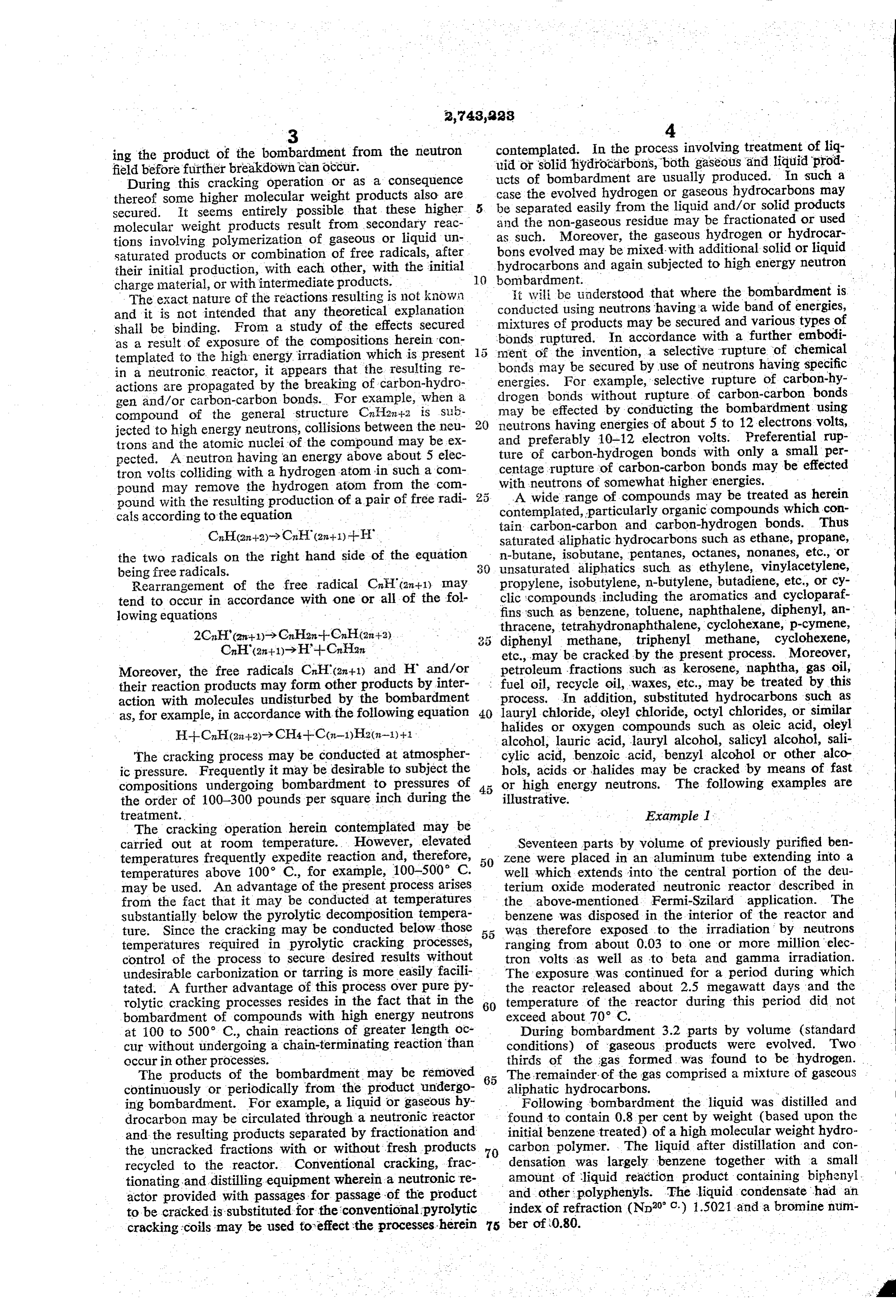
3 contemplated. In the process involving treatment of liq ing the product of the bombardment from the neutron uid or solid hydrocarbons, both gaseous and liquid prod fieldDuring beforethis further breakdown can occur.
cracking operation or as a consequence ucts of bombardment are usually produced. In such a thereof some higher molecular weight products also are case the evolved hydrogen or gaseous hydrocarbons may secured. It seems entirely possible that these higher be separated easily from the liquid and/or solid products molecular weight products result from secondary reac and the non-gaseous residue may be fractionated or used tions involving polymerization of gaseous or liquid un as such. Moreover, the gaseous hydrogen or hydrocar Saturated products or combination of free radicals, after bons evolved may be mixed with additional solid or liquid their initial production, with each other, with the initial 10 hydrocarbons and again subjected to high energy neutron charge material, or with intermediate products. bombardment.
The exact nature of the reactions resulting is not known it witi be understood that where the bombardment is and it is not intended that any theoretical explanation conducted using neutrons having a wide band of energies, shall be binding. From a study of the effects secured mixtures of products may be secured and various types of as a result of exposure of the compositions herein con bonds ruptured. In accordance with a further embodi templated to the high energy irradiation which is present ment of the invention, a selective rupture of chemical in a neutronic reactor, it appears that the resulting re bonds may be secured by use of neutrons having specific actions are propagated by the breaking of carbon-hydro energies. For example, selective rupture of carbon-hy gen and/or carbon-carbon bonds. For example, when a drogen bonds without rupture of carbon-carbon bonds compound of the general structure CnH2n+2 is sub may be effected by conducting the bombardment using jected to high energy neutrons, collisions between the neu neutrons having energies of about 5 to 12 electrons volts, trons and the atomic nuclei of the compound may be ex and preferably 10-12 electron volts. Preferential rup pected. A neutron having an energy above about 5 elec ture of carbon-hydrogen bonds with only a small per tron volts colliding with a hydrogen atom in such a com centage rupture of carbon-carbon bonds may be effected pound may remove the hydrogen atom from the com with neutrons of somewhat higher energies. pound with the resulting production of a pair of free radi A wide range of compounds may be treated as herein cals according to the equation contemplated, particularly organic compounds which con tain carbon-carbon and carbon-hydrogen bonds. Thus saturated aliphatic hydrocarbons such as ethane, propane, the two radicals on the right hand side of the equation n-butane, isobutane, pentanes, octanes, nonanes, etc., or being free radicals. unsaturated aliphatics such as ethylene, vinylacetylene, Rearrangement of the free radical CnH (2n+1) may propylene, isobutylene, n-butylene, butadiene, etc., or cy tend to occur in accordance with one or all of the foll clic compounds including the aromatics and cycloparaf lowing equations fins such as benzene, toluene, naphthalene, diphenyl, an thracene, tetrahydronaphthalene, cyclohexane, p-cymene, 3.5 diphenyl methane, triphenyl methane, cyclohexene, etc., may be cracked by the present process. Moreover,
Moreover, the free radicals CnHg2n+1) and H and/or petroleum fractions such as kerosene, naphtha, gas oil, their reaction products may form other products by inter fuel oil, recycle oil, waxes, etc., may be treated by this action with molecules undisturbed by the bombardment process. In addition, substituted hydrocarbons such as as, for example, in accordance with the following equation 40 lauryl chloride, oleyl chloride, octyl chlorides, or similar halides or oxygen compounds such as oleic acid, oleyl alcohol, lauric acid, lauryl alcohol, salicyl alcohol, sali
The cracking process may be conducted at atmospher cylic acid, benzoic acid, benzyl alcohol or other alco ic pressure. Frequently it may be desirable to subject the hols, acids or halides may be cracked by means of fast compositions undergoing bombardment to pressures of or high energy neutrons. The following examples are the order of 100-300 pounds per square inch during the illustrative.
The cracking operation herein contemplated may be Example 1. carried out at room temperature. However, elevated Seventeen parts by volume of previously purified ben temperatures frequently expedite reaction and, therefore, 50 Zene were placed in an aluminum tube extending into a temperatures above 100 C., for example, 100-500 C. well which extends into the central portion of the deu may be used. An advantage of the present process arises terium oxide moderated neutronic reactor described in from the fact that it may be conducted at temperatures the above-mentioned Fermi-Szilard application. The substantially below the pyrolytic decomposition tempera benzene was disposed in the interior of the reactor and ture. Since the cracking may be conducted below those 55 was therefore exposed to the irradiation by neutrons temperatures required in pyrolytic cracking processes, ranging from about 0.03 to one or more million elec control of the process to secure desired results without tron volts as well as to beta and gamma irradiation. undesirable carbonization or tarring is more easily facili The exposure was continued for a period during which tated. A further advantage of this process over pure py the reactor released about 2.5 megawatt days and the rolytic cracking processes resides in the fact that in the 60 temperature of the reactor during this period did not bombardment of compounds with high energy neutrons exceed about 70° C.
at 100 to 500 C., chain reactions of greater length oc During bombardment 3.2 parts by volume (standard cur without undergoing a chain-terminating reaction than conditions) of gaseous products were evolved. Two occur in other processes. thirds of the gas formed was found to be hydrogen. The products of the bombardment may be removed 65 The remainder of the gas comprised a mixture of gaseous continuously or periodically from the product undergo aliphatic hydrocarbons. - ing bombardment. For example, a liquid or gaseous hy Following bombardment the liquid was distilled and drocarbon may be circulated through a neutronic reactor found to contain 0.8 per cent by weight (based upon the and the resulting products separated by fractionation and initial benzene treated) of a high molecular weight hydro the uncracked fractions with or without fresh products 70 carbon polymer. The liquid after distillation and con recycled to the reactor. Conventional cracking, frac amount densation was largely benzene together with a small tionating and distilling equipment wherein a neutronic re of liquid reaction product containing biphenyl, actor provided with passages for passage of the product and other polyphenyls. The liquid condensate had an to be cracked is substituted for the conventional pyrolytic index of refraction (ND20 c.) 1.5021 and a bromine num cracking coils may be used to effect the processes...herein 75 ber of 0.80. -
Page 3
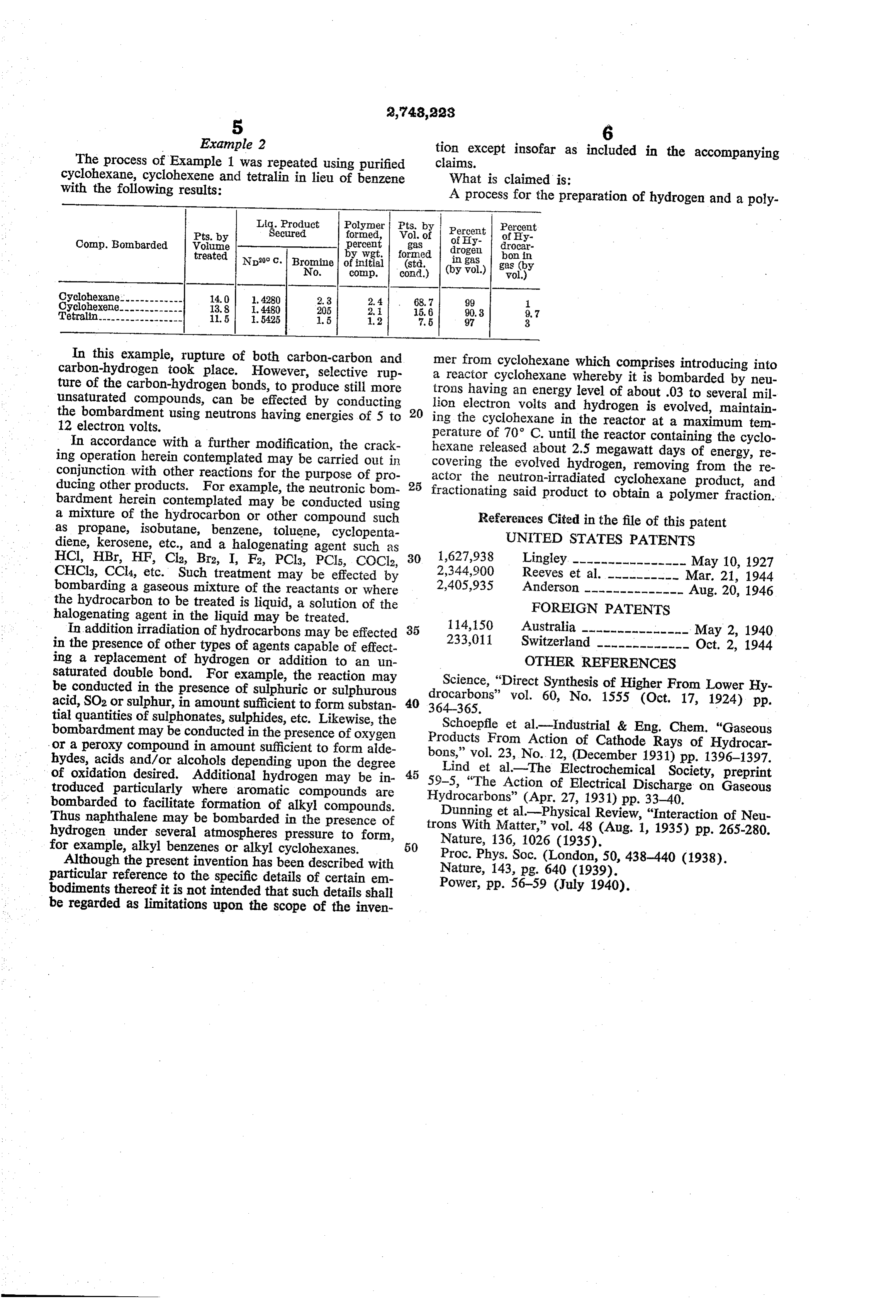
Example 2 tion except insofar as included in the accompanying The process of Example 1 was repeated using purified claims.
cyclohexane, cyclohexene and tetralin in lieu of benzene What is claimed is: with the following results: A process for the preparation of hydrogen and a poly Liq. Product Polymer Pts by Percent
Comp. Bombarded
Pts.. . bby Secured formed, percent
Wol.
gaS
drocar
Wolume by wgt. formed drogen bOn in treated ND20 C. Bromine of initial (std. (i. ES ) gas (by
Cyclohexane.----------- 14.0 1,4280 2.3 2.4 68. 99
Cyclohexene.------------- 13.8 1.4480 205 2. 15. 90.3 9,7 Tetralin------------------ 1.5 54.25 1.5 1, 2 7. 97 3
In this example, rupture of both carbon-carbon and mer from cyclohexane which comprises introducing into carbon-hydrogen took place. However, selective rup a reactor cyclohexane whereby it is bombarded by neu ture of the carbon-hydrogen bonds, to produce still more trons having an energy level of about .03 to several mil unsaturated compounds, can be effected by conducting lion electron volts and hydrogen is evolved, maintain the bombardment using neutrons having energies of 5 to ing 20 the cyclohexane in the reactor at a maximum tem 12 electron volts.
In accordance with a further modification, the crack perature of 70° C. until the reactor containing the cyclo ing operation herein contemplated may be carried out in hexane released about 2.5 megawatt days of energy, re conjunction with other reactions for the purpose of pro covering the evolved hydrogen, removing from the re actor the neutron-irradiated cyclohexane product, and ducing other products. For example, the neutronic bom 25 fractionating bardment herein contemplated may be conducted using said product to obtain a polymer fraction. a mixture of the hydrocarbon or other compound such References Cited in the file of this patent as propane, isobutane, benzene, toluene, cyclopenta UNITED STATES PATENTS diene, kerosene, etc., and a halogenating agent such as
HCl, HBr, HF, Cle, Br2, I, F2, PCl3, PCls, COCl2, 30 1,627,938 Lingley ---------------- May 10, 1927 CHCl3, CCl4, etc. Such treatment may be effected by 2,344,900 Reeves et al. ---------- Mar. 21, 1944 bombarding a gaseous mixture of the reactants or where 2,405,935 Anderson -------------- Aug. 20, 1946 the hydrocarbon to be treated is liquid, a solution of the FOREIGN PATENTS halogenating agent in the liquid may be treated.
In addition irradiation of hydrocarbons may be effected 35 114,150 Australia --------------- May 2, 1940 in the presence of other types of agents capable of effect 233,011 Switzerland ------------- Oct. 2, 1944 ing a replacement of hydrogen or addition to an un OTHER REFERENCES saturated double bond. For example, the reaction may Science, "Direct Synthesis of Higher From Lower Hy be conducted in the presence of sulphuric or sulphurous acid, SO2 or sulphur, in amount sufficient to form substan 40 drocarbons'
tial quantities of sulphonates, sulphides, etc. Likewise, the Schoepfle et al.-Industrial & Eng. Chem. "Gaseous bombardment may be conducted in the presence of oxygen Products From Action of Cathode Rays of Hydrocar or a peroxy compound in amount sufficient to form alde bons,” vol. 23, No. 12, (December 1931) pp. 1396-1397. hydes, acids and/or alcohols depending upon the degree of oxidation desired. Additional hydrogen may be in 45 59-5, Lind et al.-The Electrochemical Society, preprint troduced particularly where aromatic compounds are "The Action of Electrical Discharge on Gaseous bombarded to facilitate formation of alkyl compounds. Hydrocarbons' (Apr. 27, 1931) pp. 33-40. Thus naphthalene may be bombarded in the presence of Dunning et al-Physical Review, "Interaction of Neu hydrogen under several atmospheres pressure to form, trons With Matter,' vol. 48 (Aug. 1, 1935) pp. 265-280.
for example, alkyl benzenes or alkyl cyclohexanes. 50
Although the present invention has been described with Nature, 143, pg. 640 (1939). particular reference to the specific details of certain em Power, pp. 56-59 (July 1940). bodiments thereof it is not intended that such details shall be regarded as limitations upon the scope of the inven
Provenance
- Collection
- Cited prior art
- Original PDF
- patentimages.storage.googleapis.com →
- Filed
- 1946-08-23
- Pages
- 3
- Method
- pdftotext (the PDF's own text layer) + pdftoppm 300dpi page scans
- Source
- Google Patents bibliographic record
- Granted
- 1956-04-24
- Inventors
- Leslie T Mcclinton; Warren M Garrison; Burton Milton
- Transcribed from
- patentimages.storage.googleapis.com →