patent · US2569075
Prevention of enzymatic discoloration of potatoes
25 September 1951
Page 1 — bibliographic record
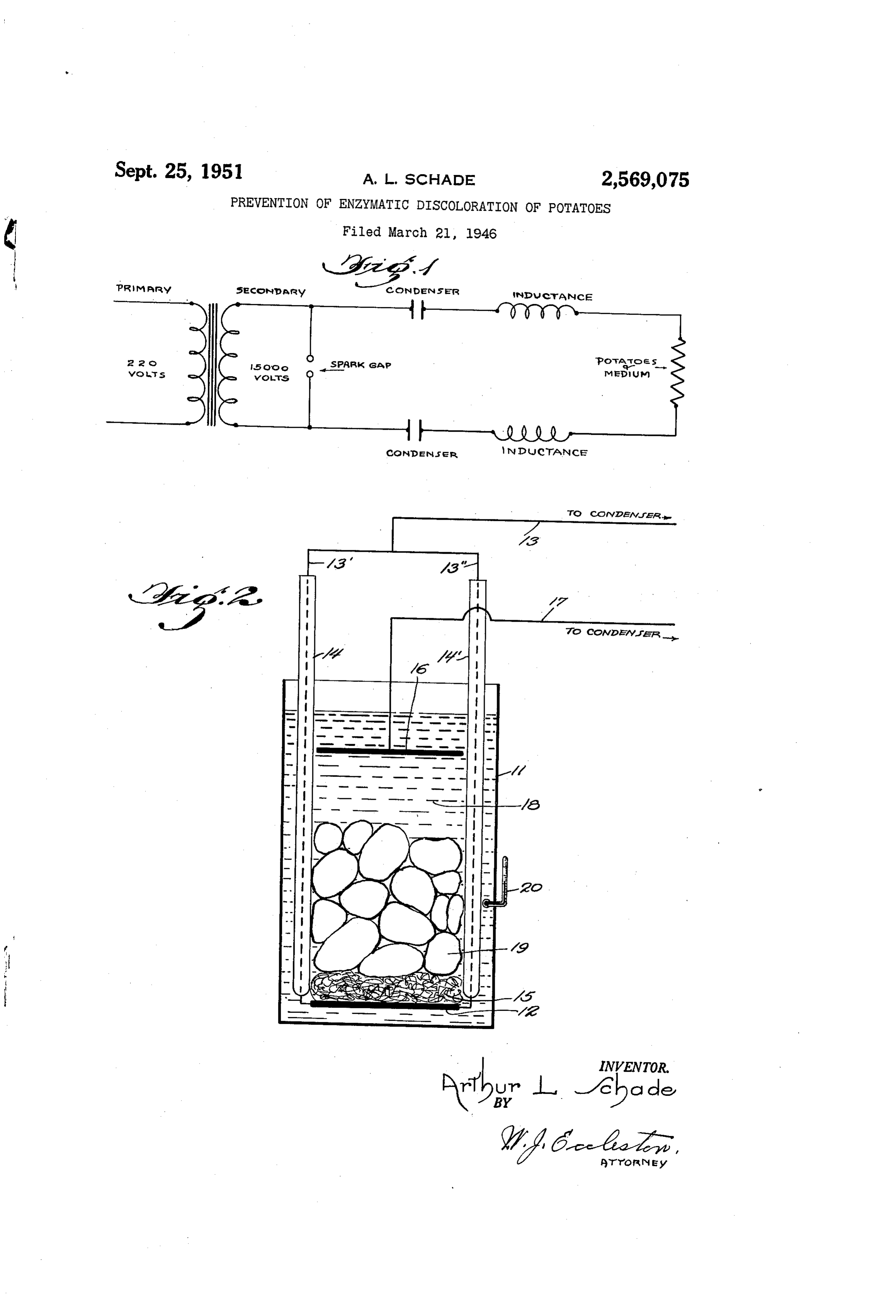
Sept. 25, 1951 A. L. SCHADE 2,569,075
PREVENTION OF ENZYMATIC DISCOLORATION OF POTATOES
: Trim Ary second Ary
Filed March 21, 1946
U222 / condenser now cAnce 22 go spark casAp Potagoe Med UM --
WCdlts
Condenster nductance to convoemuasar.
23. 70 comasMuar
INVENTOR,
Abir 1- uéba de
Page 2
Patented Sept. 25, 1951
UNITED STATES PATENT OFFICE
PREVENTION OF ENZYMATIC DISCOLORA
TION OF POTATOES
Arthur L. Schade, New York, N. Y., assignor to the United States of America as represented by the Secretary of War
Application March 21, 1946, Serial No. 656,117
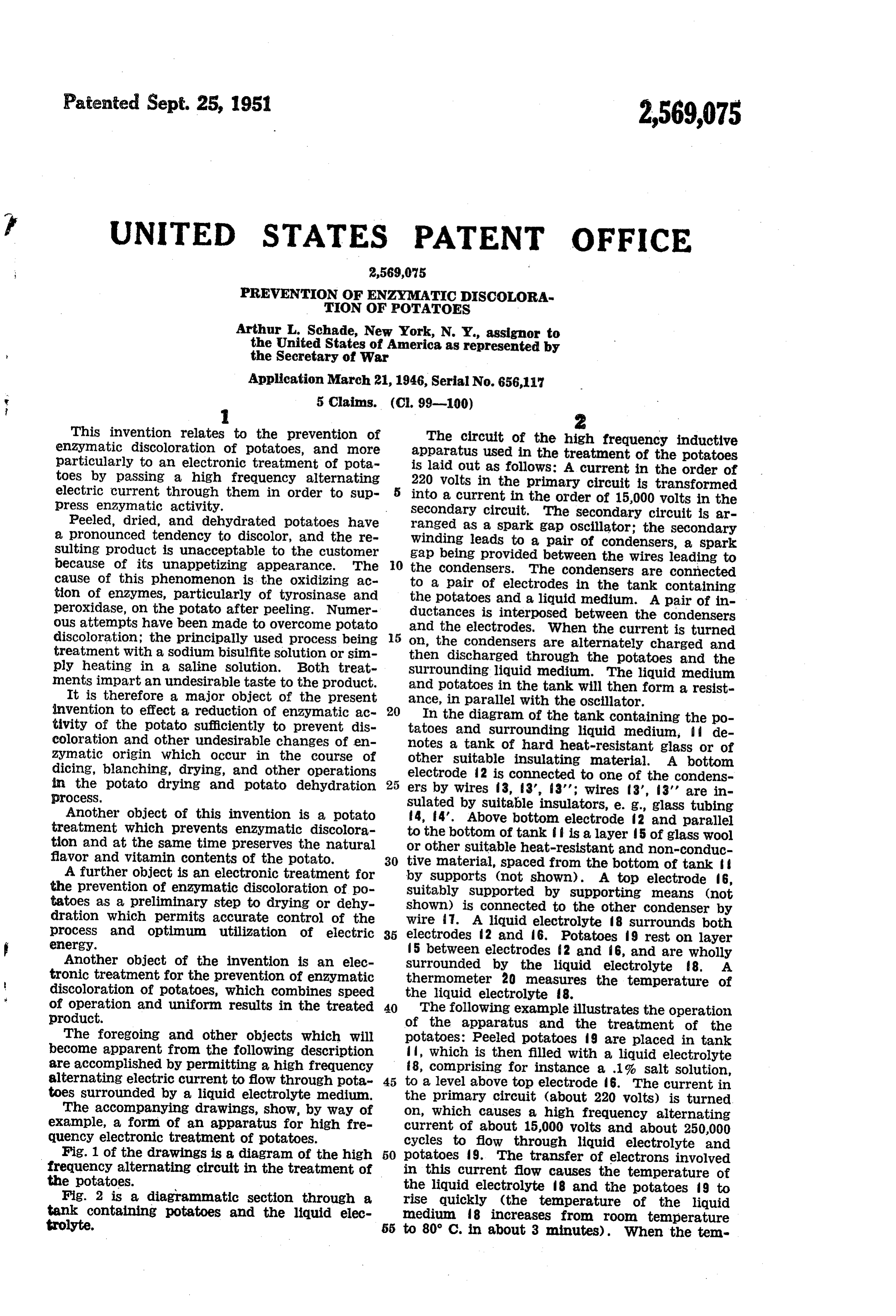
This invention relates to the prevention of The circuit of the high frequency inductive enzymatic discoloration of potatoes, and more apparatus used in the treatment of the potatoes particularly to an electronic treatment of pota is laid out as follows: A current in the order of toes by passing a high frequency alternating 220 volts in the primary circuit is transformed electric current through them in order to Sup into a current in the order of 15,000 volts in the press enzymatic activity. Secondary circuit. The secondary circuit is ar Peeled, dried, and dehydrated potatoes have ranged as a spark gap oscillator; the secondary a pronounced tendency to discolor, and the re winding leads to a pair of condensers, a spark sulting product is unacceptable to the customer gap being provided between the wires leading to because of its unappetizing appearance. The O the Condensers. The condensers are connected cause of this phenomenon is the oxidizing ac to a pair of electrodes in the tank containing tion of enzymes, particularly of tyrosinase and the potatoes and a liquid medium. A pair of in peroxidase, on the potato after peeling. Numer ductances is interposed between the condensers ous attempts have been made to overcome potato and the electrodes. When the current is turned discoloration; the principally used process being5 on, the condensers are alternately charged and treatment with a sodium bisulfite solution or sim then discharged through the potatoes and the ply heating in a saline solution. Both treat Surrounding liquid medium. The liquid medium ments impart an undesirable taste to the product. and potatoes in the tank will then form a resist It is therefore a major object of the present ance, in parallel with the oscillator. invention to effect a reduction of enzymatic ac 20 In the diagram of the tank containing the po tivity of the potato sufficiently to prevent dis tatoes and surrounding liquid medium, de coloration and other undesirable changes of en notes a tank of hard heat-resistant glass or of zymatic origin which occur in the course of other suitable insulating material. A bottom dicing, blanching, drying, and other operations electrode 2 is connected to one of the condens in the potato drying and potato dehydration 25 ers by wires 3, 3, 3’’; wires (3, 3’ are in process. Sulated by suitable insulators, e. g., glass tubing Another object of this invention is a potato 4, 4. Above bottom electrode 2 and parallel treatment which prevents enzymatic discolora to the bottom of tank is a layer 5 of glass wool tion and at the same time preserves the natural or other suitable heat-resistant and non-conduc flavor and vitamin contents of the potato. 30 tive material, Spaced from the bottom of tank A further object is an electronic treatment for by supports (not shown). A top electrode 6, the prevention of enzymatic discoloration of po Suitably Supported by Supporting means (not tatoes as a preliminary step to drying Or dehy shown) is connected to the other condenser by dration which permits accurate control of the wire . A liquid electrolyte 8 surrounds both process and optimum utilization of electric 35 electrodes 2 and 6. Potatoes 9 rest on layer energy. 5 between electrodes 2 and f6, and are wholly Another object of the invention is an elec surrounded by the liquid electrolyte 8. A tronic treatment for the prevention of enzymatic thermometer 20 measures the temperature of discoloration of potatoes, which combines speed the liquid electrolyte 8.
of operation and uniform results in the treated 40 The following example illustrates the operation product. of the apparatus and the treatment of the The foregoing and other objects which will potatoes: Peeled potatoes 9 are placed in tank become apparent from the following description , which is then filled with a liquid electrolyte are accomplished by permitting a high frequency 8, comprising for instance a .1% salt solution, alternating electric current to flow through pota 45 to a level above top electrode 6. The current in toes surrounded by a liquid electrolyte medium. the primary circuit (about 220 volts) is turned The accompanying drawings, show, by Way of on, which causes a high frequency alternating example, a form of an apparatus for high fre current of about 15,000 volts and about 250,000 quency electronic treatment of potatoes. cycles to flow through liquid electrolyte and Fig. 1 of the drawings is a diagram of the high 50 potatoes 9. The transfer of electrons involved frequency alternating circuit in the treatment of in this current flow causes the temperature of the potatoes. the liquid electrolyte 8 and the potatoes 9 to Fig. 2 is a diagrammatic section through a rise quickly (the temperature of the liquid tank containing potatoes and the liquid elec medium 8 increases from room temperature trolyte. 55 to 80 C. in about 3 minutes). When the tem
Page 3
perature of the liquid electrolyte 8 has reached until the center of the potatoes has reached a about 80° C., the current is turned off and the temperature of 90° C. or higher, such as 92 A. C. potatoes are removed. The treated potatoes are or 95° C.; at these temperatures a uniform cook found to be substantially evenly cooked, regard ing of the potato is accomplished. The time of less of shape and size. The temperature of the electronic treatment can be reduced by pre potatoes is about 95° C. at their center and about heating of the potatoes, for instance, by heating 85° C. near their surface; the temperature of the potatoes to about 60° C. in a 65 to 70° C. pre the potatoes is higher than that of the surround heating bath. The operations of peeling and pre ing liquid medium because of the greater re heating can be combined into a single operation sistance of the potatoes to the flow of the electric O by the steam-peeling the potatoes and maintaining
Steam-peeled potatoes at an elevated tem current. The difference in temperature between perature for several minutes prior to their sub center and surface regions of the potatoes is due to heat loss to the Surrounding medium; jection to the electronic treatment. Pre-heating however, the effect of this difference on the uni of the liquid electrolyte is also within the scope of formity of the product is largely compensated by 15 the present invention. Successive batches of an initially more intensive heating of the surface potatoes can be treated in the same liquid elec region of the potato, which has a resistance ex vious trolyte which remains in the tank after the pre ceeding that of the center region of the potato batch of potatoes has been removed. The heated liquid electrolyte may also serve as a by about 33%% at room temperature. Greater 20 pre-heating uniformity in the temperature of the surface and bath Subsequent to the washing but center region of the potato can be accomplished prior to the peeling of the potatoes; immersion by pre-heating the potato, e. g., in the course and removal of the potatoes may be accomplished of steam-peeling it, to a temperature Substantially by conventional means, e.g., by a net (not shown above room temperature, for instance 73° C. in the drawings).
Enzymatic tests show that in the treated potatoes It will be noted that conductive treatment of there is a complete loss of tyrosinase activity and potatoes by placing them in high-frequency al a partial loss of peroxidase activity. Discolora ternating circuit and permitting the current to tion of the treated potatoes is inhibited, as shown flow through the body of the potatoes differs in by colorimetric tests. The flavor of the treated 30 kind from capacitive heating of potatoes in an electrostatic field. In capacitive heating, as dis potatoes is that of ordinary cooked potatoes. The tinguished from the conductive treatment of the potatoes are now ready for further processing, present process, the potatoes are placed between Such as dicing, drying, comminution, and de the condenser plates of a high-frequency gener hydration. ator; it was observed that this type of heating A corresponding treatment of unpeeled potatoes produces non-uniform results due to the shape, does not produce favorable results. The current 35 irregularities does not flow through the interior of the potatoes of the potatoes, and results in the due to the extremely high resistance of the skin; scorching of the potatoes by frequent sparks. On consequently, when the temperature of the liquid the other hand, conductive treatment of the medium 8 rises from room temperature to 80 potatoes in accordance with the present inven-. C., the temperature at the center of the unpeeled tion not only precludes damage to the potatoes potatoes rises to only 58 C., the latter rise caused by Sparking, but results in a completely uniform end product, regardless of size and presumably being due substantially exclusively shape of the potatoes; uniformity of the final to heat transfer from the liquid medium to the product is of great importance, as an incom potato. No substantial loss of enzymatic activity or reduction in the speed and intensity of dis 45 pletely treated portion of the potato will still be Subject to enzymatic discoloration.
coloration of the treated unpeeled potato takes While the foregoing description and drawings place. set forth Specific instances of the application of The resistance to current flow of a peeled high frequency alternating current potatoes potato of 3 inches thickness and that of an un 50 placed in the circuit itself, and illustrate a par peeled potato of the same thickness compare as ticular arrangement of an apparatus for carry follows. The resistance of the peeled potato is ing out the treatment, it will be understood that 10,000 ohms, while the resistance of the unpeeled such specific instances and arrangements, in potato is over 1,000,000 ohms. Resistance of a cluding the Voltage in the primary and secondary cooked peeled potato after subjection to con circuits, or number of cycles of the high-fre ductive electronic heating in accordance with the 55 present invention is only a small fraction of that quency alternating current may be changed with of the uncooked peeled potato; the cooked potato out departing from the Spirit of the invention. has only about 5%% of the resistance of a cor Numerous other variations and modifications will responding peeled uncooked potato, when the 60 readily Suggest themselves for the attainment of measurement is made at 30° C.; at 90° C., the the object of the present invention, all falling Within resistance of the cooked potato is only about fore intended the Scope and Spirit thereof. It is there one half of its resistance at 30° C., or about to claim the invention broadly, 2%% of the resistance of an uncooked peeled tions and to limit its Scope not by any specific condi potato (the latter being measured at 20° C.). and arrangements Set forth in the descrip Best results are reached when the concentra 65 tion and drawings, but only by the appended tion of the liquid electrolyte is such that its claims.
resistance is intermediate that of the cooked and I claim:
uncooked potatoes: In the example described 1. A process for the prevention of enzymatic above, a resistance between 500 and 600 ohms of 70 potato discoloration, comprising immersing a the electrolyte was found to be particularly peeled potato in an electrically conductive liquid advantageous. having a resistance to an electric current below The time of treatment varies in accordance the resistance of an uncooked peeled potato and with the rate of current flow, prevailing room above the resistance of a cooked peeled potato temperature, and other variable conditions. to electric current, and passing a high-frequency However, the current should be permitted to flow 75 alternating electric current through said liquid
Page 4
and through Said potato, until said potato is peeled state and while immersed in an elec Cooked.
2. A process for the prevention of enzymatic trically conductive liquid having a resistance be potato discoloration, comprising immersing a tween about 500 ohms and about 600 ohms, until peeled potato in an electrically conductive liquid s Said potato is cooked.
having a resistance to an electric current below ARTHUR, . SCHADE. the resistance of an uncooked peeled potato and above the resistance of a cooked peeled potato REFERENCES CITED to electric current, and passing a high-frequency The following references are of record in the alternating electric current through said liquid to file of this patent:
and through said potato until the temperature of the center region of said potato is raised to at UNITED STATES PATENTs least 90° C. Number Nanne Date 3. A process for the prevention of enzymatic 267,685 Fowler ------------ Nov. 21, 1882 potato discoloration comprising passing a high 5 1035,777 Bullock ------------ Aug. 13, 1912 frequency alternating electric current through 1,057,567 Mauldin ------------ Apr. 1, 1913 a water solution of an electrolyte, said solution 1,102,769 Lincoln ------------ July 7, 1914 having a resistance between about 500 ohms and 1,189,725 Northrup ----------- July 4, 1916 about 600 ohms, and through a peeled potato in 1,404,549 Schweizer ---------- Jan. 24, 1922 mersed in said solution until the temperature of O 1,522,188 Hull ---------------- Jan. 6, 1925 the center region of said potato is raised to at least 90° C.
4. A process for the prevention of enzymatic 1930,169 Halvorson et al. ----- Oct. 10, 1933 potato discoloration, comprising non-electrically 1934,703 Golden ------------ Nov. 14, 1933 preheating a potato to a temperature in the 1992,515 Uhlmann ---------- Feb. 26, 1935 order of at least 60° C. but insufficient to cook 213714 stein--- Apr. 12, 1938 said potato, and then passing high frequency al 2,219,772 Gernhardt ---------- Oct. 29, 1940 ternating current through said potato in the 2,299,088 Griffith ------------ Oct. 20, 1942 peeled state and while immersed in an electrically 2,325,652 Bierwirth ----------- Aug. 3, 1943 conductive liquid having a resistance to an elec 2,405,984 Sharpe ------------Aug. 20, 1946 tric current below the resistance of an uncooked 2474,650 Birdseye -------- June 28, 1949 peeled potato and above the resistance of a FOREIGN PATENTS cooked peeled potato, until said potato is cooked.
5. A process for the prevention of enzymatic Number Country Date potato discoloration, comprising non-electrically 23,893 Great Britain ------- May 11, 1901 preheating a potato to a temperature in the 5 of 1900 order of at least 60° C. but insufficient to cook 509,293 Great Britain ------ July 13, 1939 said potato, and then passing high frequency al 599,690 France ------------ Oct. 23, 1925 ternating current through said potato in the 848,801 France ------------ July 31, 1939
Provenance
- Collection
- Cited prior art
- Original PDF
- patentimages.storage.googleapis.com →
- Filed
- 1946-03-21
- Pages
- 4
- Method
- pdftotext (the PDF's own text layer) + pdftoppm 300dpi page scans
- Source
- Google Patents bibliographic record
- Granted
- 1951-09-25
- Inventors
- Arthur L Schade
- Transcribed from
- patentimages.storage.googleapis.com →