report
Phenomena of free energy
1 January 1995
Page 98
(Translated from raum&zeit 49/91, January/February 1991)
Free Energy
PHENOMENA OF THE FREE
ENERGY IN NATURE AND
TECHNOLOGY
by Dr. Ing. Jacob Huber, Kehrsatz, Switzerland
The author is amongst those scientists who are not satisfied with the declarations of orthodox physics on, for example, the subject of "Phenomena of Gravity.” Dr
Huber has already reported in raum&zeit No.35 about the "Ether and its influence on the Physics of Open
Systems" and in the same edition has published a study entitled "Calculation of the Planetary Orbit".
Particularly, in the first of these studies, Huber supplied the mathematical proof that energy conversion is possible in open systems. In the article which now follows he investigates the Phenomena of Free Energy, as they appear, especially, in a flash of lightning. The enormous energies released by lightning form part of the “Mechanism of Energy in Nature", of which Tesla spoke.
The subject of Phenomena of Free Energy (FE) in Nature and Technology recalls Pioneer Viktor Schauberger's declaration : "First understand Nature, then copy it.” Such a
procedure not only corresponds to the human order, but also leads most definitely to a _ Natural technology.
The question now arises as to how far we have got in pursuing this objective. The example of the natural phenomenon of lightning is taken as a definition of the position.
Lightning is an electrical discharge which occurs between clouds or from cloud to earth. Of particular interest are the circumstances of its generation and the origin of its important energy. Even believing, with good reason, the ocean to be the source of FE, it is Of great significance to know the conditions under which such an enormous concentration of energy is achieved and developed in lightning.({see Ref. (1))
Page 99
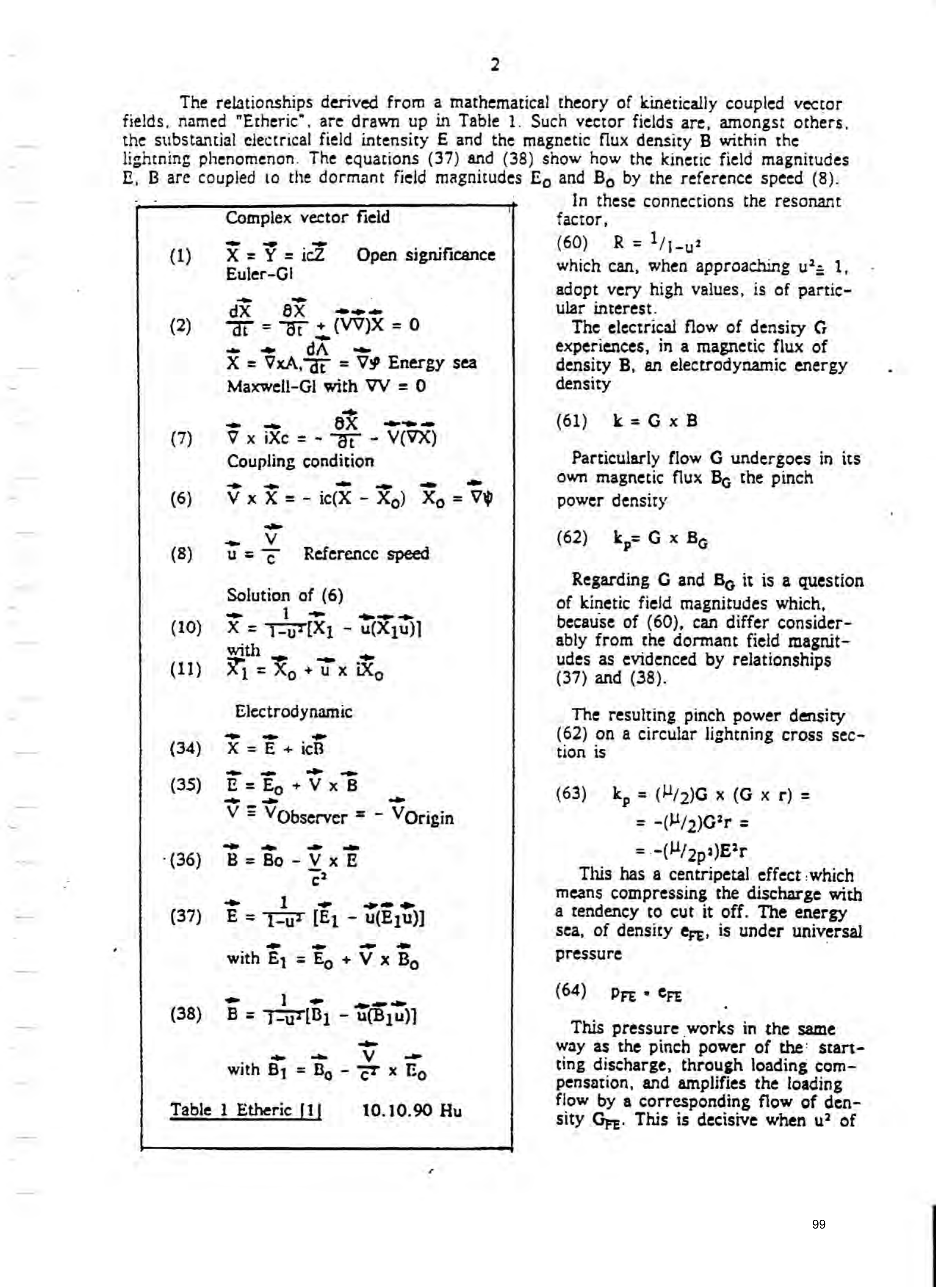
The relationships derived from a mathematical theory of kinetically coupled vector
fields, named "Erheric’,
are drawn up in Table 1. Such vector fields are, amongst others.
the substantial electrical field intensity E and the magnetic flux density B within the lightning phenomenon. The equations (37) and (38) show how the kinetic field magnitudes £, B are coupled to the dormant field magnitudes Ep and Bog by the reference speed (8).
Complex vector field (1) X-=¥-=icZ Open significance
X = Fae = V9 Energy sea
Maxwell-Gl with VV = 0
Coupling condition
(8) us ¢ Reference speed
Solution of (6)
with
Electrodynamic
V = VObserver = - Vorigin
with 2’ = Eo +Vx Bo
with By = By - @r x Eg
In these connections the resonant
factor,
which can, when approaching u?: 1, adopt very high values, is of particular interest.
The electrical flow of density G experiences, in a magnetic flux of density B, an electrodynamic energy density
Particularly flow G undergoes in its own magnetic flux Bg the pinch
power density
Regarding G and Bg it is a question of kinetic field magnitudes which, because of (60), can differ considerably from the dormant field magnit-
udes as evidenced by relationships
The resulting pinch power density (62) on a circular lightning cross section is
This has a centripetal effect :which means compressing the discharge with a tendency to cut it off. The energy sea, of density @rp, is under universal pressure
This pressure works in the same way as the pinch power of the’ startting discharge, through loading compensation, and amplifies the loading flow by a corresponding flow of den- Sity Grp. This is decisive when u? of
Page 100
the plasma of the discharge is approaching the value of 1. Then the lightning is substantially fed by the FE of the ocean.
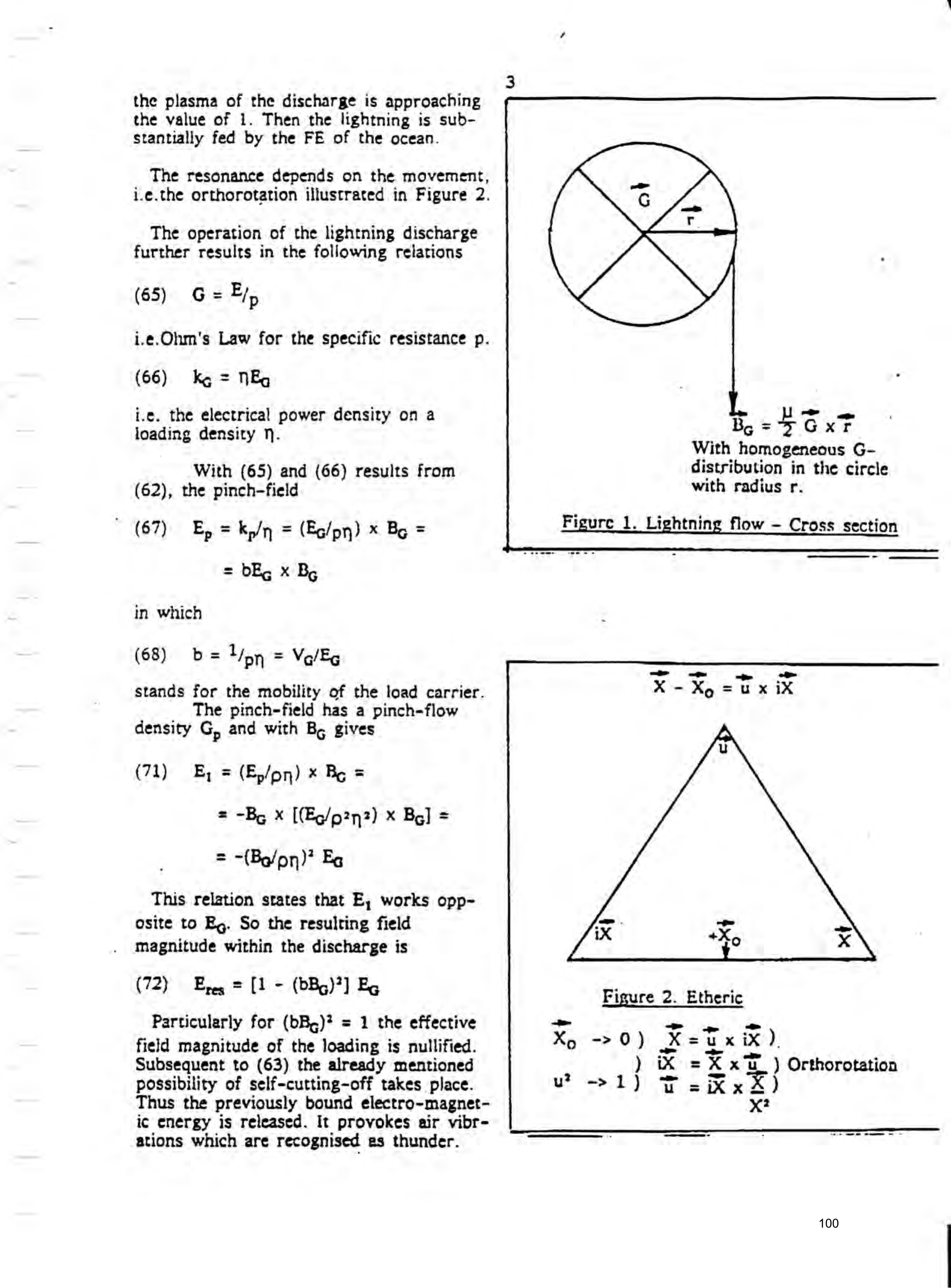
The resonance depends on the movement, i.e.the orthorotation illustrated in Figure 2.
The operation of the lightning discharge further results in the following relations
i.e.Ohm's Law for the specific resistance p.
kg = NEg
i.e. the electrical power density on a loading density 1.
With (65) and (66) results from (62), the pinch-field
in which
stands for the mobility of the load carrier. The pinch-field has a pinch-flow density G, and with Be gives
This relation states that E, works opposite to Eg. So the resulting field magnitude within the discharge is
Particularly for (bBg)* = 1 the effective
field magnitude of the loading is nullified. Subsequent to (63) the already mentioned possibility of self-cutting-off takes place. Thus the previously bound electro-magneti¢ energy is released. It provokes air vibrations which are recognised es thunder.
Ee Rese &
Bg = ‘ Gxr
With homogeneous G-
distribution in the circle with radius r.
Figure 1. Lightning flow - Cross section URE
Orthorotation
Page 101
Consequently the lightning phenomenon is mainly determined by two conditions :
1) The resonanr condition determines the concentration of free energy in the lightning discharge.
2) The cut-off condition determines when the bound energy in the lightning is released.
The Jightning functions like a "FE valvepump. "
Closely analagous considerations are also valid for the generation and demise of a tornado, as can be proved by the formulation X = a+ icw. According to recent investigations, beside the classical weather mechanism, electrical discharges in the form of spherics appear to govern initiation.
Acknowledging the significance of this natural! phenomenon both as a dangerous threat over wide areas and, probably, as a source of energy to be exploited, further research is necessary.
In connection with the lightning phenomenon, the so-called lightning machines (Testatika-, Searl-, Newman- machine etc) for the exploitation of free energy should be mentioned, The afore mentioned conditions 1) and 2) have to be fulfilled for them too. The relevant steps to be taken have to be considered on a case by case basis. (60) plays a major part in the sought after over-one-factor. However mobility (68) is of decisive importance for any exploitation.
Here the question arises whether, according to Stan Meyer for the Water Fuel Cell, the mobility of the electrolytes in the sense of (72) may be responsible for the fact that, in this cell, less energy is needed to separate H, and O than is produced by
combining them.
As can be gathered from this report, there is still a lot more research to be done. Further clarification is needed for greater understanding of the FE phenomena and In particular for the realization of optimal technical solutions.
To answer the topical question over the necessity of new energy sources and the _ advancements of knowledge, it is necessary further to investigate the possibility of putting them into effect and the moral and ethical issues involved.
Reference: [1] Record of the International Congress for
Free Energy, Einsiedeln 1989, Chapter 8
Provenance
- Pages
- pages 98–101 of 140
- Binder
- WFC Project Binder 423-DA
- Method
- pdftoppm 300dpi + tesseract 5 (eng), orientation-corrected
- Source
- WFC International Independent Test-Evaluation Report (1995), scanned binder
- Attribution
- Translated from raum&zeit 49/91
- Reproduced material
- Reproduced inside Meyer's 1995 report as bound; copyright is the original author's.