report
Dublin Institute of Technology: explanation of the Meyer fuel cell
1 January 1995
Page 81
INSTITIUID TEICNEOLAIOCHTA BHAILE ATHA CLIATH
DUBLIN INSTITUTE OF TECHNOLOGY
14 Upper Mount Street, Dublin 2.
INDUSTRIAL LIAISON OFFICE
Industrial Liaison Officer: Rea O'Neill, M.A.. M.Sc., M.Inst.P.
“At viaseat + * ”
SIMPLE EXPLANATION OF
MEYER FUEL CELL TECHNOLOGY
The electrolysis process is not dependent on energy. From Arthenius theory, molecules in solution dissociate into ions and the ions are collected at the electrode.
No energy is required for ionic dissociation and electrolysis processes are so efficient that they are used to measure current e.g. silver coulometer.
When we apply this to the dissociation with water, the key requirement to produce 1.008 gm of hydrogen is that 1 Faraday of electricity flows. (1 Faraday equals
If we assume that this is s produced by passing 2 amps of current for 96,494 secs. at 4 volt, then the energy needed is 2 x 2 x 96,494 joules or 96,494 joules i-e. 96. 494 KJ of energy.
The same mole of Hz is capable of releasing 285 KJ of energy on combustion with oxygen.
The process of producing H> from water usually requires an electrolyte to produce it in quantities.
It suffers from polarisation at the electrodes with hydrogen collecting there. A number of methods are known for improving the efficiency of the process. In theory the process can be made energy efficient without a breach of any of the laws of thermodynamics.
Meyer has obviously discovered some method of collecting the hydrogen different from the traditional methods.
* From Faraday's Laws of Electrolysis
The Dublin Institute of Technology was established by rhe Dublin instirure of Technology Act 1992 and is constirures = -—
College of Technology. Bolron Sereer. College of Catering. Cathal Brugha Srreer. Callege ot Steen: = = = my College of Technology. Kevin Street. College of Marketing & Design. Mountjoy Suuire a ieee V4 Rd ee bce Shoes
Page 82
POCO CHEB O DDO OH
pereain
INST’TIUID TEICNEOLAIOCHTA BHAILE ATHA CLIATH
DUBLIN INSTITUTE OF TECHNOLOGY
14 Upper Mount Street. Dublin 2.
INDUSTRIAL LIAISON OFFICE
I-custrial Liaison Officer: Rea O'Neill, M.a., M.Se.. M.lns: ?
REPORT ON VISIT TO STAN MEYER
I visited Columbus Ohio to meet Stan Meyer and discuss Water Fuel Cell Technology from 28th July to 31st July 1993. I was accompanied by Noel Whitney of Quantum Leap and Michael Carberry, Chief Engineer of Avonmore Pic.
During the course of our stay most of our time was spent discussing the underlying principles behind the technology and the details of the electronics circuits etc. On the second dav Meyer demonstrated a version of his water fuel cell technology which was built in 1982. This demonstration clearly indicated to me that Meyer has developed a novel process for producing hydrogen and oxygen together. This process does not utilise the large currents needed for normal electrolysis.
Since my return to Ireland I have studied the literature and compared this with the data supplied by Meyer. I have formed the view that Meyer has developed a novel form of electrolysis for water and that this form of electrolysis has the potential to make available more heat energy than the energy input needed to stimulate the process. I have explained this process on the accompanying pages.
In all the time I had contact with Meyer, I formed a very positive view of his sincerity and his enthusiasm. From the literature supplied, the patents and equipment shown to us it is evident that Meyer has concentrated his development on producing this water fuel cell in a form immediately suitable for retrofitting to the everyday motor vehicle. To complete this development he has to develop his electronics further to produce an integrated chip and this will take some further months.
I am convinced that the technology demonstrated is a novel and exciting technology and will provide an alternative fuel for use in motor vehicles in the not too distant furure. It is difficult at this stage to assess whether its performance as a simple burner will exceed the performance of existing technology from heat pumps etc. The substantial gain to be made if this proves to be the case, however, would justify significant investment to move to the proof of concept stage.
Signed: ges ZN
Rea ONeill
Industna! Liaison Officer .
The Dublin Institute ot Tecmnolcs. 439 establisned by the Dublin Institute ot Technology Act 1902 and ss csnutitutes strom: College of Technolugy. Bolton Srse:- College of Carerng. Cathal Brayha Sereet, College 21 Commesce. Rasmunes. College of Technology. Kevin Stree: College of Marketing & Design. Mounrjoy Square. College 21 Music, Adelause Rud
Page 83
EXPLANATION OF MEYER FUEL CELL
In ordinary water a small amount of the water dissociates to hydrogen and hydroxyl ions. These ions are immediately hydrated. The amount dissociating depends on the purity of the water and in very pure water is equal to | part in 10 million. Normally ordinary water is described as non-conducting. The process has never been fully explained. Hydrogen and hydroxyl ions are constantly being created and then decaying back to water; but there is always a balance between the numbers ionised and the
numbers in solution. (See Appendix I for details of the ionic process involved)
Under normal electrolvsis these ions can be swept to electrodes and neutralised with the opposite charge. Hydrogen and Oxygen can be produced. With conventional circuits however, the energy used in collecting the hydrogen is greater than the energy that is available from the hydrogen. Meyer has utilised a novel electronic circuit which produces high voltages but prevents currents from flowing. This circuit is similar to a
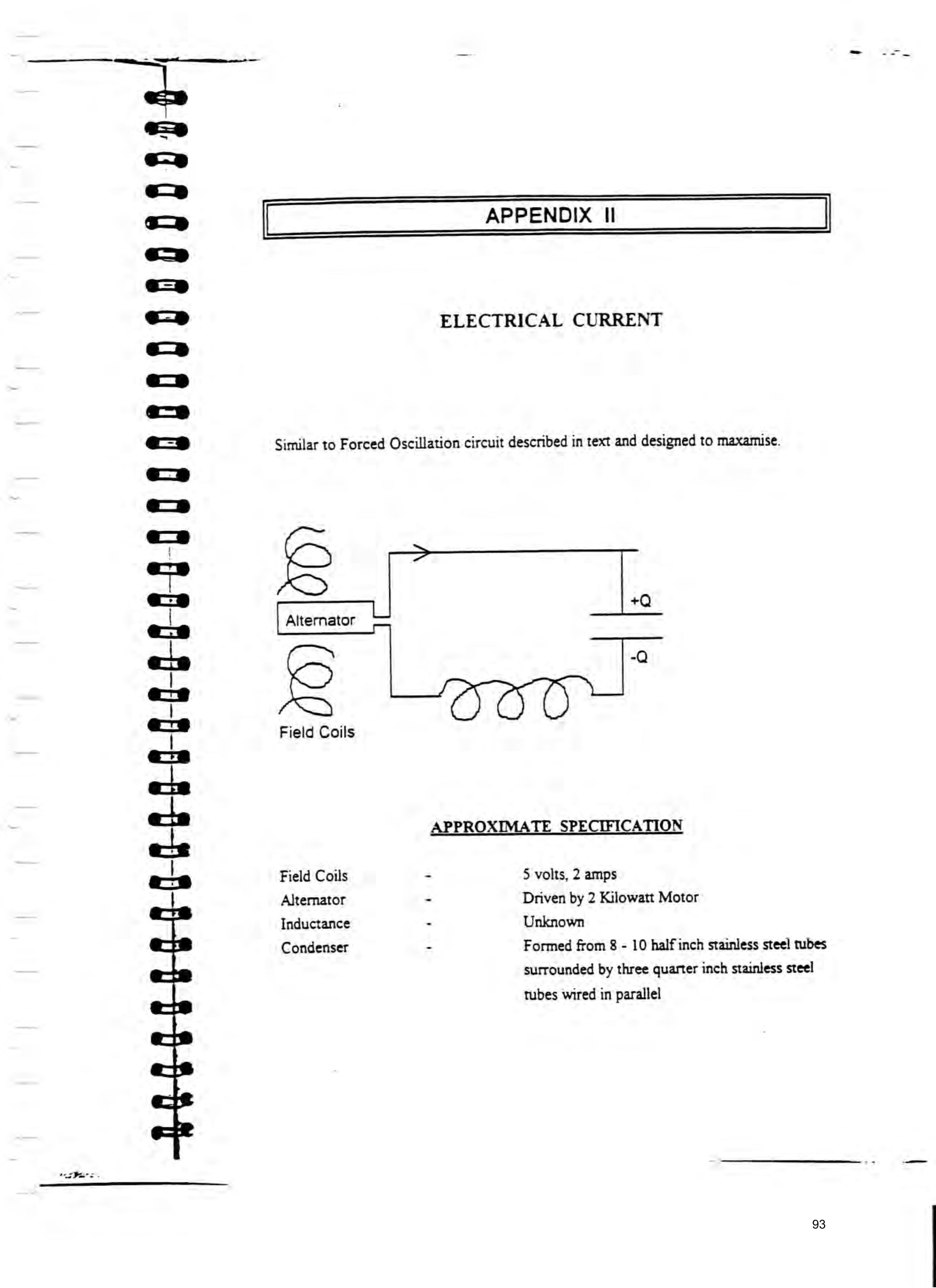
classical forced oscillation circuit where charge q can go to infinity. (See Appendix II).
The power to this circuit is coming from an alternator which is across a stainless steel capacitor with water between its plates. The dielectric water itself provides the charge to charge up the capacitor and create the high voltage. This charge comes from the hydrogen and hydroxyl ions. The more charge that flows the more the voltage builds up and the more ions are pulled out of solution. The circuit has a high frequency of the order of five kilohertz superimposed through the windings of the field coils. In
addition the circuit is half-wave rectified to allow the capacitor to discharge.
Page 84
CCCUUCUUUOU Udo aod
UCCCCCR TCC eD
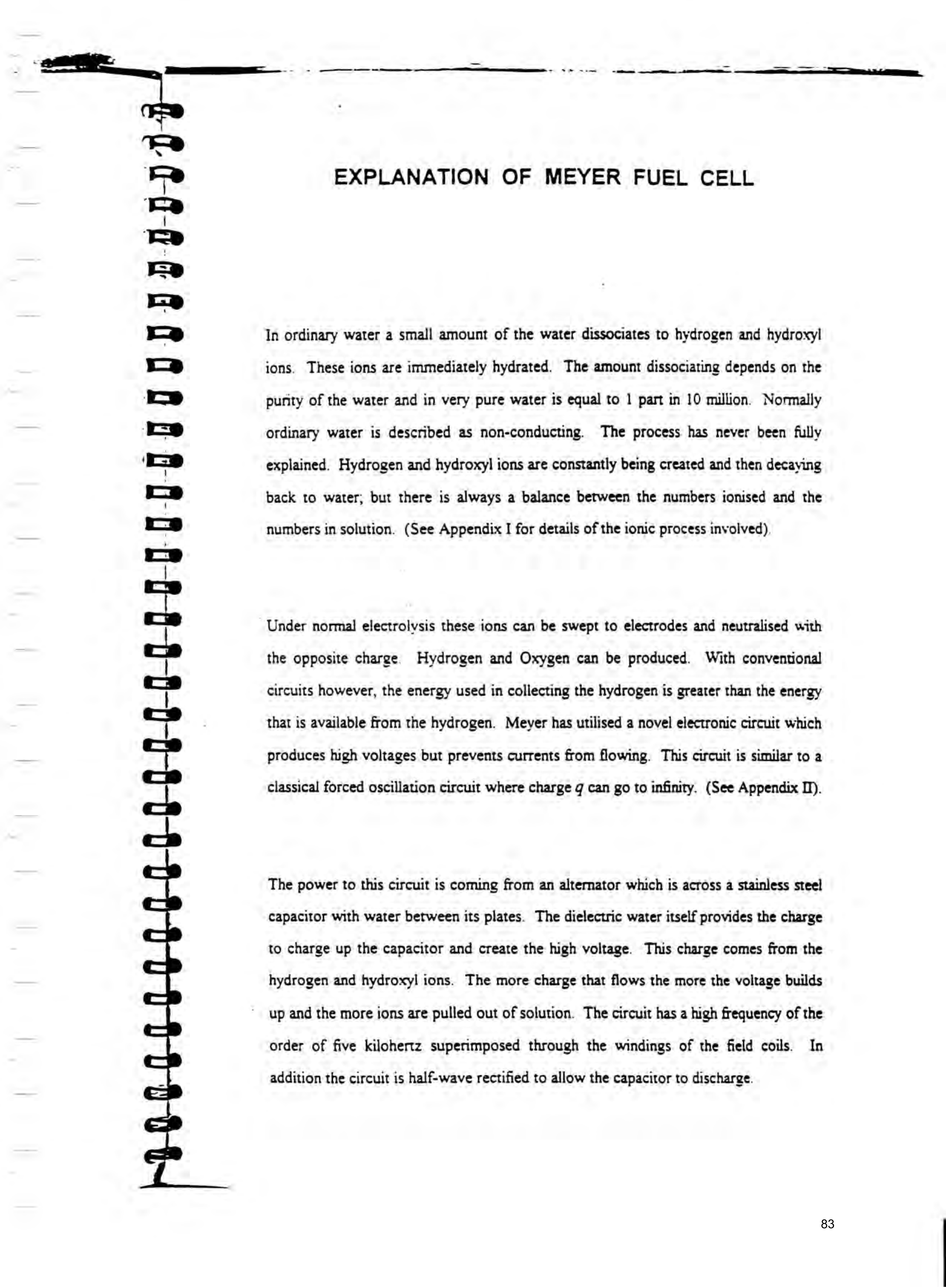
On the charging up side the ions are pulled out of the dielectric and moved towards the metal electrodes. On the discharging side they may go back into solution. The circuit
succeeds in increasing briefly the number of ions which are out of solution.
A portion of these ions are able to form hydrogen and oxygen by normal electrolysis type processes. The hydrogen and oxygen bubble to the surface. The circuit is novel in that it is a form of electroyisis but there is no need for any nett current to flow. While the voltage applied is zero the ionised charges are able to recombine without
flowing around the circuit and using energy.
Theoretically there is no reason why the process cannot be totally efficient in producing hydrogen and oxygen. The efficiency depends on the tuning frequency of the LC circuit and having this balanced with the mobility of the ions and the spacing
between the plates. There may also be a need to allow a definite relaxation time after
Page 85
GCCUCCCCOCCCUORRT UD D Dao:
each pulse, to incrase the period B to C in which the ionised charges may recombine
and hydrogen and oxygen may be collected.
The process does not defy the laws of thermodynamics in that the energy comes from the energy of dissociation of the molecules. A portion of the molecules are dissociating and associating automatically all the time. In the normal course of events this does not change the energy of the water. This process interrupts this cycle and
allows a portion to form water in the stable state of H2 and O2
The process is not dissimilar to the vapourisation of water which takes place naturally. The water forms clouds, then rain. Rivers flow and energy is extracted from the rivers. The difference is that it is possible to carry out the cycle under laboratory type
conditions or industrial type conditions and extract the energy in the form of hydrogen
By developing a process to utilise the hydrogen ions directly on formation, a great deal more energy will be available and this is Meyer's intention in terms of adaption of his fuel cell for an ordinary car. In addition he utilises laser light to stimulate the transfer
between energy levels and increase the efficiency of the process.
This process would equally explain the explosions in water performed in the University of Kansas which have been recorded in the literature. Deuterium present in the water will be selected out during the reaction and the water remaining in the condenser will
become deuterium rich which will inhibit the process.
In the process gases absorbed in water are preferentially desorbed. These amount to 3
per cent approximately of water by weight. It is not clear if they play any significant
part in the process. In addition impurities in the water are taken out of the solution.

Page 86
-DOSCTOOOC CODON ORONO DDD DODD
On the basis of the theory proposed, the process could continue indefinitely, the energy effectively coming from the zero point energy of vibration of the atoms in the molecule. This is probably assisted by infra red radiation from the surroundings so that the whole device will act as an efficient heat pump. The deuterium vibrations will be similar in frequency to the hydrogen vibrations. Resonance affects between the two vibrations may also contribute to the process. If this is a serious contributor to the process then the water produced from the hydrogen and oxygen will be less likely to produce further energy as the deuterium will have largely been selected out in the total process. There is no reason to believe this is the case and in any event the balance will
be restored by nature mixing the water formed with normal water vapour.
Where does the energy come from?
Effectively the water molecule is marginally unstable in water solution and is constantly
acting as a ‘radioactive’ molecule tossing out H* and OH™ ions. The energy of the
process comes from the formation energy of these ions.

Page 87
SCH Ooo odo
APPENDIX I
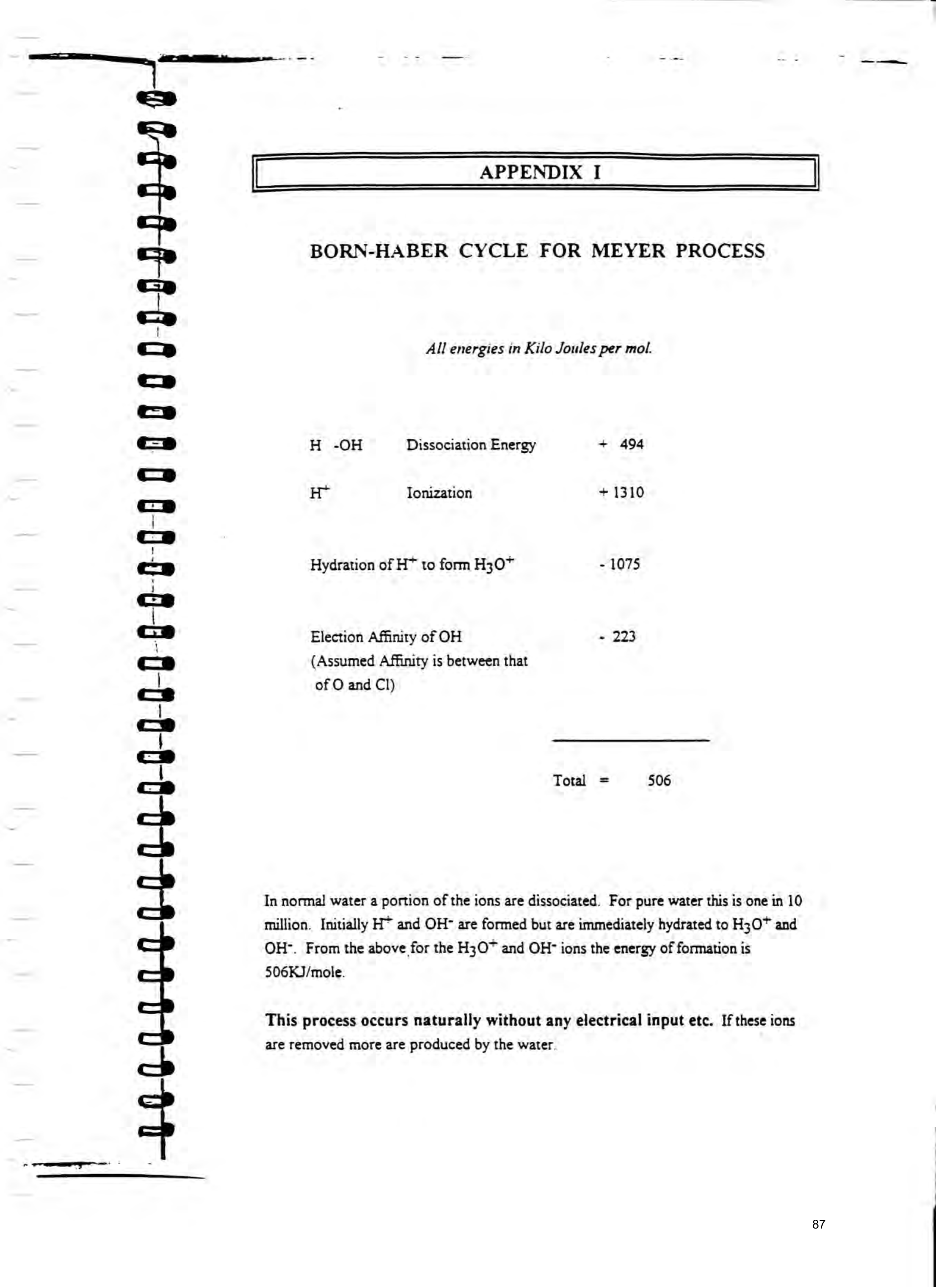
BORN-HABER CYCLE FOR MEYER PROCESS
All energies in Kilo Joules per mol.
H -OH Dissociation Energy + 494
H- Ionization +1310
Hydration of H™ to form H30* - 1075
Election Affinity of OH - 223
(Assumed Affinity is between that of O and Cl)
In norma! water a portion of the ions are dissociated. For pure water this is one in 10 million. Initially H~ and OH™ are formed but are immediately hydrated to H30* and OH-. From the above for the H307* and OH" ions the energy of formation is
This process occurs naturally without any electrical input etc. If these ions are removed more are produced by the water.
Page 88
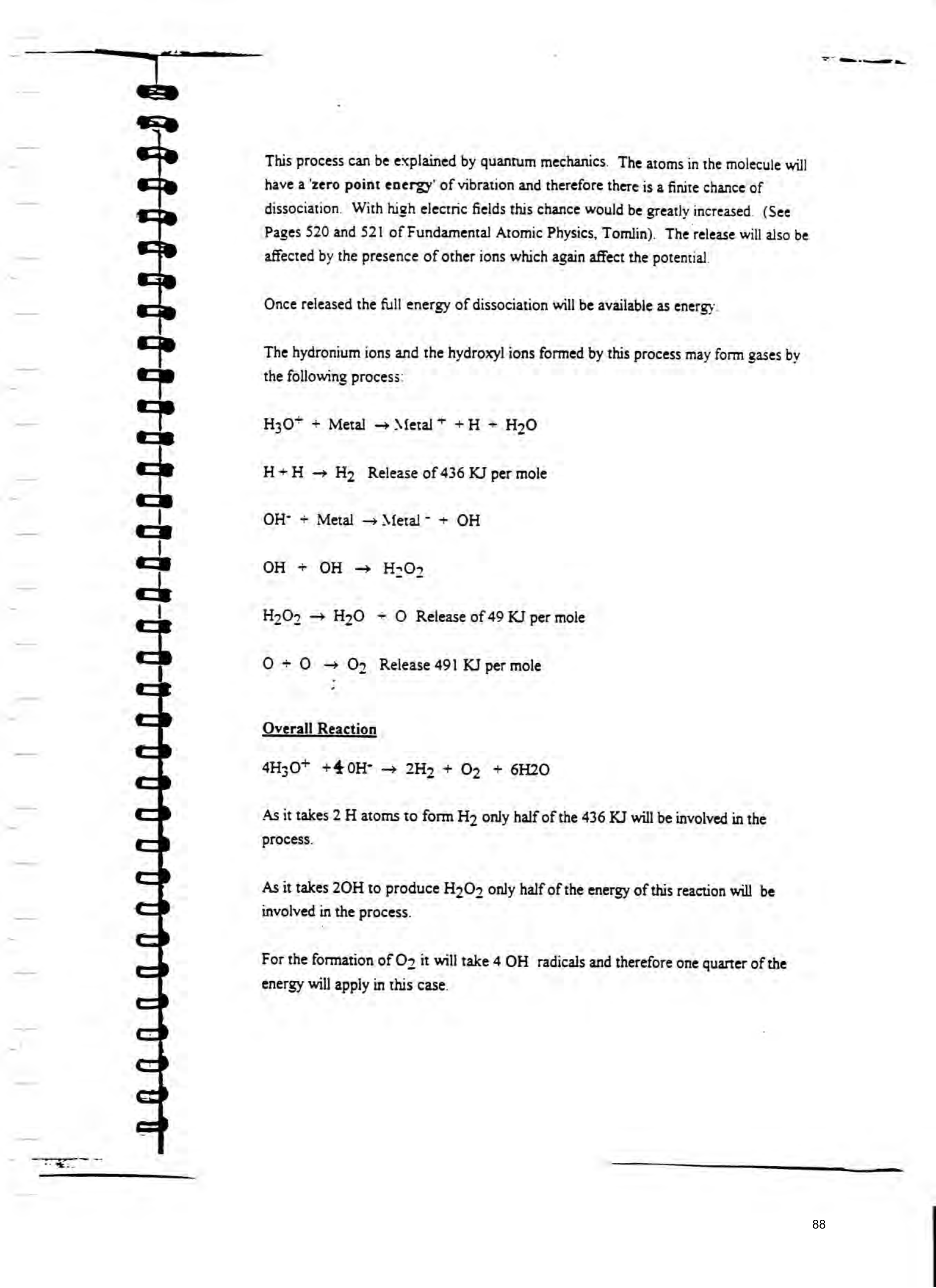
This process can be explained by quantum mechanics. The atoms in the molecule will have a 'zero point energy’ of vibration and therefore there is a finite chance of dissociation. With high electric fields this chance would be greatly increased. (See Pages 520 and 521 of Fundamental Atomic Physics, Tomlin). The release will also be affected by the presence of other ions which again affect the potential
Once released the full energy of dissociation will be available as energy
The hydronium ions and the hydroxyl ions formed by this process may form gases by the following process:
H+H — H> Release of 436 KJ per mole
OH- + Metal — Meral- + OH
H202 — H20 ~ O Release of 49 KJ per mole
O+0O -— O2 Release 491 KJ per mole
Overall Reaction
As it takes 2 H atoms to form H? only half of the 436 KJ will be involved in the process.
As it takes 20H to produce H30> only half of the energy of this reaction will be involved in the process.
For the formation of O2 it will take 4 OH radicals and therefore one quarter of the energy will apply in this case.
Page 89
COCCCCOC ROO OO ea oo
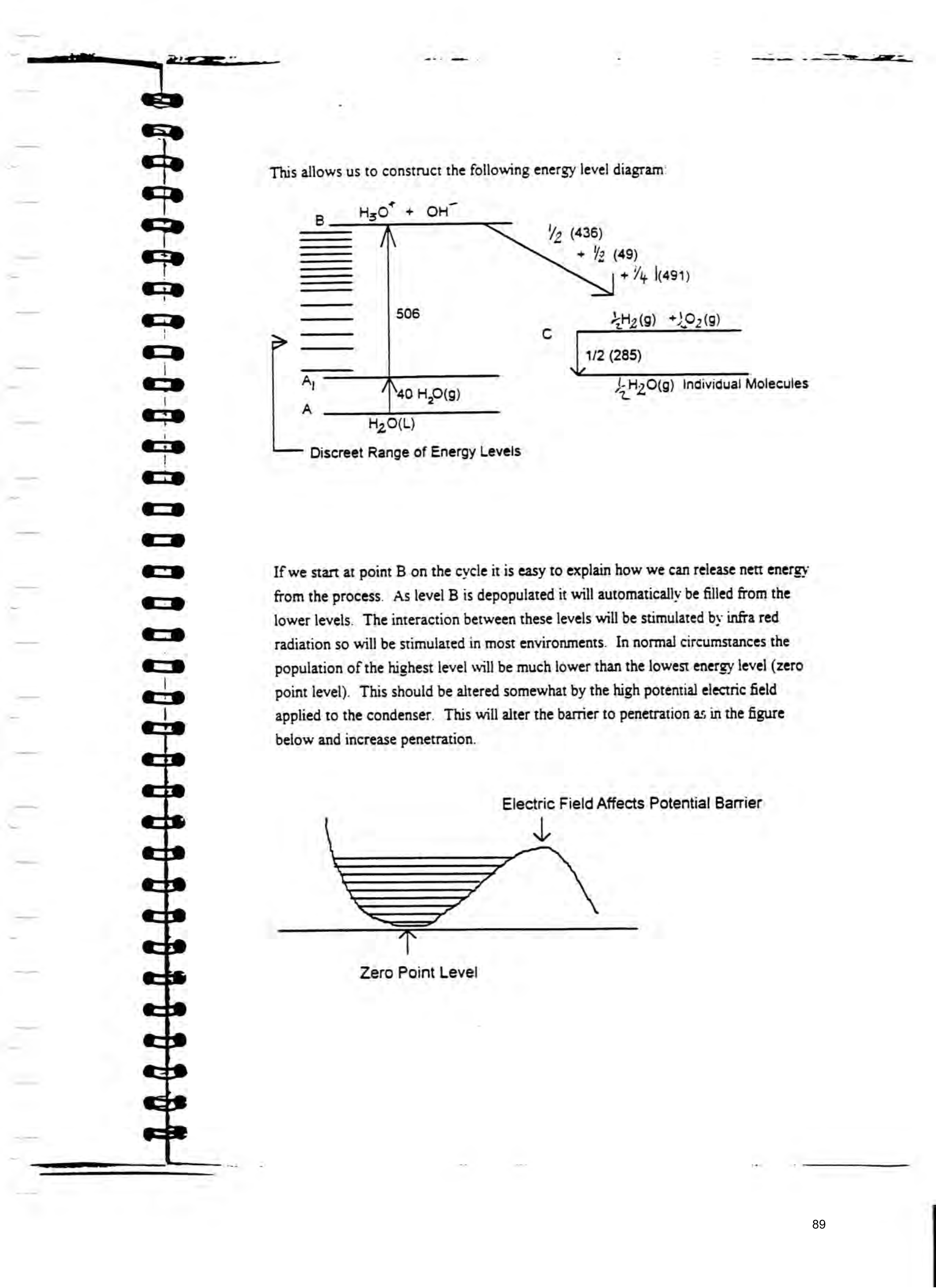
This allows us to construct the following energy level diagram:
5 40 H,0(g) aH20(9) Individual Molecules
—— Discreet Range of Energy Levels
If we start at point B on the cycle it is easy to explain how we can release nett energy from the process. As level B is depopulated it will automatically be filled from the lower levels. The interaction between these levels will be stimulated by infra red radiation so will be stimulated in most environments. In normal circumstances the population of the highest level will be much lower than the lowest energy level (zero point level). This should be altered somewhat by the high potential electric field applied to the condenser. This will alter the barrier to penetration as in the figure below and increase penetration.
Electric Field Affects Potential Barrier
Zero Point Level
Page 90
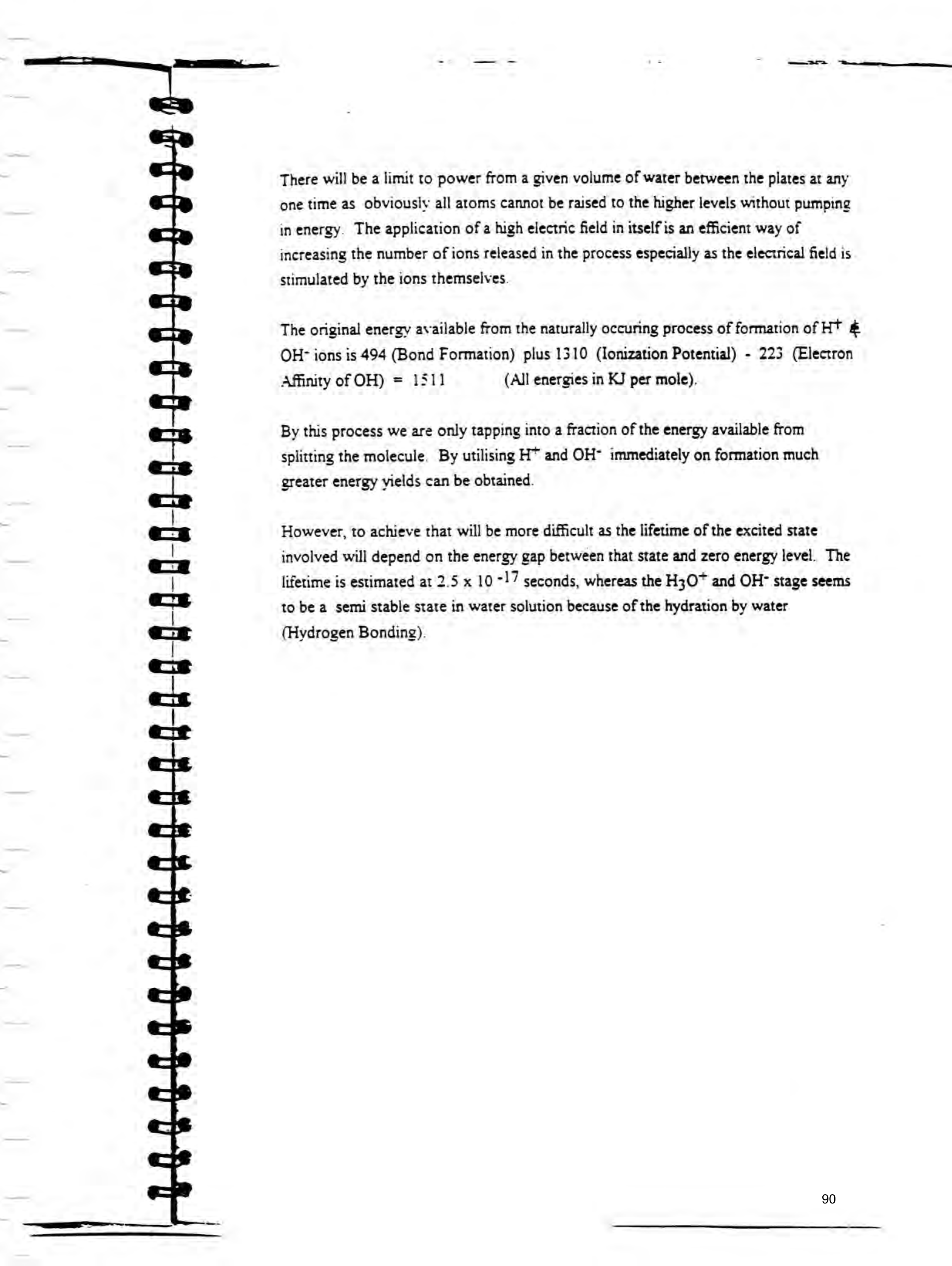
There will be a limit to power from a given volume of water between the plates at any one time as obviously all atoms cannot be raised to the higher levels without pumping in energy. The application of a high electric field in itself is an efficient way of increasing the number of ions released in the process especially as the electrical field is stimulated by the ions themselves.
The original energy available from the naturally occuring process of formation of Ht & OH- ions is 494 (Bond Formation) plus 1310 (Ionization Potential) - 223 (Electron Affinity of OH) = 1311 (All energies in KJ per mole).
By this process we are only tapping into a fraction of the energy available from splitting the molecule, By utilising H~ and OH immediately on formation much greater energy yields can be obtained.
However, to achieve that will be more difficult as the lifetime of the excited state involved will depend on the energy gap between that state and zero energy level. The lifetime is estimated at 2.5 x 10 -!7 seconds, whereas the H3O* and OH" stage seems to be a semi stable state in water solution because of the hydration by water (Hydrogen Bonding).
Page 91
HHH obo bbe e
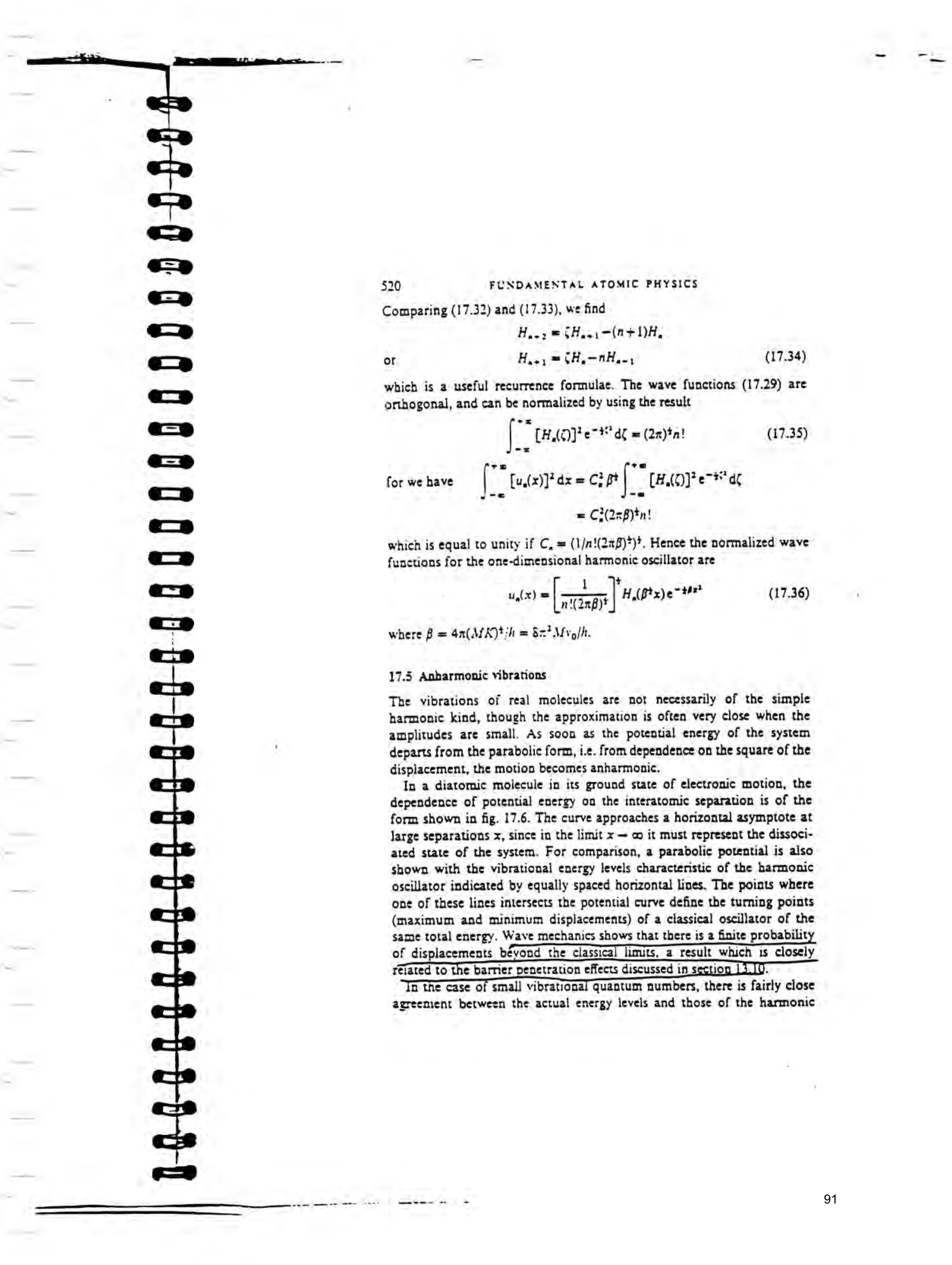
520 FUNDAMENTAL ATOMIC PHYSICS
which is a useful recurrence formulae. The wave functions (17.29) are orthogonal, and can be normalized by using the result
which is equal to unity if C, = (1/m!(27B)*)*. Hence the normalized wave functions for the one-dimensional harmonic oscillator are
17.5 Anbarmonic vibrations
The vibrations of real molecules are not necessarily of the simple harmonic kind, though the approximation is often very close when the amplitudes are small. As soon as the potential energy of the system departs from the parabolic form, i.e. from dependence on the square of the displacement, the motion becomes anharmonic.
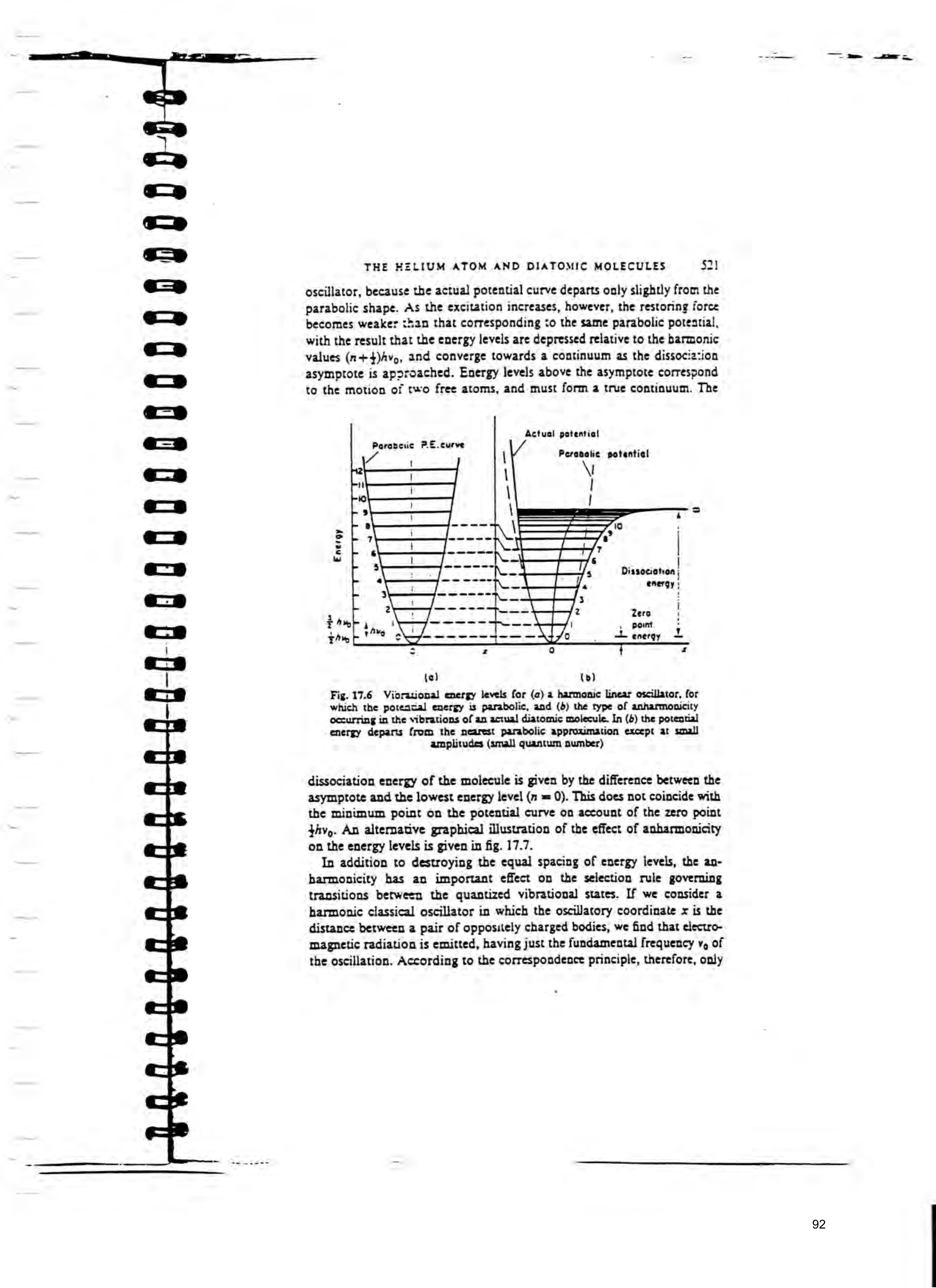
In a diatomic molecule in its ground state of electronic motion, the dependence of potential energy on the interatomic separation is of the form shown in fig. 17.6. The curve approaches a horizontal asymptote at large separations x, since in the limit x — oo it must represent the dissociated state of the system. For comparison, a parabolic potential is also shown with the vibrational energy levels characteristic of the harmonic oscillator indicated by equally spaced horizontal lines. The points where one of these lines intersects the potential curve define the turning points (maximum and minimum displacements) of a classical oscillator of the same total energy. Wave mechanics shows that there is 2 finite probability of displacements beyond the classical limits. a result which is closely
related to the barnier penetration effects discussed in section 13.10. To the case of small vibrational quantum numbers, there is fairly close agreement between the actual energy levels and those of the harmonic
Page 92
AO OOOO o ooo deeb od:
THE HELIUM ATOM AND DIATOMIC MOLECULES $2)
oscillator, because the actual potential curve departs only slightly from the parabolic shape. As the excitation increases, however, the restoring force becomes weaker than that corresponding <o the same parabolic potential, with the result that the energy levels are depressed relative to the barmonic values (n+4)Av, and converge towards a continuum as the dissoci2:ion asymptote is aporoached. Energy levels above the asymptote correspond to the motion of two free atoms, and must form a true continuum. The
Actusl potential
Paretcuc PE curve
Percpolic potential
Di ton;
energy ;
i Zero
T% point
Thi energy —
Fig. 17.6 Viorasional energy levels for (a) 2 harmonic Linear oscillator, for
which the potencal energy is parabolic, and (5) the rype of anharmonicity
occurring in the vibrations of an actual di ic molecule. In (6) the p ial
energy departs from the nearest parabolic approximation except at small amplitudes (small quantum oumber)
dissociation energy of the molecule is given by the difference between the asymptote and the lowest energy level (n = 0). This does not coincide with the minimum point on the potential curve on account of the zero point 4hyp. An alternative graphical illustration of the effect of anharmonicity on the energy levels is given in fig. 17.7.
In addition to destroying the equal spacing of energy levels, the anharmonicity has an important effect on the selection rule governing transitions between the quantized vibrational states. If we consider a harmonic classical oscillator in which the oscillatory coordinate x is the distance between a pair of oppositely charged bodies, we find that electromagnetic radiation is emitted, having just the fundamental frequency v, of the oscillation. According to the correspondence principle, therefore, only
Page 93
| APPENDIX Il
ELECTRICAL CURRENT
Similar to Forced Oscillation circuit described in text and designed to maxamuse. Alternator —
Field Coils
Field Coils
Alternator
Inductance
Condenser
SACO OO dood dead bee +s Pans -
APPROXIMATE SPECIFICATION
- 5 volts, 2 amps - Driven by 2 Kilowatt Motor - Unknown - Formed from 8 - 10 half inch stainless steel tubes surrounded by three quarter inch stainless steel tubes wired in parallel
Page 94
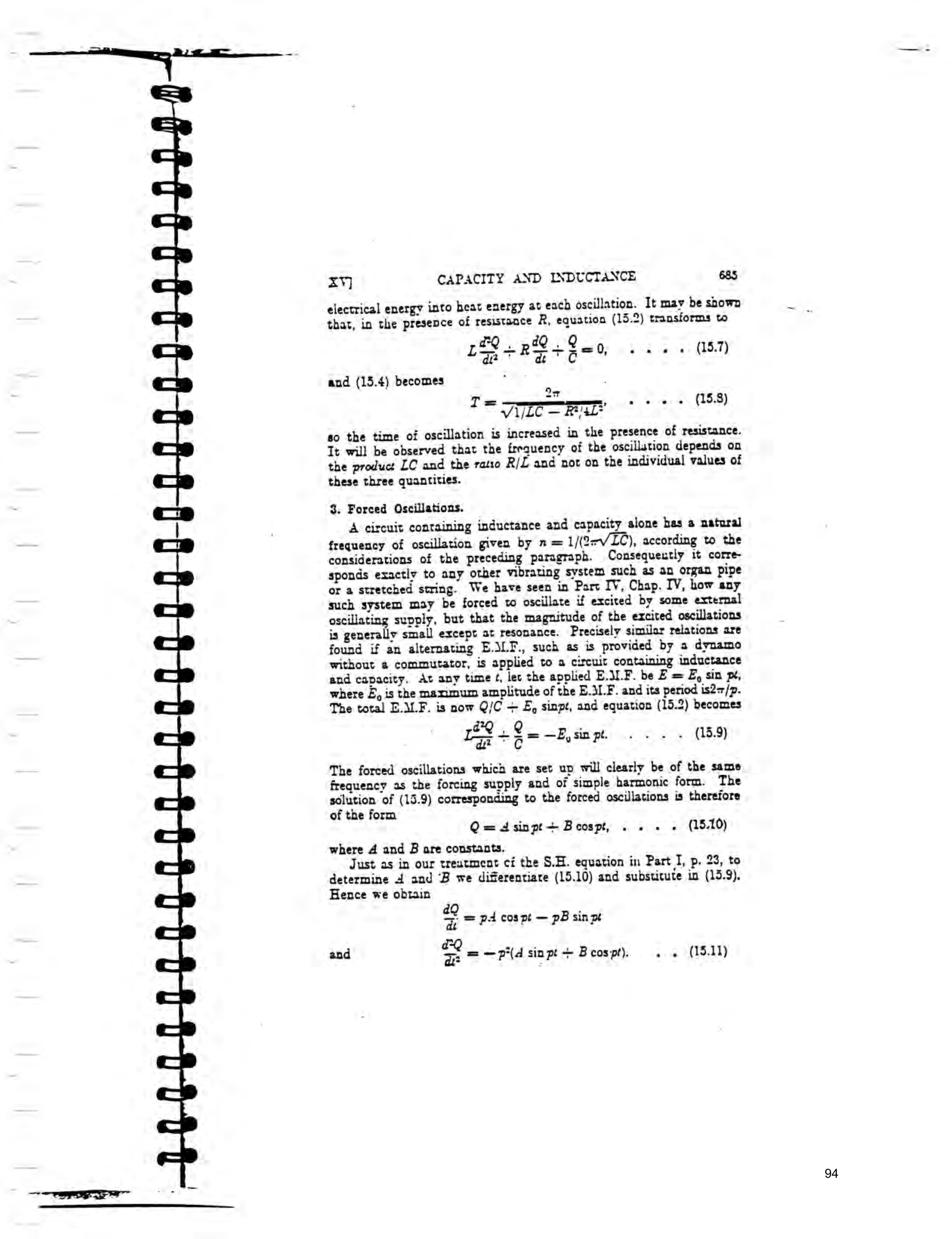
xv) CAPACITY AND INDUCTANCE 685
electrical energy into heat energy at each oscillation. It mav be shown that, in the presence of resistance R, equation (15.2) transforms to
and (15.4) becomes A 2
so the time of oscillation is increased in the presence of resistance. It will be observed that the frequency of the oscillution depends on the produc LC and the ratio R/L and not on the individual values of these three quantities.
8. Forced Oscillations.
A circuit containing inductance and capacity alone bas 3 natural frequency of oscillation given by n= 1/(2-VIC), according to the considerations of the preceding paragraph. Consequeutly it corresponds exactly to any other vibrating system such as an organ pipe or a stretched string. We have seen in Part IV, Chap. IV, how any such system may be forced to oscillate if excited by some external oscillating supply, but that the magnitude of the excited oscillations is generally small except at resonance. Precisely similar relations are found if an alternating E.\LT., such as is provided by a dynamo without a commutator, is applied to a circuit containing inductance and capacity, At any time ¢, lec the applied E.MF. be E=E, sin pt, where E, is the mammum amplitude of the E.3I.F. and its period is2=7/p. The total E.MWF. is now Q/C — E£, sinpt, and equation (15.2) becomes
The forced oscillations which are set up will clearly be of the same frequency as the forcing supply and of simple harmonic form. The solution of (15.9) corresponding to the forced oscillations is therefore of the form
where 4 and B are constants.
Just as in our treatment ci the S.H. equation in Part I, p. 23, to determine and ‘B we diferentiate (15.10) and substitute in (15.9). Hence we obtain
= = pd cospt — pB sina
Page 95
See eee eee ere LEP ere Te eer ee
656 ELECTRICAL OSCILLATIONS [CRar.
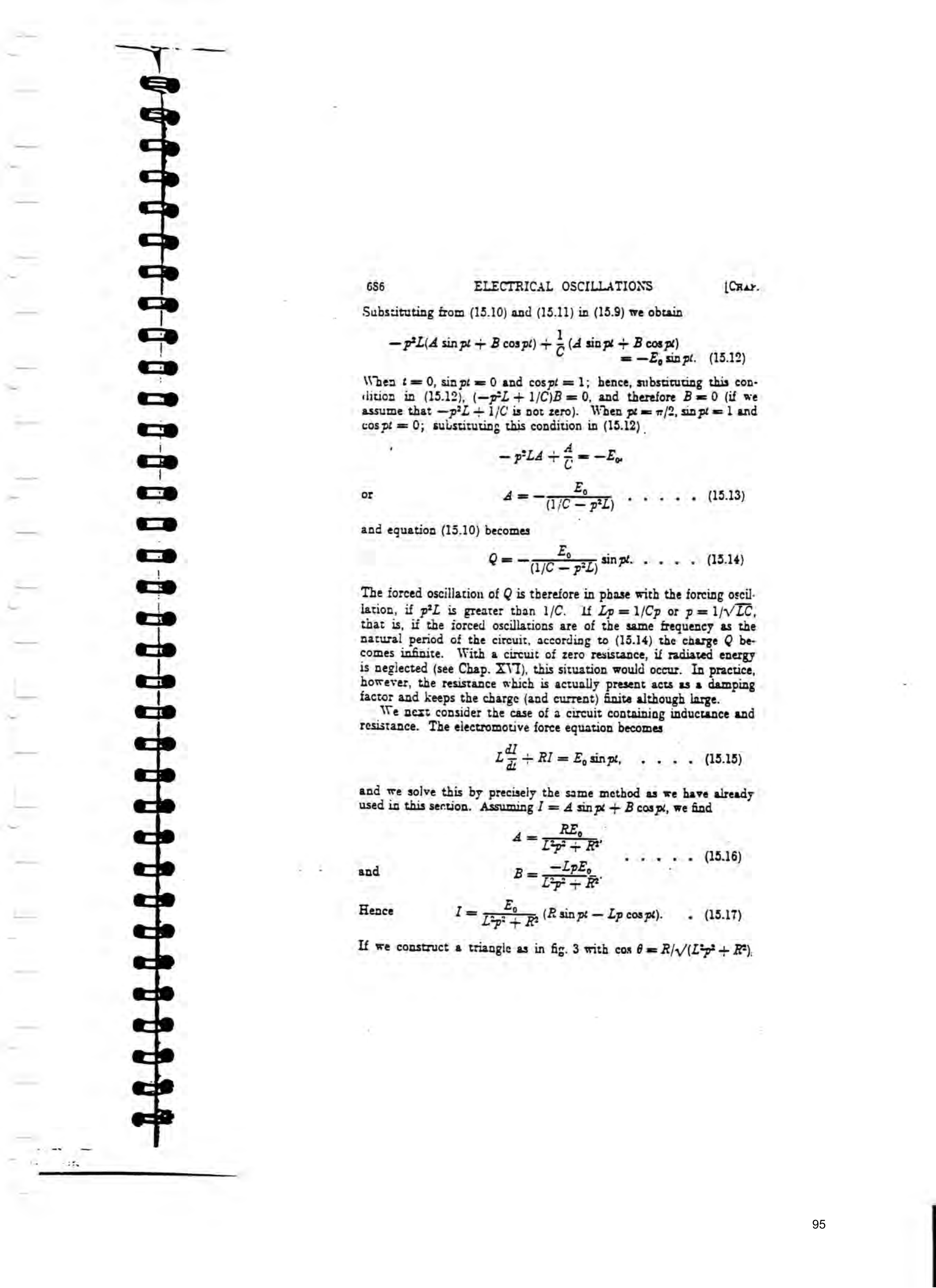
Substituting fom (15.10) and (15.11) in (15.9) we obtain
—pLl(A sinpt + Bcospt) + = (d sinpt + Bcosp)
When t= 0, sinpt = 0 and cospf = 1; hence, substituting this con-
assume that —p*2 + 1/C' is not zero). When ptm n/2, snpi=1 and cospt = 0; substituting this condition in (15.12).
and equation (15.10) becomes
The forced oscillation of Q is therefore in phase with the forcing oscillation, if pL is greater than 1/C. Lf Lp =1/Cp or p=1/V/IC, that is, if the orced oscillations are of the same frequency as the natural period of the circuit, according to (15.14) the charge Q becomes infinite. With a circuit of zero resistance, if radiated energy is neglected (see Chap. XVT), this situation would occur. In practice, however, the resistance which is actually present acts as a damping factor and keeps the charge (and current) finite although large.
We next consider the case of a circuit containing inductance and resistance. The electromotive force equation becomes
and we solve this by precisely the same method as we have already used in this section. Assuming J = 4 sinpt + Bcospi, we find
Hence I =
If we construct @ triangle as in fig. 3 with con @ = R/s/(L*p* + FP),
Provenance
- Pages
- pages 81–95 of 140
- Binder
- WFC Project Binder 423-DA
- Method
- pdftoppm 300dpi + tesseract 5 (eng), orientation-corrected
- Source
- WFC International Independent Test-Evaluation Report (1995), scanned binder
- Attribution
- Dublin Institute of Technology
- Reproduced material
- Reproduced inside Meyer's 1995 report as bound; copyright is the original author's.