How to Build a Jet Engine
Started by Aaron · · 11 posts · last reply 24 December 2011
-
#1 ·

How to Build a Jet Engine
This is a video package showing how I built a turbojet
engine based on Michael John Nunnerley's specs. This
is the same type of jet engine he powered with the ammonia
on demand water fuel concept.
Purchasing the package from the link above or by clicking on that
banner supports Energetic Forum.
Also, proceeds from this package will be donated to Michael John
Nunnerley's son's recovery fund - or you can make a donation directly
on the website linked to above through paypal.
Michael's son was hit by a car and was in a coma and suffered
severe brain swelling, etc... he is now out of intensive care but
has a severe amount of recovery to go through.
Anyway, you can learn more about this jet engine on the
How to Build a Jet Engine page. How to Build a Jet Engine
If you want to see the inspiration of this jet, read the
Ionization & Water Fuel thread in this forum. -
#2 ·
-
#3 ·
Just ad some water
Hi Aaron & Michael,
Maybe a idea to ad some water, google on: Emulsified fuel
waterinfuelblends - braxpeace2
Rudolf Gunnerman: Water-Alcohol-Fuel Emulsion for IC engines: 25% + mpg. 2 Articles & patents
Is working in: Diesel-Engine look: OostromTechnicsSL's Channel - YouTube
This Engine is: Mitsubishi S6, 6 cilinder and 5 ltr.
Also tested in: Jets and (home) Heating, oil or gas.
Thanks for your attention in advance!
Kind regards,
Johan Oostrom
Skype: johan_1955
Oostrom Technics -
#4 ·
What sort of power out will it give for various fuel input conditions? -
A little explination of events
Hi All and thank you Aaron for all you are doing
Aaron and I have been working on a complete replication of my work that was stopped back in the 1980's. That work as some will know was the breaking of the water molecule and then transformed into another fuel, and used to run a jet turbine.
For the last two months I have not been around as my youngest son was hit by a 3500wt van at a cross road. He has been in a coma for 5 weeks, he was not expected to live in the first week as he had two very big strokes and also showed on cat scans that the base of the brain was very swollen. I have never seen so many machines connected to a person even in films. Well to cut the story short, he came out of the coma at the 5 week period and little by little machines were removed and I have to thank a very dedicated lady doctor for saving his life.
Now after two months he can speak some single words only, he can't move his left leg and his left arm and hand are about 50%, his mental state is of a 7 year old. The hospital where he was can no longer do any more for him, he has had to be moved to another special hospital which is private and very expensive. We are hoping in time the insurance company of the driver of the van that hit him will cover all the costs, but as they are looking at very large cost and damage, they are going to fight and will take up to two years in the court system here in Spain.
Meanwhile the costs have to be met and I have to find the money that is needed on a day to day basis and this is where Aaron came in to help to raise some money which will go into Mark's recuperation fund, All is welcome, even if it is just a few euros. At the time the insurance pays up, this money will go to help him for the rest of his life as it has been explained he will never be the same again. I am nearly 61 years old and I will not be around forever to look after him so I need to leave a good sound base for his future.
Donations can be made using paypal, the paypal e-mail for this is [email protected] please make a reference to Mark's donation fund. I thank you all in advance and thank you all that have already sent donations as they have been coming in the last 24hrs, I want to give you all a big
Aaron has already told you about the videos, all I can say is the combustion chamber and heat converter are designed in a way so as the engine runs at very low RPM of 4000-5000, or can be ramped up to 25000rpm. I can also say that if it is run on an alternative fuel it will run an alternator and power 1.5kw of excess power after the power needed to run the system, this was done in 1989 and demonstrated to a group of people and then I was stopped until now.
Please do not ask me a lot of questions as I have very little time at the moment as can be expected, buy the videos and ask me afterwards, I will try to pop in here from time to time to answer questions.
thank you Aaron and all
my best wishes to all
Mike -
#6 ·
how to build a turbojet engine
Wrench76, I moved your post about those other home made jet engines.
This thread is for my engine. I put your post into the turbojet thread
that I started way back that has links to many home made jet engine
sites. -
unknown
#7 ·
When the fuel is a hydroxy mixture with an air intake and the jet turbine is a rather the base of a cylinder to lift water through a closed system fluid generator wheel, would having the density of hydraulic pressure cause any increase in performance? Could the energy present within the fluid shockwave perform work in a more efficient manner? -
#8 ·
@Geotron
Geotron,
I'm not really sure what you're asking in relation to the jet.
There is a disadvantage to the jet and that there is no separate intake
cycle that causes a vacuum cycle to help vaporize what you put into it.
You mentioned "having the density" but having the density what more or
less? -
unknown
#9 ·
It would be a combination of the higher density of fluid with the sudden
impact of igniting hydroxy fuel utilized into driving a hydraulic tubine
generator. The system pictured is only a rough sketch; it would work by
accelerating the turbines alternately with one-way valves allowing flow to
proceed only in a useful way, each tubine only receiving pressure from one
resevoir. There could likely be a way to run the system with only a single
fluid pressure cylinder.
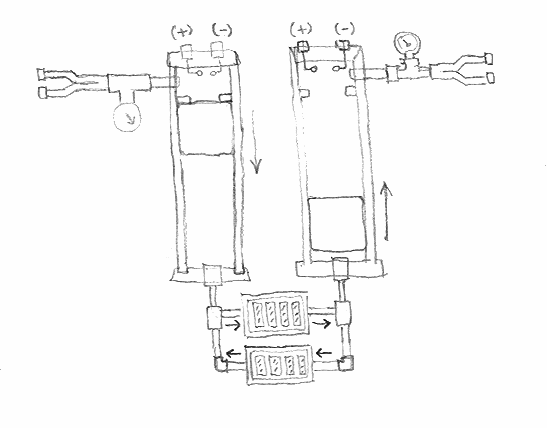
-
#10 ·
@Geotron
Ok, I get the general concept but I think if the "piston"
is pushed down, isn't it supposed to keep a seal so the fluid
doesn't move up into the combustion chamber? If so, it seems
there might be quite a bit of drag on the piston countering the
explosion and don't think it would move much.
At least not with just "hho" from a fuel cell. It was modified
with ionized air that will give a real punch but I still don't think
it would push hard enough long enough.
It would have to be a very short stroke system with that kind
of drag opposing the punch but in any case, at this time, I don't
see this system working in any practical way. Not impossible
I suppose.
If you have an affinity for this concept, I think pushing compressed
air through an air turbine would have less drag that a hydraulic
fluid but it would still be operating in a conventional way and I don't
know what kind of efficiency you can have with this method compared
to conventional generators. Only experiment will tell.
Thanks for sharing your idea! -
unknown
#11 ·
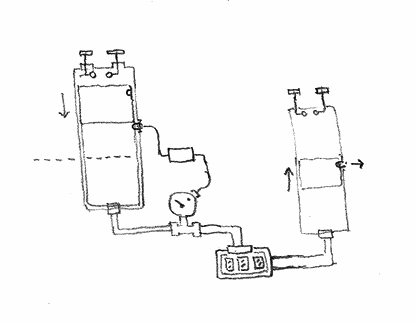
Countering the initial propulsive energy, the fluid then returns
it in the opposite direction from where it ought to end up. The
turbine would not spin and the transfer of energy would be to lift
the device by inertia.
What if the cylinder was given a notch onto which the
piston would latch until being released by a sensor?
Sign in to reply, or ask for an account.