patent · US4057479
Solid polymer electrolyte cell construction
8 November 1977
Page 1 — bibliographic record
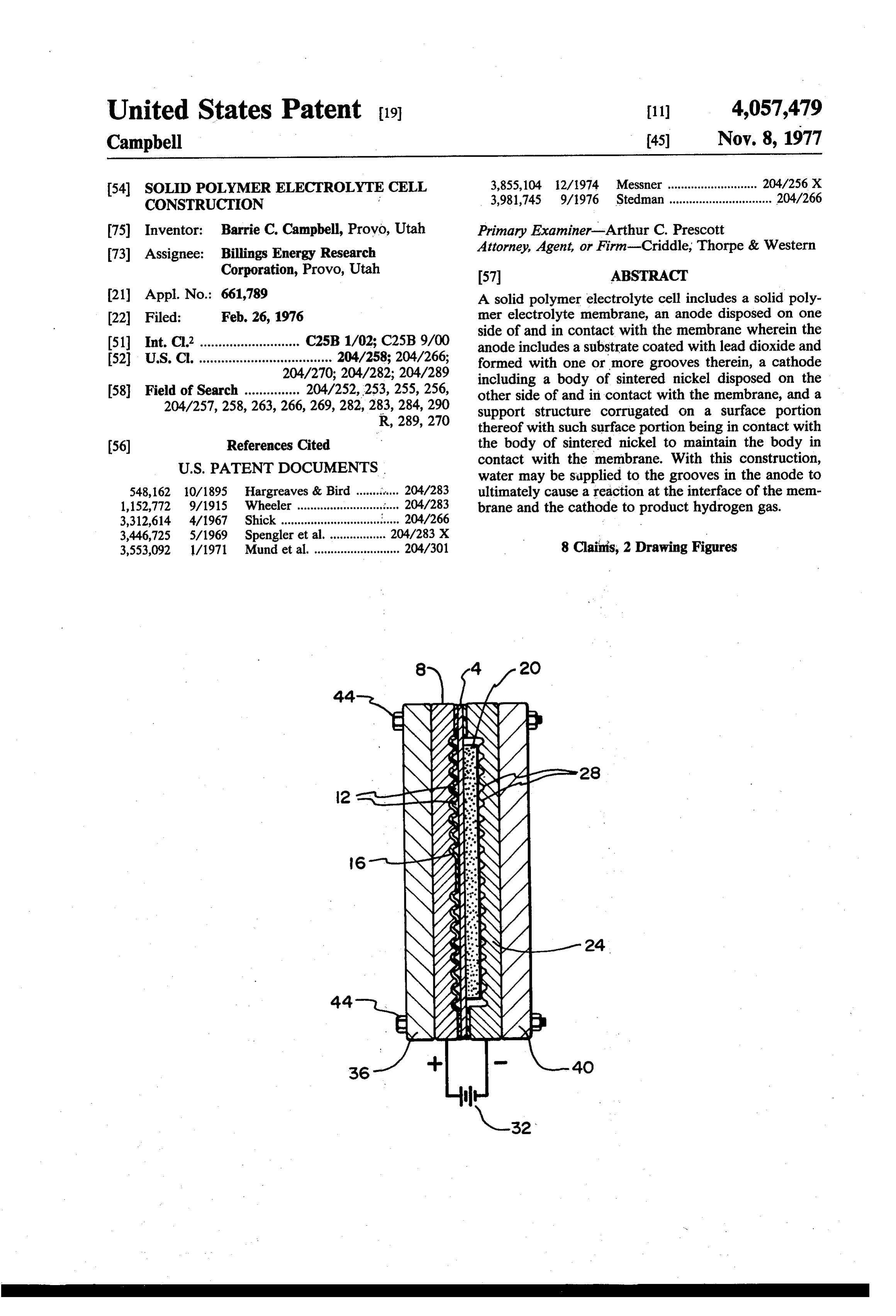
United States Patent (19) 11) 4,057,479 Campbell 45) Nov. 8, 1977 54). SOLID POLYMERELECTROLYTE CELL 3,855,104 12/1974 Messner ........................... 204/256 X CONSTRUCTION 3,981,745 9/1976 Stedman ............................... 204/266 75) Inventor: Barrie C. Campbell, Provo, Utah Primary Examiner-Arthur C. Prescott 73) Assignee: Billings Energy Research Attorney, Agent, or Firm-Criddle, Thorpe & Western Corporation, Provo, Utah 57 ABSTRACT 21 Appl. No.: 661,789 A solid polymer electrolyte cell includes a solid poly (22) Filed: Feb. 26, 1976 mer electrolyte membrane, an anode disposed on one side of and in contact with the membrane wherein the : s w0 ow. a dow cases:;: anode includes a substrate coated with lead dioxide and U.S. C. .......................3.04/270.s 20472.85.s 204/285 formed with one or more grooves therein, a cathode including a body of sintered nickel disposed on the 58 Field of Search ............... 204/252,253, 255, 256, other side of and in tact with th b d
er side of and in contact with the membrane, and a support structure corrugated on a surface portion ar, y thereof with such surface portion being in contact with (56) References Cited the body of sintered nickel to maintain the body in
O . water may be supplied to the grooves in the anode to 548,162. 10/1895 Hargreaves & Bird ............. 204/283 ultimately cause a reaction at the interface of the mem
y May
Ele iss 3.5.
1CK . . . . . . . . . . . . . . . . . . . . . . . . . . . . . . .
brane and the cathode to product hydrogen gas.
3,446,725 5/1969 Spengler et al... ... 204/283 X 3,553,092 1/1971 Mund et al. .......................... 204/301 8 Claimis, 2 Drawing Figures
36 4O
Page 2
Drawing sheet — no readable text.
Page 3
It is still another object of the present invention, in
SOLID POLYMERELECTROLYTE CELL accordance with one aspect thereof, to provide such a CONSTRUCTION cell having one electrode composed of a substrate coated with lead dioxide and another electrode con
BACKGROUND OF THE INVENTION 5 posed of a body of sintered nickel. The above and other objects of the present invention
This invention relates to a solid polymer electrolyte are realized in a SPE cell having a solid polymer elec cell arrangement, trolyte membrane, a first electrode disposed on one side As a result of recent shortages in hydrocarbon fuels of and in contact with the membrane wherein the elec and the recognition that the supply of such fuels will 10 trode is formed to enable the flow of fluid between the ultimately be exhausted, there has naturally been an electrode and membrane, and a second electrode increased interest in finding and developing alternative formed into a body of sintered material adapted to en fuels. Hydrogen, being one of the most abundant of all able the flow of fluid through the material and disposed elements and being relatively pollution free when on the other side of and in contact with the membrane. burned, is considered one of the more attractive alterna 15 The body of sintered material may either be held in tives to hydrocarbon fuels, and electrolysis is consid place against the membrane by a support structure dis ered one of the more attractive and economically feasi posed in contact with the body or be laminated together ble methods of producing hydrogen. with the membrane. In one specific embodiment of the Prior art electrolytic cells have typically included a 20 invention, a first electrode includes a substrate having container of some type for holding a liquid electrolyte one or more grooves formed therein with the grooved and a pair of electrodes immersed in the electrolyte. portion being coated with lead dioxide, and a second Application of direct current across the electrodes pro electrode includes a body of sintered nickel. The lead duces an electrochemical reaction in which the electro dioxide electrode provides an effective catalyst for the lyte is decomposed into one or more gas products. For decomposition of water at the electrode/membrane example, with an aqueous electrolyte, oxygen and hy 25 interface. Provision of the sintered body electrode facil drogen may be produced. itates good contact between the electrode and the solid Because of the inefficiencies, portability drawbacks, polymer gen to electrolyte membrane and yet allows hydro escape from the interface of the electrode and and maintenance requirements of the liquid electrolyte cells, considerable interest has centered on a fairly new 30 membrane.
technology involving solid polymer electrolytes (SPE). BRIEF DESCRIPTION OF THE DRAWINGS See, for example, "Solid Electrolytes Offer Route to
Hydrogen', Chemical and Engineering News, Aug. 27, ofThe the above and other objects, features and advantages present invention will become apparent from the 1973; "Electrolytic Hydrogen Fuel Production with following detailed description presented in connection Solid Polymer Electrolyte Technology” by W. A. Tit 35 with the accompanying drawings in which: terinton and A. P. Fickett, VIII IECEC Proceedings;
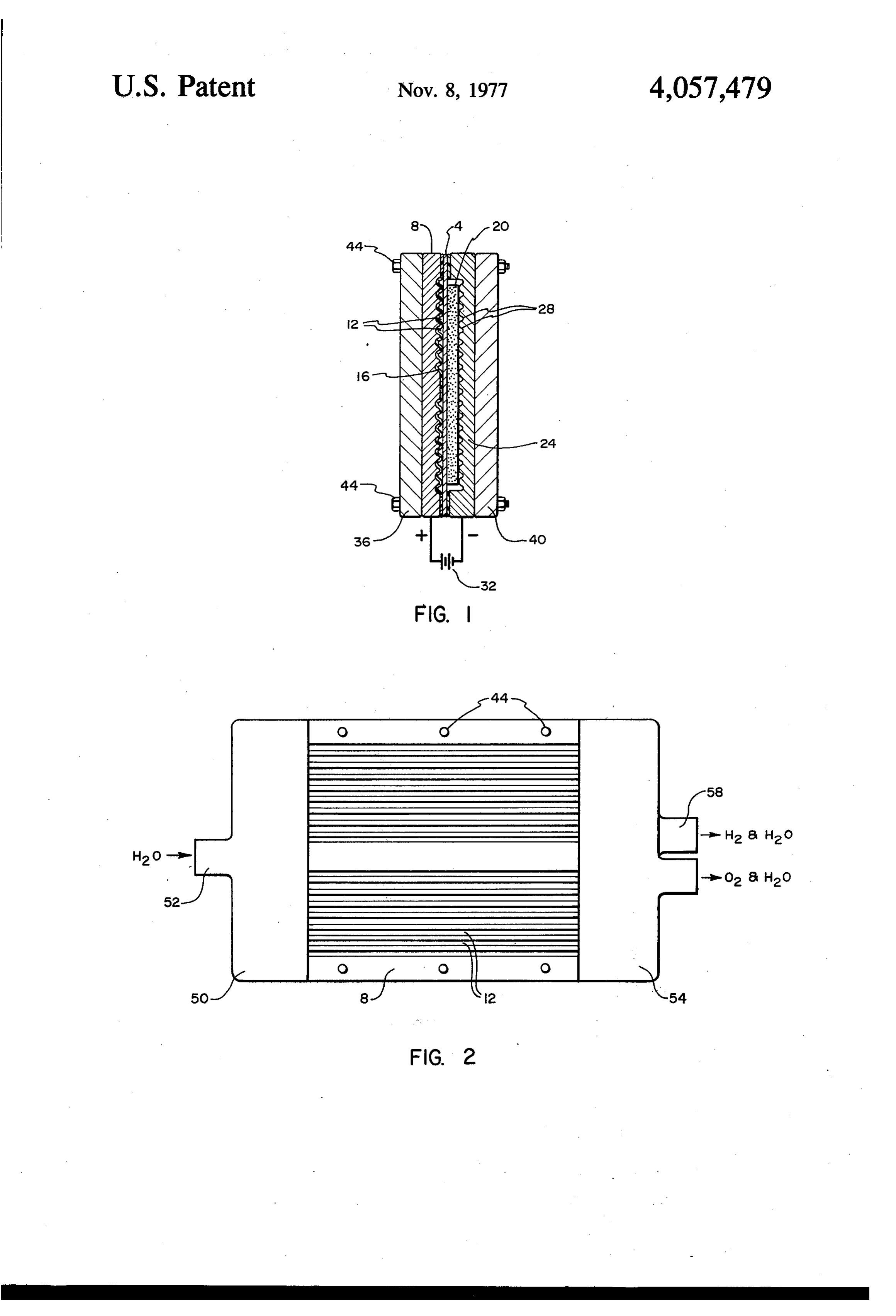
and "A Hydrogen-Energy System', published by polymer electrolyte cell cross-sectional
FIG. 1 shows an end, made in view of a solid accordance with the
American Gas Association, 1973. As described in these principles of the present invention; and references, SPE is typically a solid plastic sheet of per FIG. 2 shows a schematic side view of the cell of fluorinated sulfonic acid polymer which, when satu FIG. 1.
rated with water, becomes an excellent ionic conductor.
The ionic conductivity results from the mobility of the DETAILED DESCRIPTION hydrated hydrogen ions which move through the poly FIG. 1 shows an end, cross-sectional view of a solid mer sheet by passing from one sulfonic acid group to polymer electrolyte cell which includes a solid polymer another. An anode and cathode are positioned on either 45 electrolyte membrane 4, advantageously composed of a side of the sheet and pressed thereagainst to form the perfluorosulfonic acid polymer produced by Du Pont desired SPE cell. and known as "nafion'. The "nafion' membrane is Hydrogen is produced by the SPE cell by supplying described in an article entitled "Nafion, an Electro water to the anode where it is electrochemically de chemical Traffic Controller', by Daniel J. Vaughan, composed to provide oxygen, hydrogen ions, and elec 50 published in DuPont Innovation, Vol. 4, No. 3, Spring, trons. The hydrogen ions move through the SPE sheet 1973.
to the cathode while the electrons pass through the Disposed on one side of and in contact with the mem external circuit. At the cathode, the hydrogen ions and brane 4 is a substrate 8, one side of which includes a the electrons recombine electrochemically to produce plurality of grooves 12. The grooves are formed on the hydrogen gas. 55 side of the substrate 8 which is placed in contact with Although the prior art SPE cell described provides a the membrane 4. The grooved side of the substrate 8 is reliability and efficiency not achieved with the liquid coated with a layer of lead dioxide 16 which serves as electrolyte cell, the cell still requires noble metal cata the anode of the cell. Substrates coated with lead diox lysts and this is quite costly. In addition, cell breakdown ide for use as anodes are produced by Pacific Engineer is more frequent than is desirable. ing and Production Company of Nevada and Sanwa SUMMARY OF THE INVENTION Chemical Company Ltd. of Tokyo, Japan. The pro cesses for producing the lead dioxide anodes are appar
It is an object of the present invention to provide a ently proprietary but the products made by the pro new and less costly SPE cell especially adapted for use cesses are commercially available. Of course, other in producing hydrogen. 65 types of anodic material could be used in the cell con It is another object of the present invention to provide struction of FIG. 1. “. . . such a cell in which at least one electrode of the cell is Disposed on the other side of the membrane 4 and constructed of a body of sintered material. maintained in contact therewith is a body of sintered
Page 4
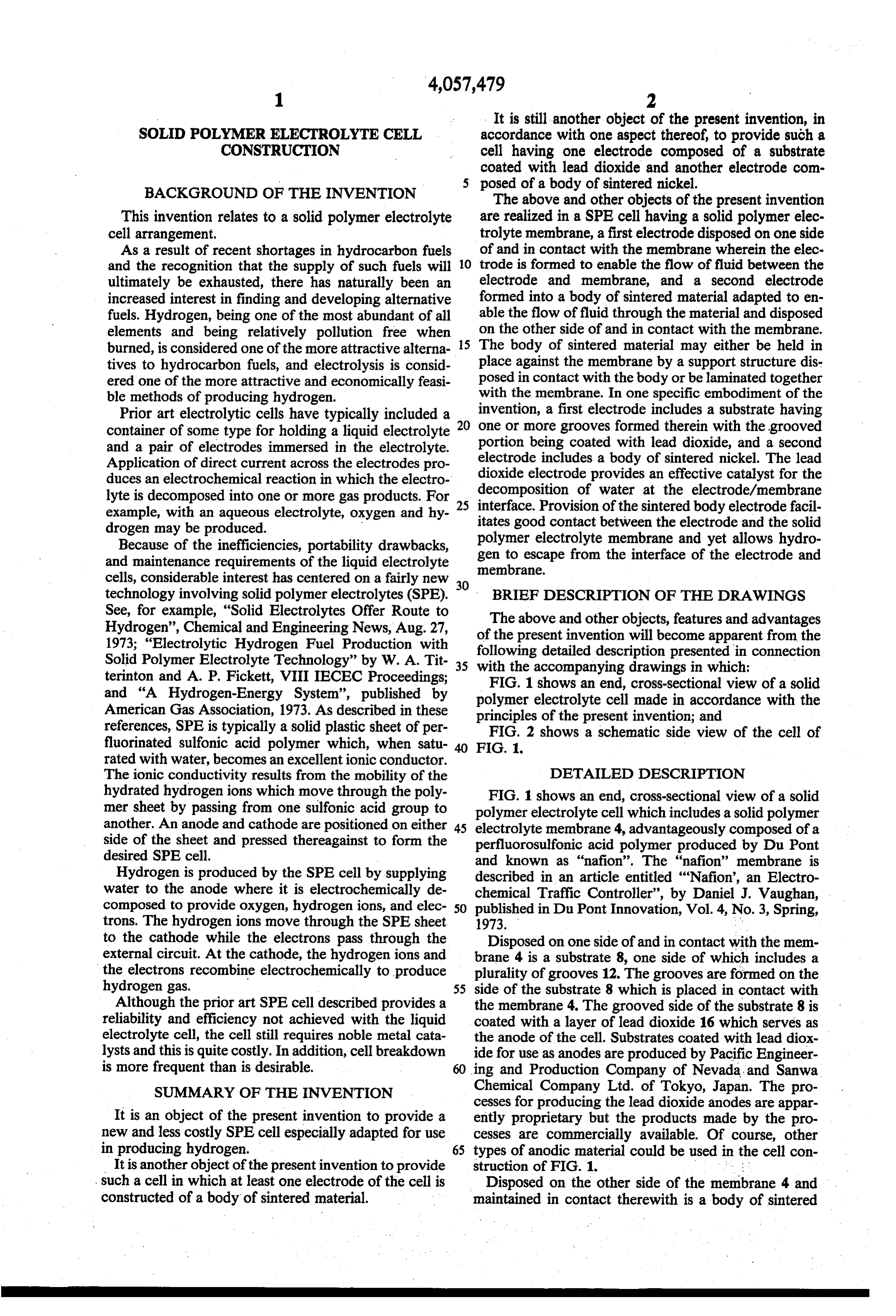
nickel 20. It has been found that sintered nickel having temperatures. With the process described, a sintered a porosity of from 10 microns to 100 microns functions nickel cathode may be securely laminated to the mem suitably and porosities greater or lesser than this range brane to provide a simple cell construction. may also operate respectably. With such porosity, When water is applied to the grooves 12 and a direct water and gases may readily flow through the cathode current to the anode and cathode, hydronium ions body and yet good surface contact may be maintained HO-- are formed at the anode/membrane interface (as between the cathode body and the membrane 4. A sup is oxygen gas) and these hydronium ions are transported port structure 24 is positioned on the side of the cathode through the membrane by passing among sulfonic acid body 20 which is not in contact with the membrane 4 to groups. When the hydronium ions reach the cathode, force the cathode against the membrane. This structure O they combine with free electrons supplied by the cath may be composed of any electrically conductive mate ode to produce water and hydrogen gas. The hydrogen rial and is provided with corrugations or grooves 28 on gas so produced may then be collected for subsequent the side thereof which is in contact with the cathode. Sec.
Provision of the corrugations facilitates the flow of The electrolyte cell construction described provides water and hydrogen gas from the cell as will be dis 15 an inexpensive and yet reliable, and long-lived electrol cussed further momentarily. ysis apparatus. The use of sintered nickel as the cathode A battery or other direct current source 32 is coupled especially facilitates the production and collection of to the substrate 8 and to the support structure 24 to hydrogen gas.
thereby provide current to the lead dioxide anode 16 It is to be understood that the above-described ar and to the sintered nickel cathode 20. 20 rangement is only illustrative of the application of the The membrane 4, substrate 8, sintered nickel body 20 principles of the present invention. Numerous other and support structure 24 are held in place by a pair of modifications and alternative arrangements may be end plates 36 and 40 which, in turn, are held together by devised by those skilled in the art without departing bolts and nuts 44. The end plates 36 and 40 and bolts and from the spirit and scope of the present invention and nuts 44 are insulated from the membrane 4, substrate 8, 25 the appended claims are intended to cover such modifi sintered nickel body 20 and support structure 24. Of cations and arrangements.
course, a variety of arrangements could be employed to What is claimed is:
maintain the cell in the configuration shown in FIG. 1. 1. A solid polymer electrolyte cell comprising FIG. 2 schematically shows a side view of the elec 30 - a solid polymer electrolyte membrane, trolyte cell of FIG. 1. The pattern of the grooves 12 of an anode disposed on one side of and in contact with the substrate 8 are shown to be linear and to extend in a said membrane, said anode including a substrate parallel relationship on the substrate between a pair of coated with lead dioxide and being formed to en manifolds 50 and 54. Manifold 50 is coupled over one able the flow of fluid between the anode and mem end of the cell to communicate with the grooves 12 brane, with the lead dioxide being maintained in formed in the substrate 8. Water is applied to a nozzle 52 35 contact with the membrane, and of the manifold 50 which then guides the water to the a cathode formed of a body of sintered material grooves 12 to flow toward the manifold 54. The mani adapted to enable the flow of fluid therethrough fold 54 is coupled over the other end of the cell to also and disposed on the other side of and in contact communicate with the grooves 12 and to collect water with said membrane.
and oxygen which is produced at the anode/membrane 2. A cell as in claim 1 wherein said body of sintered 4 interface. Another manifold 58 is coupled over one rimaterial is laminated onto said membrane. end of the cell to communicate with the grooves 28 (not 3. A cell as in claim 1 further comprising shown in FIG. 2) and to collect water and hydrogen a support structure disposed in contact with said body which is produced at the cathode/membrane 4 inter 43 of sintered material to maintain the body in contact face. Specific arrangements for applying water to elec trolyte cells and for collecting water and gas products with the membrane, the surface area of the support produced in such cells are described in greater detail in structure which is in contact with said body being
copending application Ser. No. 661,788, filed Feb. 26, 4. A cell as in claim 1 wherein said anode is formed 1976. The specific manner of applying water to the cell with one or more grooves therein facing the membrane, and collecting products produced thereby is not of 50 concern in this application. the grooved bottoms being spaced from the membrane Although the body of sintered nickel 20 is shown in to thereby enable the conveyance of fluid through the FIG. 1 and described as being held in contact with the grooves. 5. A cell as in claim 1 wherein said cathode is com membrane 4 by a support structure 24, an alternative prised of a body of sintered nickel. arrangement would be to laminate the sintered nickel 55 6. A cell as in claim 1 wherein said substrate is com body directly onto the membrane. Then, the support posed of graphite.
structure 24 of FIG. 1 would be unnecessary other than 7. A cell as in claim 1 wherein said membrane is a perhaps to guide the flow of water and hydrogen gas as hereafter described. Sintered nickel may be laminated 60 perfluorosulfonic acid membrane. 8. A cell as in claim 1 further comprising onto a "nafion' membrane simply by placing the mem brane in contact with a body of sintered nickel in a high means for applying water to the grooves in the anode temperature press, and then heating the press to about to flow therethrough 200 C and applying a pressure of about 800 lbs/in2 for means for applying a D.C. current to the cathode and roughly three minutes. The press is then cooled to room anode, and temperature while the pressure is maintained and this 65 means for collecting the products produced at the completes the process. Gasketing may be used to pre interface of the membrane and cathode.
vent dehydration of the membrane at the laminating
Provenance
- Collection
- Cited prior art
- Original PDF
- patentimages.storage.googleapis.com →
- Filed
- 1976-02-26
- Pages
- 4
- Method
- pdftotext (the PDF's own text layer) + pdftoppm 300dpi page scans
- Source
- Google Patents bibliographic record
- Granted
- 1977-11-08
- Inventors
- Barrie C. Campbell; Billings Energy Research Corp
- Transcribed from
- patentimages.storage.googleapis.com →