patent · US20140367269A1
Methods and systems for hydrogen dissociation
18 December 2014
Page 1 — bibliographic record
(19) United States (12) Patent Application Publication (10) Pub. No.: US 2014/0367269 A1
Inskeep (43) Pub. Date: Dec. 18, 2014 (54) METHODS AND SYSTEMS FOR HYDROGEN (52) U.S. Cl.
DISSOCATION CPC. C25B 15/02 (2013.01); C25B I/04 (2013.01) USPC ........................................ 205/335; 204/230.6 (71) Applicant: Charles G. Inskeep. Descanso, CA (US)
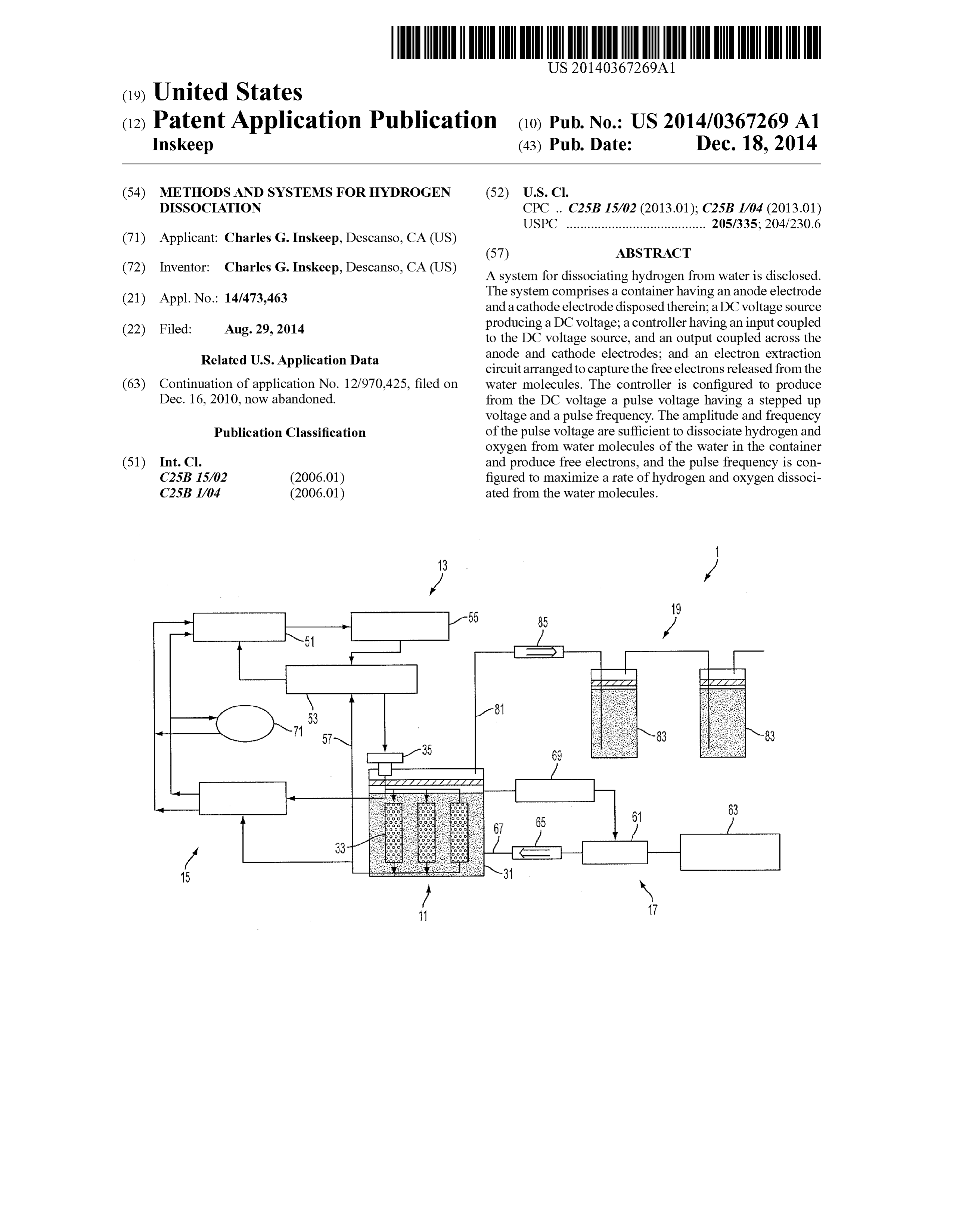
(72) Inventor: Charles G. Inskeep. Descanso, CA (US) A system for dissociating hydrogen from water is disclosed. The system comprises a container having an anode electrode (21) Appl. No.: 14/473,463 and a cathode electrode disposed therein; a DC voltage source 1-1. producing a DC voltage; a controller having an input coupled (22) Filed: Aug. 29, 2014 to the DC voltage source, and an output coupled across the Related U.S. Application Data anode and cathode electrodes; and an electron extraction circuit arranged to capture the free electrons released from the (63) Continuation of application No. 12/970,425, filed on water molecules. The controller is configured to produce Dec. 16, 2010, now abandoned. from the DC voltage a pulse Voltage having a stepped up Voltage and a pulse frequency. The amplitude and frequency
Publication Classification of the pulse Voltage are Sufficient to dissociate hydrogen and oxygen from water molecules of the water in the container (51) Int. Cl. and produce free electrons, and the pulse frequency is con C25B 5/02 (2006.01) figured to maximize a rate of hydrogen and oxygen dissoci C25B I/04 (2006.01) ated from the water molecules.
Page 2
Drawing sheet — no readable text.
Page 3
Drawing sheet — no readable text.
Page 4
Drawing sheet — no readable text.
Page 5
Drawing sheet — no readable text.
Page 6
US 2014/0367269 A1 Dec. 18, 2014
METHODS AND SYSTEMIS FOR HYDROGEN BRIEF DESCRIPTION OF THE DRAWINGS
DISSOCATION
0007. The features and advantages of the invention will be
CROSS-REFERENCE TO RELATED
apparent from the following drawings wherein like reference
APPLICATIONS
numbers generally indicate identical, functionally similar, and/or structurally similar elements.
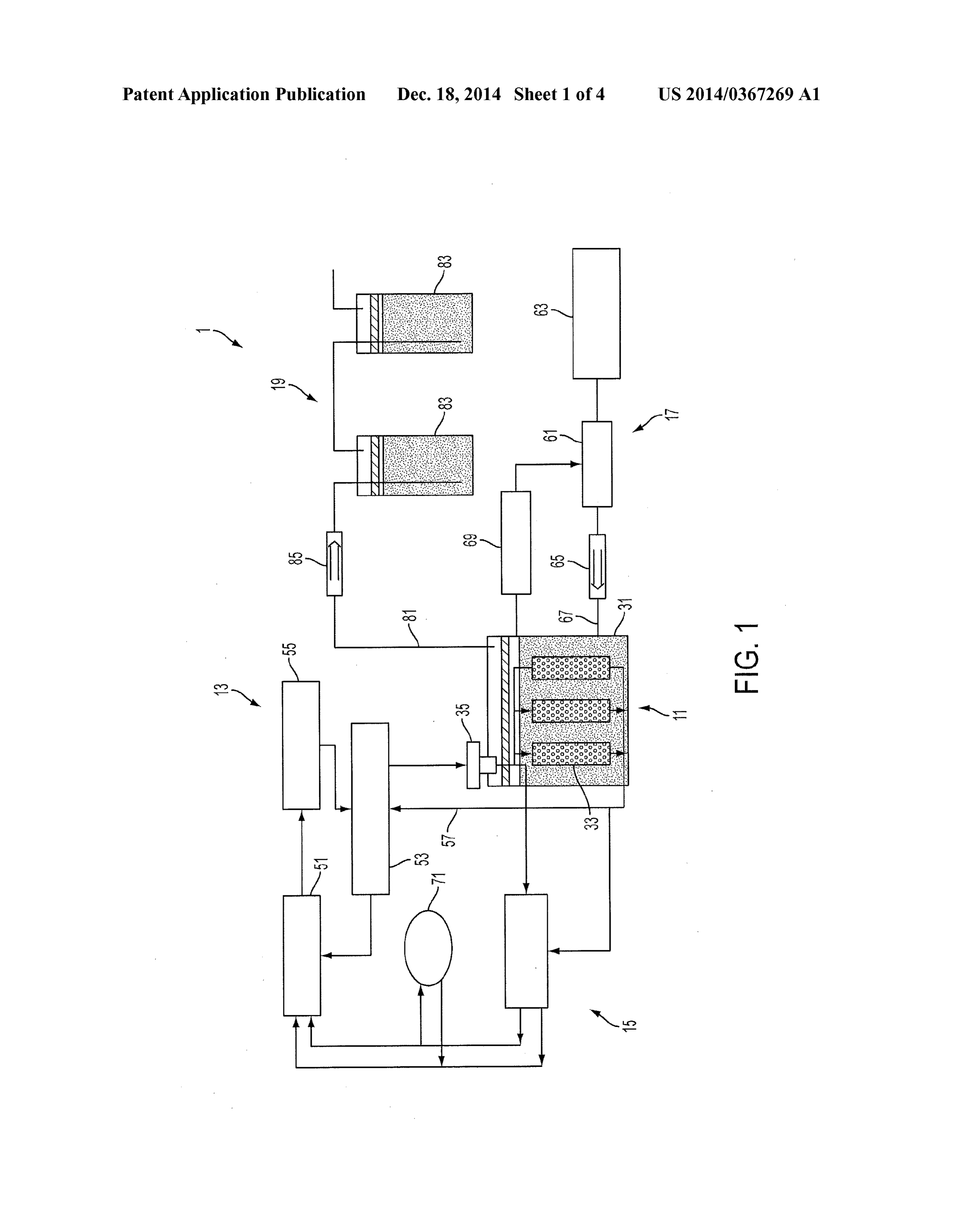
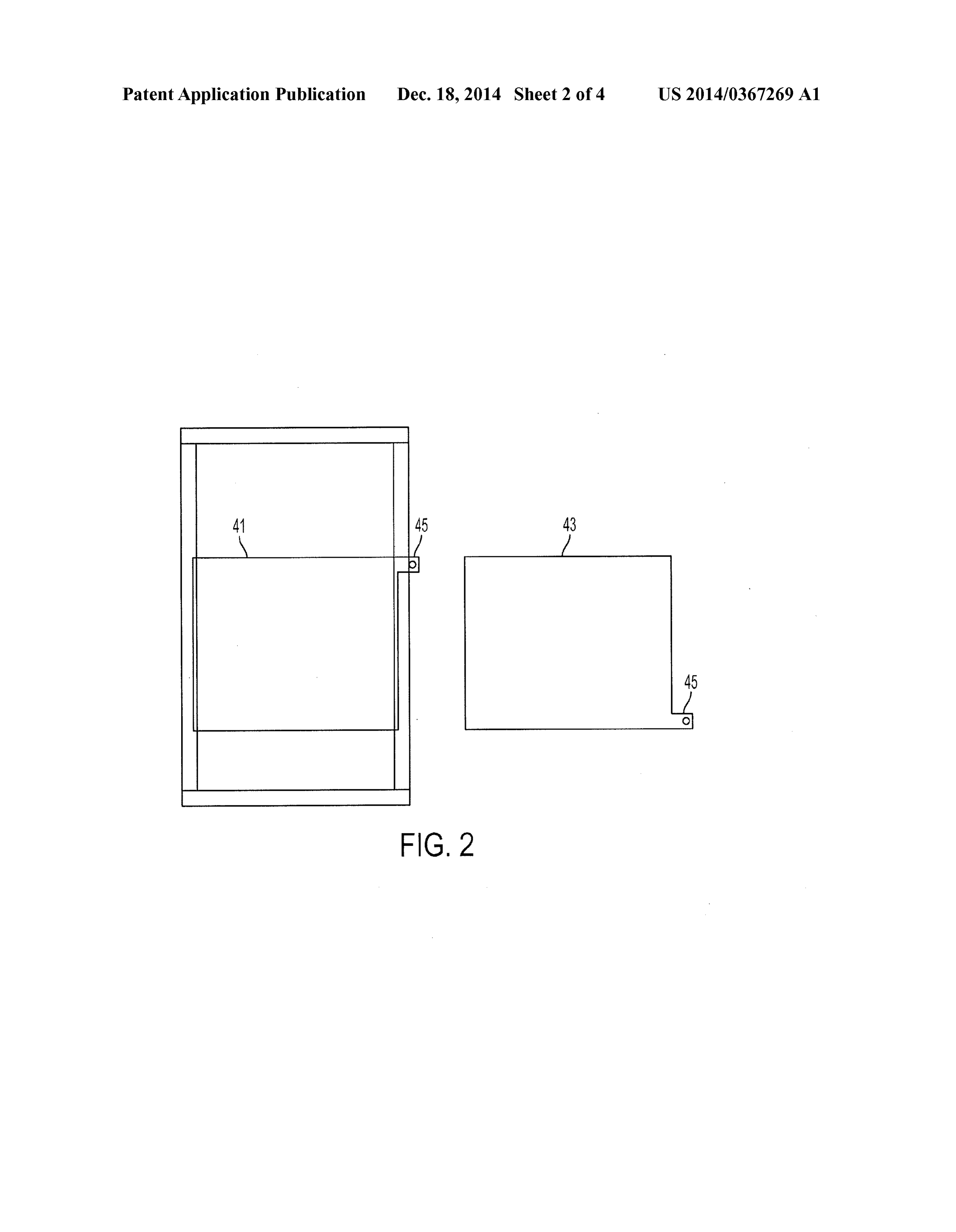
0001. This application is a continuation of U.S. patent 0008 FIG. 1 is a process flow diagram of an embodiment application Ser. No. 12/970,425, filed Dec. 16, 2010, the of a system for separating hydrogen from water, disclosure of which is incorporated herein by reference in its 0009 FIG. 2 is an anode electrode and a cathode electrode entirety. according to an embodiment;
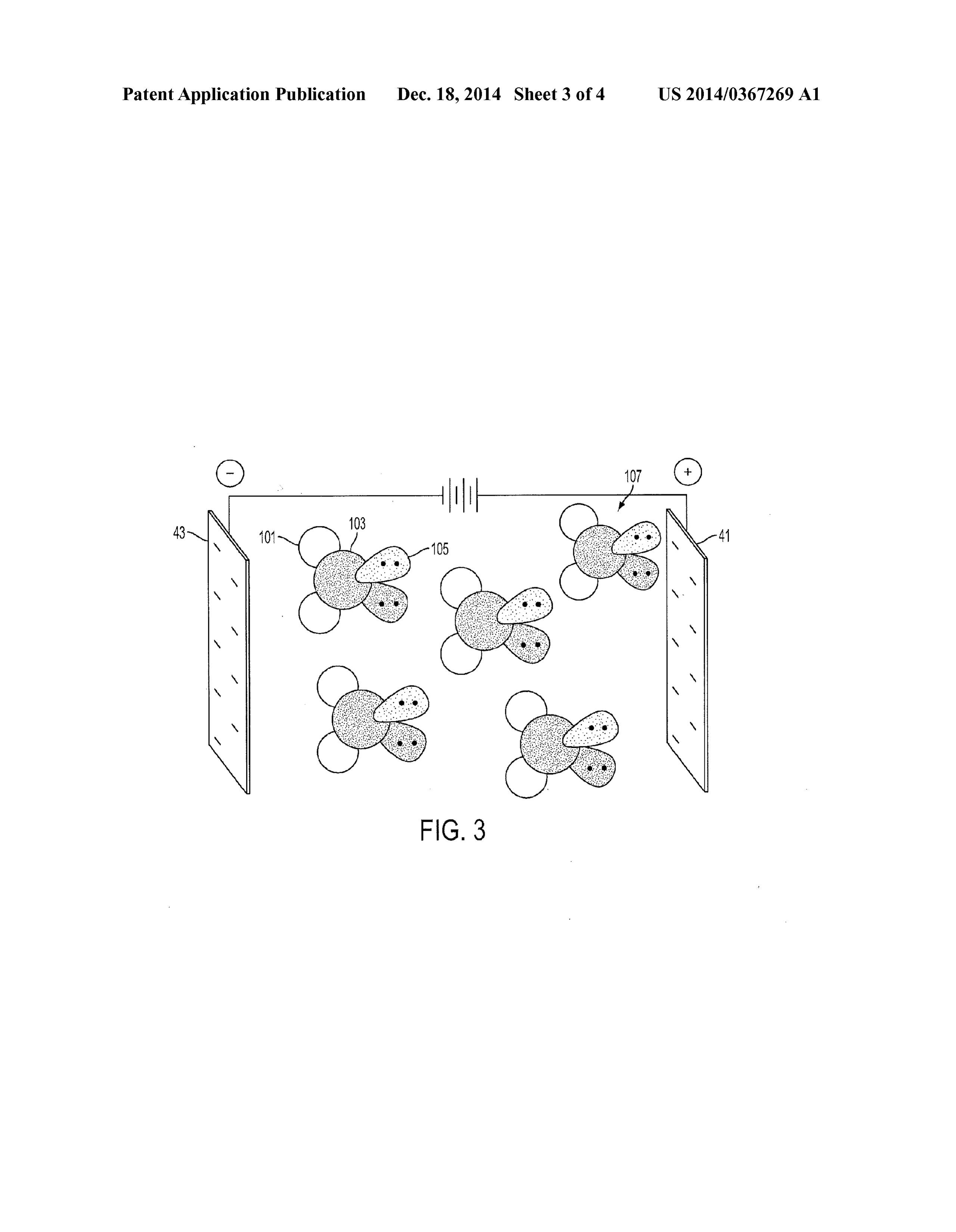
0010 FIG. 3 is a simplified diagram of water molecules between an anode electrode and a cathode electrode accord
TECHNICAL FIELD
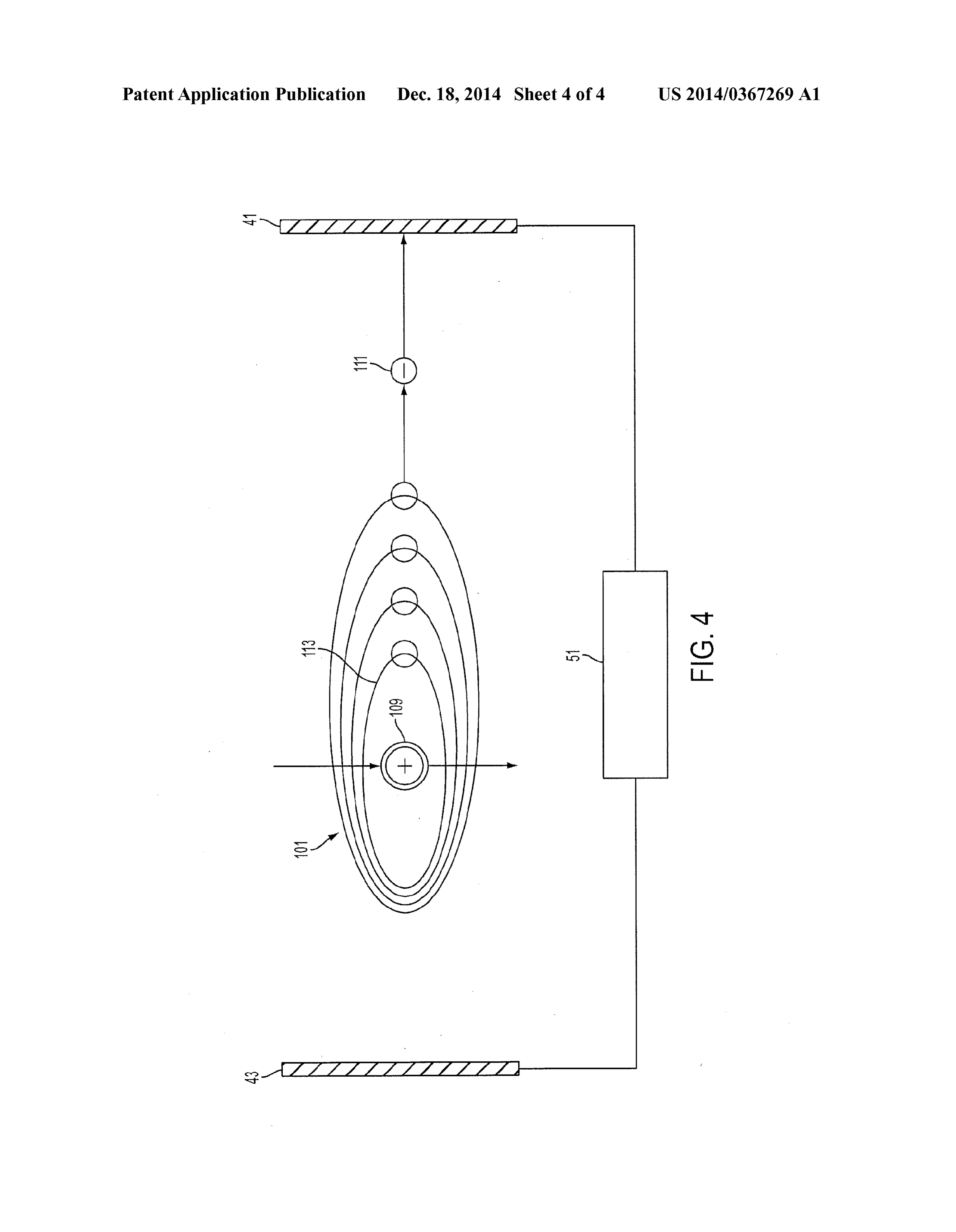
ing to an embodiment; and 0002 The present invention relates generally to fuel pro 0011 FIG. 4 is a simplified diagram of a hydrogen mol duction, and, particularly, to methods and systems for disso ecule between an anode electrode and a cathode electrode ciating hydrogen from water. according to an embodiment.
DETAILED DESCRIPTION
BACKGROUND
0012 Embodiments of the invention are discussed in 0003 Methods for separating hydrogen from water detail below. In describing embodiments, specific terminol include electrolysis, which employs an electrical potential ogy is employed for the sake of clarity. However, the inven across a pair of electrodes immersed in an electrolyte. For tion is not intended to be limited to the specific terminology so example, the electrodes may absorb or release electrons from selected. A person skilled in the relevant art will recognize or onto the water molecule to oxidize and reduce the water to that other equivalent parts can be employed and other meth yield an overall reaction of 2HO (liquid)->2H (gas)+O. ods developed without departing from the spirit and scope of (gas). Electrolysis of water produces significant waste heat the invention.
thereby limiting efficiency. Accordingly, there remains a need 0013 Referring now to FIG. 1, a system 1 for dissociating for an energy efficient process to dissociate hydrogen from hydrogen from water molecules is illustrated. The system 1 Water.
may generally comprise a splitting section 11, a power con trol section 13, an electron extraction circuit 15, a water
SUMMARY supply section 17, and a fuel extraction section 19. As explained in more detail below, system 1 may split the water 0004. According to an embodiment of the present inven molecule into constituent parts according to the following tion, a system for dissociating hydrogen from water is dis equation:
closed comprising a container having an anode electrode and a cathode electrode disposed therein, wherein the container is configured to contain a Volume of water, a DC voltage source 0014. The system 1 may split the water molecule into producing a DC voltage; a controller having an input coupled constituent parts by Subjecting the water molecule to physical to the DC voltage source, and an output coupled across the stress applied by an amplitude of Voltage at a resonant fre anode and cathode electrodes, the controller being configured quency that also Subjects the water molecule to an electric to produce from the DC voltage a pulse Voltage having a field. As explained in more detail below, the combination of stepped up Voltage and a pulse frequency, wherein the ampli physical stress and electric field may result in molecular tude and frequency of the pulse Voltage are sufficient to dis fission to split the water molecule into the constituent parts. Sociate hydrogen and oxygen from water molecules of the 0015 The splitting section 11 may comprise a container water in the container and produce free electrons, wherein the 31 having at least one or a plurality of electrode pairs 33 pulse frequency is configured to maximize a rate of hydrogen therein. For example, the container 31 may be a sealed con and oxygen dissociated from the water molecules; and an tainer having a pressure relief valve 35thereon. The container electron extraction circuit arranged to capture the free elec may be configured to hold water therein such that the elec trons released from the water molecules.
trode pair 33 is at least partially or completely submersed in 0005 According to another embodiment, a method for the water. According to an embodiment, the container 31 may dissociating hydrogen from water is disclosed comprising be formed or molded from a plastic or other nonconductive providing water in a container, applying a pulsed Voltage at a material, as known by one of ordinary skill in the art. frequency across the anode and cathode electrodes arranged (0016 Referring now to FIGS. 2 and 3, the electrode pair in the water in the container in order to dissociate hydrogen 33 may comprise an anode electrode 41 and a cathode elec and oxygen from water molecules of the water in the con trode 43. The anode electrode 41 and the cathode electrode 43 tainer, monitoring a pressure change in the container caused may be spaced at a predetermined distance from each other to by a rate of hydrogen and oxygen dissociated from water form a dipole. With the plurality of electrode pairs 33, the molecules of the water in the container; and configuring the spacing between the respective anode electrode 41 and cath frequency of the pulsed Voltage to maximize the pressure ode electrode 43 of each electrode pair 33 may be the same or change. approximately the same.
0006 Further aspects, objectives, and advantages, as well 0017 Referring now to FIG. 2, the anode electrode 41 and as the structure and function of embodiments, will become the cathode electrode 43 may each beformed having a tab 45 apparent from a consideration of the description, drawings, extending therefrom. When assembled with the container 31, and examples. the respective tabs 45 of the anode electrode 41 and the
Page 7
US 2014/0367269 A1 Dec. 18, 2014
cathode electrode 43 may be received by grooves or slots resonant frequency Sufficient to dissociate hydrogen from the formed in the inner sides of the container 31. For example, the water contained within the container 31. The resonant fre tabs may help maintain the predetermined distance between quency Sufficient to dissociate hydrogen from the water con the anode electrode 41 and the cathode electrode 43 by the tained within the container 31 may be a resultant resonant slots or grooves pre-formed in the container 31. frequency of the resonant frequency of the circuit comprising 0018. According to an embodiment, the tabs 45 may indi the power control section 13 and the splitting section 11 and cate the direction from which the respective electrodes 41 and the resonant frequency of the water in the container 31. The 43 are electrically connected. For example, the tab 45 of the resonant frequency of the water in the container 31 may be the anode electrode 41 may be located towards the bottom of the resonant frequency of a vibrating O-H bond. container 31 to indicate that the anode electrode 41 is electri 0024 However, the resonant frequency of the water in the cally connected at or towards the bottom end, and the tab 45 container 31 may depend upon, for example, but not limited of the cathode electrode 43 may be located towards the top of to, temperature, water Volume, and impurities in the water. the container 31 to indicate that the cathode electrode 43 is Further, the resonant frequency of the water may be dynamic electrically connected at or towards the top end. By electri depending on variances of the conditions. Accordingly, the cally connecting the anode electrode 41 and the cathode elec controller 53 may be configured to vary the predetermined trode 43 at or towards opposite ends, magnetic fields created frequency between 0 kHz and 45 kHz as conditions vary to by each of the anode electrode 41 and the cathode electrode change the resonant frequency of the water. As explained 43 may aid each other to establish current flow through water below, the predetermined frequency may be set at the reso contained in the container 31. nant frequency, multiple, or Sub-multiple of the resonant fre 0019. It is foreseen that the anode electrode 41 and the quency Sufficient to perform ionization and hydrogen fractur cathode electrode 43 may be formed of 0.065" metal tubing, ing of the water to produce monatomic hydrogen. flat sheets of metal, or thin shim stock. According to an (0025. The controller 53 may be further configured to vary embodiment, the anode electrode 41 and the cathode elec the voltage amplitude and the duty cycle of the predetermined trode 43 may be formed by plates stamped from 0.0625" frequency. For example, the controller 53 may be configured stainless steel type 316L or aluminum. to vary the Voltage from OV to in excess of 5,000V. for 0020. As explained in further detail below, the water con example up to 20,000V, and vary the duty cycle between 5% tained in the container 31 may be subjected to Voltage through and 90%. The varying voltages and duty cycles may be used the electrode pairs 33 in order to dissociate hydrogen from the to optimize the circuit for optimal hydrogen dissociation and water molecule. The power control section 13 and the split ionization.
ting section 11 comprises a circuit to step up the amplitude of 0026. According to an embodiment, an external variable the Voltage and tune the pulse frequency to a resonant fre inductor may be further included with or in the controller 53 quency of the container with the water and electrodes dis of the power control section 13. For example, the external posed therein sufficient to dissociate hydrogen from the water variable inductor may be a parallel circuit to the splitting contained in the container 31. section 11. The external variable inductor may be configured 0021. According to an embodiment, the power control to tune the total configuration of the circuit to the resonant or section 13 may be configured to apply a high Voltage pulsed Sub-resonant frequency of the water contained in the con at a predetermined frequency to the electrode pairs 33 con tainer 31. According to an embodiment, the external variable tained in the container 31 of the splitting section 11. In order inductor may tune the system to achieve a high Q factor. For to apply the Voltage pulses, the power control section 13 may example, the system having a high Q factor may resonate with comprise a power source 51 and a controller 53. According to greater amplitude at the resonant frequency but have a smaller an embodiment, the power control section 13 may further range of frequencies around the resonant frequency. comprise a power switch circuit breaker 55. As illustrated at 0027. The method of producing monatomic hydrogen FIG.1, the controller 53 may be connected between the power from HO utilizes a process generally called molecular fis source 51 and the electrode pairs 33. The controller 53 may be sion or, specifically, hydrogen fracturing. According to an configured to control the predetermined frequency of Voltage embodiment, hydrogen fracturing utilizes high direct Voltage pulses from the power source 51 to the electrode pairs 33. and low current to generate high Voltage, polarized electrical 0022. According to an embodiment, the power source 51 pulses at the resonant frequency of the circuit Sufficient to may be a 12 volt battery. The direct current from the power break the O—H bond of the water molecule. The pulses of the source 51 may be provided to the controller 53. According to electrical field oscillate the O—H bond of the HO molecule an embodiment, the direct current may be provided through at Such a frequency, such as a resonant frequency, multiple, or the power switch circuit breaker 55 to the controller 53. For sub-multiple of the resonant frequency, to break the bond. example, the controller 53 may be configured to include a 0028 Referring now to FIG.3, the HO molecules subject boost or step-up converter, as known to one of ordinary skill to the electric field of the pulsed Voltage, generally shown as in the art. For example, the boost or step-up converter may 107, may align into a periodic formation with the hydrogen step up the 12 volts provided by the power source 51 to 5,000 atoms 101 aligning toward the cathode 43, and the free elec volts at low current. For example, the current may be 10 trons 105, which refer to the electrons which are not being milliamps or less in a high Q factor circuit. It is foreseen that used for bonding, on the oxygen 103 positioned facing the the boost or step-up converter may step up 12 volts to in anode 41. The alignments of the hydrogen atoms 101 and the excess of 5,000 volts, such as, for example, 20,000 volts at positioning of the free electrons 105 may occur because the 150 milliamps. For example, at such low currents, heat loss is positive charge on the anode 41 attracts the free electrons 105, minimized. while the negative charge of the cathode 43 attracts the par 0023 The predetermined frequency of voltage pulses tially positive dipole on the hydrogen atoms 101. For from the power source 51 to the electrode pairs 33 may be set example, the dipole refers to the electric dipole moment of the according to a resonant frequency or a Sub-multiple of the molecule which relates the separation of positive and negative
Page 8
US 2014/0367269 A1 Dec. 18, 2014
charge on a molecule. Additionally, the dipole moment may 0033. The pump 61 may be any type of pump such as, for be treated as a vector which may align with the electric field. example, but not limited to, a gear pump, a piston pump, a Further reasons for alignment may be achieved due to hydro screw pump, a diaphragm pump, or other pumps as known to gen bonding, where the hydrogen atoms 101 in polar mol one of ordinary skill in the art ecules, for example HO 107, create a strong dipole-dipole 0034. According to an embodiment, a water inlet 67 to the attraction with the negative dipole of other polar molecules. container 31 from the pump 61 may be located towards the bottom of the container 31. A check valve 65 may be located 0029. According to an embodiment, pulsing the electric between the pump and the container 31 to order to prevent field at a frequency harmonic to the O—H bond vibrations of gravity driven backflow from the container 31. According to the HO molecule 107 may excite the O H bond into break another embodiment, the water inlet 67 may be located ing. The breaking of the O H bond may occur due to the towards the top of the container 31. In such an embodiment, physical stress placed on the bond by the amplitude of the no check valve may be necessary because water cannot back pulsed Voltage. flow by gravity from the container 31. 0030 Referring now to FIG. 4, the electrons may be 0035. According to an embodiment, the water supply sec extracted simultaneously to the hydrogen fracturing used to tion 17 may further comprise a level sensor 69 operatively dissociate the H2O molecule. According to an embodiment, connected to the container 31 of the splitting section 11. The attracting the positive nucleus 109 of one of the atoms using level sensor 69 may include a level switch such as a float or other sensor to detect a water level in the container 31. The the cathode 43, and attracting the electron 111 using the level sensor may be configured to detect a water level in the anode 41, the pulse of the electric field at the resonant or container 31 corresponding to a predetermined Volume of Sub-resonant frequency may pull the electron 111 away from water to achieve a desired resonant frequency. For example, the nucleus 109. For example, as the field is pulsed, the strong attractive forces may pull the electron 111 off of the atom, as the water level in the container 31 decreases, the level 59 resulting in ionization, which refers to the atom or molecule may activate the pump 61 to Supply additional water to the gaining a positive or negative charge. According to an container 31 from the water tank 63. embodiment, the pulsed electric field pulling the electron 111 0036. According to an embodiment, the electron extrac away from the nucleus 109 may result in a higher probability tion circuit 15 may be configured to extract free electrons of the electrons 111 being found farther away from the from the container 31. As explained above, the system 1 may nucleus 109. If the electron 111 has a probable location out dissociate and ionize water H2O into two monatomic hydro side the orbital 113, the electron 111 may break free of the gen ions, one monatomic oxygen ion, and two free electrons orbital 113 and atom so that ionization of the atom occurs. e. As a result of ionization of the water, as explained above, the free electrons may be extracted by the electron extraction 0031. According to an embodiment, the controller 53 may circuit 15. For example, the electron extraction circuit 15 may have a feedback 57 from the pressure relief valve 35 on the comprise a screen conductor between the anode electrode 41 container 31. The controller 53 may sense the pressure of the and cathode electrode 43 in the container 31 to extract the free container 31 and/or the rate of change of pressure of the electrons or current. The current generated by the free elec container 31 to determine if the predetermined frequency of trons extracted by the electron extraction circuit 15 depends voltage pulses from the power source 51 is at or near the on the rate of ionization of the water in the container 31. resonant frequency, multiple, or Sub-multiple of the resonant 0037. The electron extraction circuit 15 may be configured frequency of the water. For example, a high pressure or a high to power an external load 71 with the extracted free electrons rate of change of pressure sensed by the controller 53 at the or current. For example, the external load 71 may be a battery feedback 57 may indicate the frequency of voltage pulses charger, a light, aheating element, or any other electrical load from the power Source 51 is at or near the resonant frequency, as known to one of ordinary skill in the art. The electron multiple, or sub-multiple of the resonant frequency of the extraction circuit 15 may be further configured to charge the water. The pressure in the container 31 may increase due to power source 51.
the hydrogen dissociating from the water molecule and as 0038 According to an embodiment, the fuel extraction water is replenished from the water supply section 17, section 19 may be configured to extract the monatomic hydro explained below. In contrast, a low pressure or low rate of gen ion, the monatomic oxygen ion, and/or a hydroxy, OH, in change of pressure sensed by the controller 53 at the feedback gas form. As a result of dissociation and ionization, the mona 57 may indicate the frequency of voltage pulses from the tomic hydrogen ions, the monatomic oxygen ion, and/or the power source 51 is not at or near the resonant frequency, hydroxy OH may build up pressure in the container 31 and multiple, or sub-multiple of the resonant frequency of the exit through the fuel extraction section 19. According to an water and is not dissociating hydrogen from the water mol embodiment, the pressure relieve valve 35 may be set, for ecule. example, at 5 psi absolute or less in order to prevent overpres 0032. According to an embodiment, the water supply sec sure of the container 31 or other combustion. tion 17 may be configured to supply water to the container 31 0039. The fuel extraction section 19 may comprise a fuel of the splitting section 11. The water supply section 17 may outlet 81 and at least one or a plurality of bubblers 83. As comprise pump 61 to pump water from a water tank 63 to the oxygen ions, hydrogen ions, and/or hydroxy gas exits the container 31. The water tank 63 may be configured to store a container 31 through the fuel outlet 81, the oxygen ions, volume of water for use in the container 31. For example, the hydrogen ions, and/or hydroxy gas passes through the at least water stored in the water tank may be distilled water, salt one or more bubblers 83 in order to prevent back flow or back water, or other types of water. It is foreseen that additives or flash of the gases that may occur downstream. According to contaminants may be added to or removed from water in the an embodiment, a check valve 85 may be included with the water tank 63 in order to achieve a water having a desired fuel extraction section 19 in order to prevent back flow of the resonant frequency. oxygen ions, hydrogen ions, and/or hydroxy gas.
Page 9
US 2014/0367269 A1 Dec. 18, 2014
0040 According to an embodiment, monatomic oxygen 4. The system of claim 1, wherein the controller further ions and monatomic hydrogen ions may be separated into comprises a step up converter to convert the Voltage of the separate chambers or vessels. For example, the oxygen ions power source to a relatively higher voltage than the DC volt and the hydrogen ions may be separated with electric fields age source of at least 5000 volts. and/or magnetic fields. 5. The system of claim 1, wherein the controller and the 0041. It is foreseen that the fuel extracted by the fuel container comprise an electrical circuit, wherein the control extraction section 19, whether hydroxy gas, monatomic oxy ler further comprises an external variable inductor configured gen ions, monatomic hydrogen ions, or a combination to tune the electrical circuit to achieve a predetermined Q thereof, may be used as fuel for an internal combustion factor.
engine, a generator to charge batteries, or other apparatus as 6. The system of claim 5, wherein the external variable known to one of ordinary skill in the art. inductor is in electrical parallel with the anode and cathode 0042. The embodiments illustrated and discussed in this electrodes.
specification are intended only to teach those skilled in the art 7. The system of claim 1, further comprising a fuel extrac the best way known to the inventors to make and use the tion section configured to extract at least one of monatomic invention. Nothing in this specification should be considered oxygen, monatomic hydrogen and hydroxy gas from the con as limiting the scope of the present invention. All examples tainer.
presented are representative and non-limiting. The above 8. The system of claim 1, further comprising a water Supply described embodiments of the invention may be modified or section configured to Supply water to the container. varied, without departing from the invention, as appreciated 9. A method for dissociating hydrogen from water, the by those skilled in the art in light of the above teachings. It is method comprising:
therefore to be understood that, within the scope of the claims providing water in a container, and their equivalents, the invention may be practiced other applying a pulsed Voltage at a frequency across the anode wise than as specifically described. and cathode electrodes arranged in the water in the con I claim: tainer in order to dissociate hydrogen and oxygen from 1. A system for dissociating hydrogen from water, the water molecules of the water in the container; system comprising: monitoring a pressure change in the container caused by a a container having an anode electrode and a cathode elec rate of hydrogen and oxygen dissociated from water trode disposed therein, wherein the container is config molecules of the water in the container, and ured to contain a Volume of water; configuring the frequency of the pulsed Voltage to maxi a DC voltage source producing a DC Voltage; mize the pressure change.
a controller having an input coupled to the DC voltage 10. The method of claim 9, further comprising ionizing the Source, and an output coupled across the anode and water with the voltage.
cathode electrodes, the controller being configured to 11. The method of claim 10, wherein the frequency of the produce from the DC voltage a pulse Voltage having a pulsed Voltage is sufficient to split the water molecule into a stepped up Voltage and a pulse frequency, wherein the monatomic hydrogen, a monatomic oxygen, and a free elec amplitude and frequency of the pulse Voltage are suffi trOn.
cient to dissociate hydrogen and oxygen from water 12. The method of claim 11, further comprising extracting molecules of the water in the container and produce free the free electron from the container. electrons, wherein the pulse frequency is configured to 13. The method of claim 12, further comprising extracting maximize a rate of hydrogen and oxygen dissociated the monatomic hydrogen and the monatomic oxygen from the from the water molecules; and container.
an electron extraction circuit arranged to capture the free 14. The method of claim 12, wherein the configuring com electrons released from the water molecules. prises adjusting the frequency of the pulsed Voltage to maxi 2. The system of claim 1, wherein the amplitude of the DC mize the pressure change.
Voltage applied to the anode electrode and cathode electrode 15. The method of claim 14, wherein adjusting the fre is sufficient to ionize the water. quency of the pulsed Voltage adjusts a rate of pressure change 3. The system of claim 2, wherein the controller is config in the container caused by a changed rate of hydrogen and ured to adjust the pulse frequency to correspond to a resonant oxygen dissociated from water molecules of the water in the frequency or Submultiple of the resonant frequency of the container.
container with the volume of water.
Provenance
- Collection
- Patents citing this work
- Pages
- 9
- Method
- pdftotext (the PDF's own text layer) + pdftoppm 300dpi page scans
- Patent office record
- patents.google.com →
- Source
- Google Patents citing-documents table
- Assignee
- Charles G. Inskeep
- Inventors
- Charles G. Inskeep
- Published
- 2014-12-18
- Transcribed from
- patentimages.storage.googleapis.com →