patent · EP0101761A2
Controlled Hydrogen Gas Flame
14 December 1982
Page 1 — bibliographic record
Office européen des brevets
@) Application number: 82111597.9
(1) Publication number:
EUROPEAN PATENT APPLICATION
@) Date of publication of application:
Designated Contracting States:
) Applicant: Meyer, Stanley A.
3792 Broadway
Grove City Ohio 43123(US)
@) Inventor: Meyer, Stanley A.
3792 Broadway - uc
Grove City Ohio 43123(US) -
Representative: Wasmeier, Alfons, Dipl.-Ing. et al, Postfach 382 Greflingerstrasse 7
‘€) Controlied hydrogen gas flame.
@) A sustained controllable gas flame. The hydrogen generator utilized is that for separating gasses from water having impurities and other gasses entrapped therein. The gasses separated from the water comprises hydrogen, oxygen, and the non-combustible gasses, such as nitrogen. The nitrogen, oxygen and hydrogen are mixed as they are released in the process by the generator and collected as the mixture of gasses in the collection chamber of the generator. The method and system comprises a nozzle of a given configuration connected through a line to the uppermost region of the gas collection chamber of the hydrogen generator. The nitrogen reduces the velocity and temperature of the burning flame from that of the hydrogen/oxygen mixture. To further control the temperature and velocity of the burning gas mixture there is added to the collection chamber other non-burnable gasses. The configuration of the nozzle and its port opening is dependant on the mixture of gasses utilized and restricted thereby. An increase in the size of the flame requires additional port openings to prevent blowout.
CROSS REFERENCE:
The hydrogen/oxygen generator utilized in the present invention is that disclosed and claimed in my co-pending
September 16, 1981, for; HYDROGEN GENERATOR SYS-
TEM. in that process for separating hydrogen and oxygen atoms from water having impurities, the water is passed between two plates of similar non-oxidizing metal. No electrolyte is added to the water. The one plate has placed thereon @ positive potential and the other negative potential from a very low amperage direct-current power source. The sub-atomic action of the direct current voltage on the non-electrolytic water causes the hydrogen and oxygen atoms to be separated --- and similarly other gasses entrapped in the water such as nitrogen. The contaminents in the water that are not released are forced to disassociate themselves and may be collected or utilized and disposed of in a known manner.
The direct current acts as a static force on the water molecules; whereas the non-regulated rippling direct current acts as a dynamic force. Pulsating the direct current further
enhances the release of the hydrogen and oxygen atoms from the water molecules.
hae
Croydon Printing Company Ltd
Page 2
Drawing sheet — no readable text.
Page 3
Controlled Hydrogen Gas Flame eo
The electrolysis Process for generating hydrogen and , oxygen gas is well known in the art. It is, of .course, further understood with a proper mixture of oxygen gas, the hydrogen gas : is combustible and under ideal conditions a flame, may be had. Reference is made‘ to U.S. Patent Number: 4,184,921. However, in that the burning velocity of hydrogen is 265-325 cm. /sec, versus 37-45 cm./sec. of that of gasoline, _ the velocity of hydrogen is so great that the hydrogen ensuing from a nozzle will not under ordinary circumstances sustain a flame.
Therefore, to sustain a flame ata nozzle attached to a een a:
hydrogen generator the burning velocity of the hydrogen gas must be reduced.
it has been found that all water in its natural state whether it be tap water, well water, sea water, or fresh water is_a saturate of ambient air: Further, in that ambient air contains a substantial amount of nitrogen, all natural | " water will have entrapped therein nitrogen. Again, the per- ‘centage of nitrogen entrapped in natural water has been determined to be a fixed percentage and very uniform at seventeen (17%) percent ---~ irrespective of the source of the water or its impurities. Hence, a natural water gas analysis will show a seventeen percent of nitrogen relative to the hydrogen and oxygen...
Page 4
The nozzle connected to the collection chamber via an _ appropriate line, has a port opening of a controlled size and configuration, related to the size of ‘the flame and the temperature and velocity of the burning gas mixture. To maintain the flame, that is to prevent blowout, additional nozzles are included when the overall flame size is to be increased. .
OBJECTS :
. It is accordingly a principal object of the present ‘invention to provide a new and improved hydrogen /oxygen generator that is operable from a water source that provides hydrogen/oxygen output that will have a “sustained burn. Another object of the present invention is to provide _ a hydrogen/oxygen generator that in addition to the hydrogen and oxygen gasses releases non-combustible nitrogen gas capable of reducing the burning velocity and temperature of
3 pure hydrogen/oxygen flame.
A further. object of the present | invention is to provide a hydrogen generator that includes the controlled addition of other non-combustible gasses. to the gas chamber thereof to thereby further control the burning velocity and temperature of the hydrogen gas.
Other objects and features of the present invention will -become apparent from a reading of the detailed description
Page 5
non Ww = WH PP
€ toe , er ve
t t tae e ‘ a
anaaan
of the preferred embodiment taken in conjunction with the
single figure drawings in which:
BRIEF DESCRIPTION OF THE DRAWINGS:
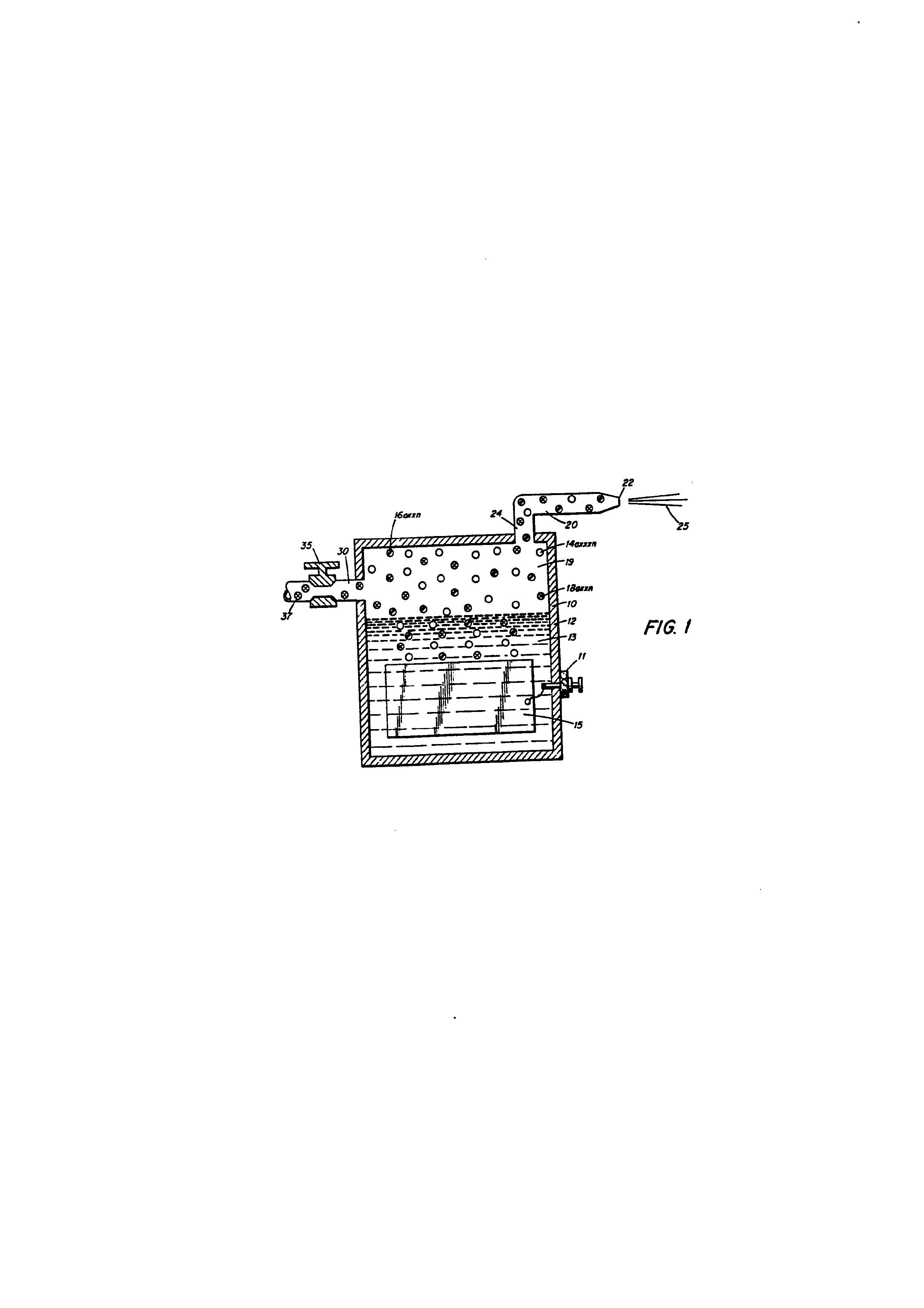
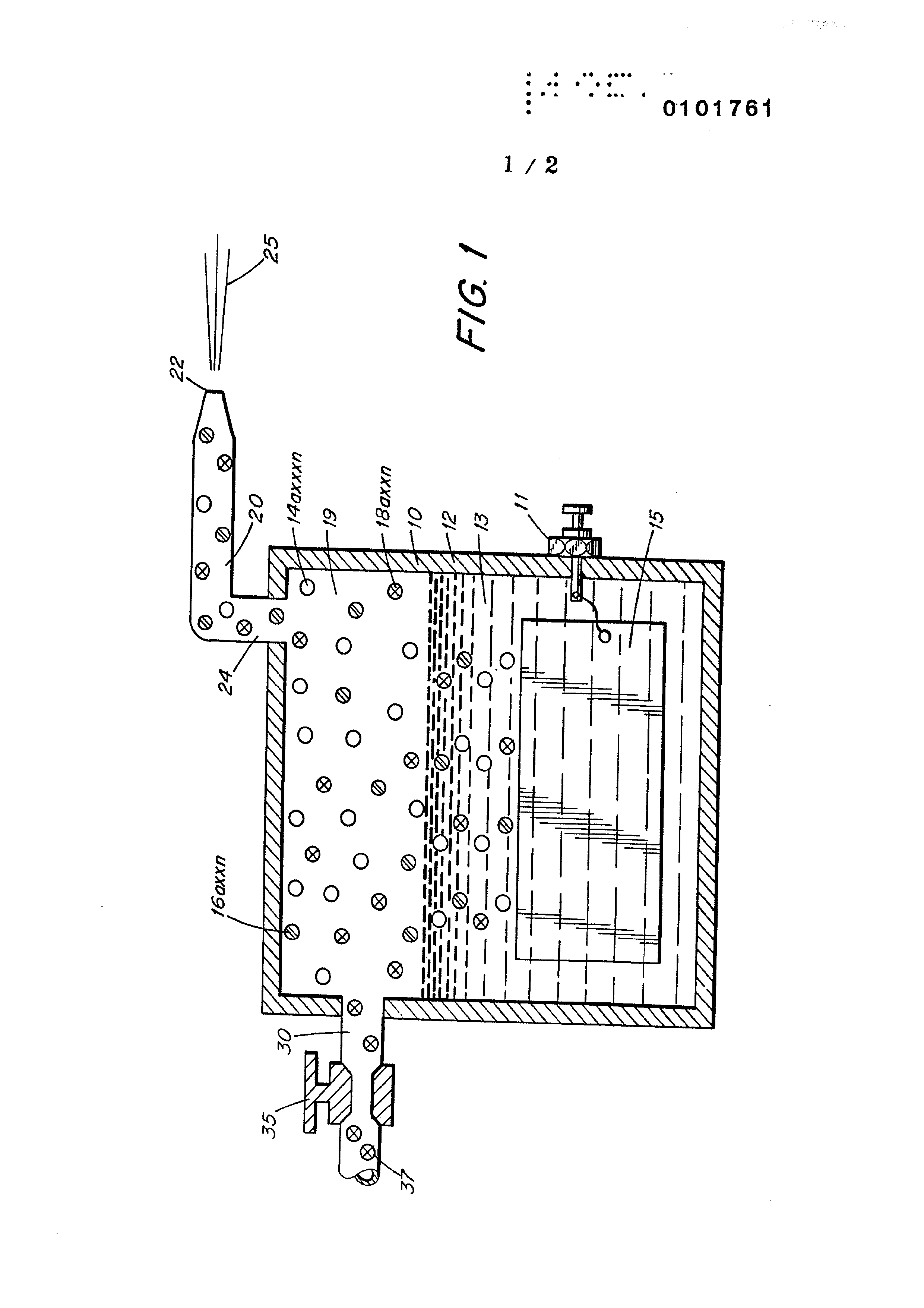
Figure 1 is a crossection of a hydrogen generator illustrating the features of the present invention in its nost
preferred embodiment incorporated therein.
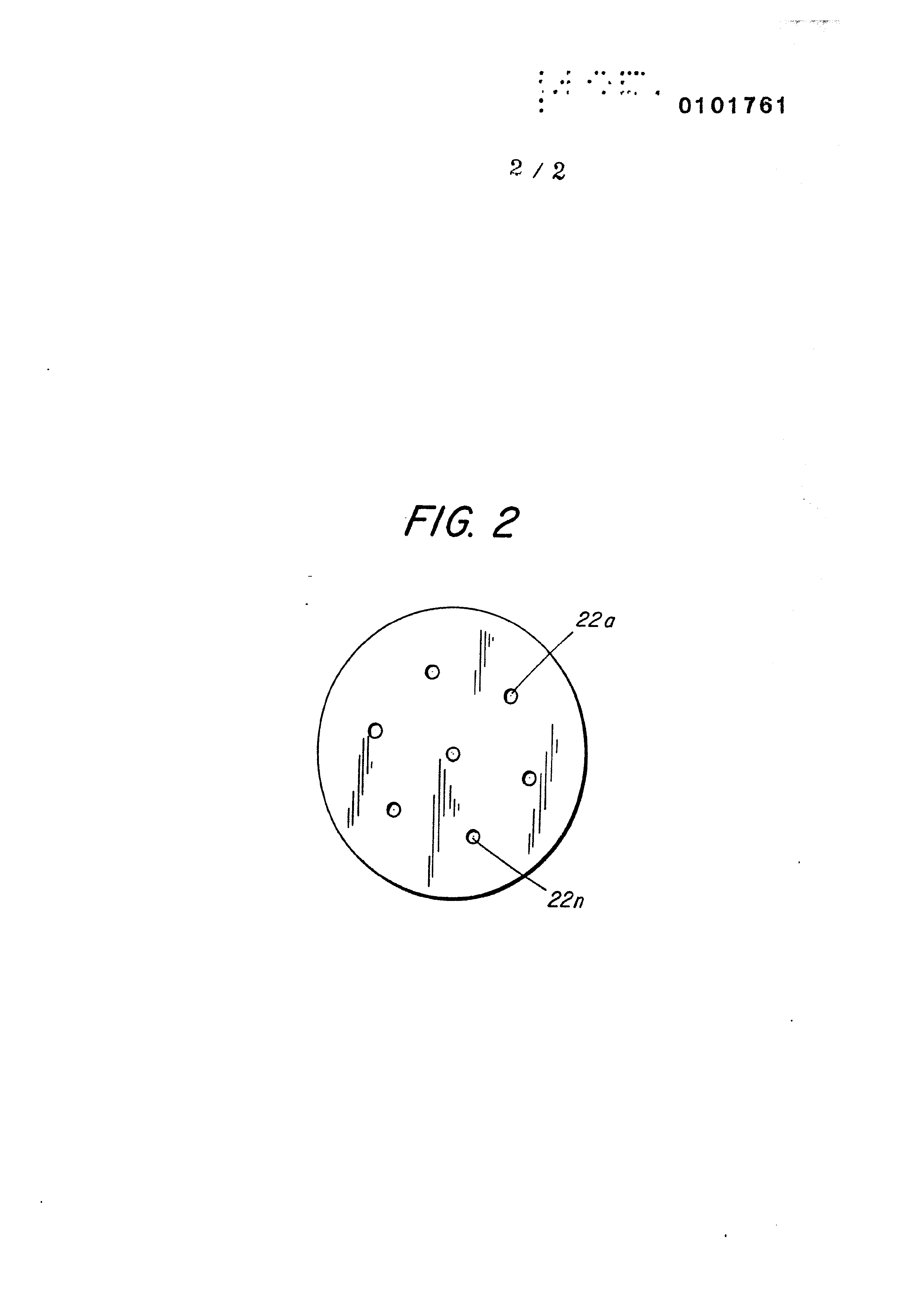
Figure 2 schematically shows the increased number of nozzle ports to increase the flame size. :
DETAILED DESCRIPTION OF DRAWINGS; . | *
The hydrogen generator 10 is that of my co-pending patent application, supra. This generator comprises a’ closed watertight housing 12 having therein natural water 13. Submerged in the water 13 is a pair of plates 15 (one not shown) — having a direct current low amperage voltage, via’ connector
11, applied thereto. As set forth in my co-pending patent
application. supra, the .électrical potential applied to the ©
. similar 1 non-oxidizing metal. plates is a sub- ~atomic action.
‘In this way the hydrogen atoms 14 a xxx n and the oxygen
atoms a Xxx N are released. from the water molecule. -
Unlike the ‘electrolysis process for generating hydrogen from distilled water, the hydrogen. generator of my aforementioned patent ‘application, utilizes water 13 that need’ not be pure --- simply any water irrespective of contaminents
and source.
Page 6
anre
ana aan
Natural water such as tap, well, sea, or fresh water is
an absorber of ambient air. Ambient air in turn, contains
a substantial amount of nitrogen gas. Water as an absorber
of ambient air will entrap seventeen percent (172%) of ni-
‘trogen gas; that is natural water,absorbs seventeen percent | |
(172) of nitrogen gas in comparison to its hydrogen and oxygen
gas content. In operation of the hydrogen ‘generator, in that it is a subatomic or force-type of genérator the gasses in the water will be released. Therefore, when natural water
is used the nitrogen gas will be released together with the
_ hydrogen and oxygen gasses.
In, the preferred embodiment utilizing tap water, the nitrogen gasses 16 a xxx n are intermixed with the hydrogen gasses 14 a xxx n and the oxygen gasses 18 a xxx 1 in the chamber 19 of the hydrogen generator 10.
Upon release of the gasses via line ‘2h and nozzle 20 |
-and then port 22 the gas mixture is ignited to provide
flame 25.
The flame 25 is sustained in that the nitrogen gasses | 16 a xxx n reduces the burning velocity and temperature of the hydrogen gas ‘1A a xxx n. |
A realistic and practical manner. of further controlling
the burning velocity and temperature of the hydrogen gasses 14 a xxx n, is by adding non-combustible gasses directly to
the hydrogen and oxygen gasses generated. This is accomplished,
Page 7
' generator. Valve means 35 is adjustable to control the emount ;
a amen
aneae
by inlet 30 to the upper gas chamber 19 of the hydrogen
of non-combustible gasses 16 a xxx n, added to the gas chamber | 19: The nozzle 20 connected to the chamber 19 of the generezor |
10 via line 17, is of a given congiguration to permit a pre-
determined quantity of gasses to be expelled from the port 22.
The port size is dependant on the gasses generated, and collected!
in the chamber 19, the pressure of the chamber 19 of the gener- | ator 10, and the size of the flame dexired. - }
To increase the size of the flame 25 would appear to be 2 | simple matter of increaseing the rate of gasses generated. .!
However, an increase of gasses merely causses a blowout at the
port 22 opening of the nozzle 20. This flame blowout will occur since an increase in hydrogen gas generation disrupts the ratio
of the initial mixture even though the percentages remain const-
ant. Typically, tap water will contain 624 hydrogen, 312 oxygen, and 172 nitrogen. In actuality the percentages may be somewnat | less dependant on: \ the other gasses that may be trapped in the
tap water. The increase in production will not affect the per- |
centages but it must be appreciated that the volume of the” ‘gasses - will be proportionately increased. In turn, ‘the ‘volume being directly related to pressure, the pressure will be similarly in-
creased,
To effectively reduce or counter the velocity due to the
increased pressure of the hydrogen gas mixture in the chember 19, _a larger port 22 would appear to be capable of handling the increased pressure. But, as aforesaid, a larger port end the
Page 8
i~ WwW
shown in Figure 2, of a port size a predetermined as aforesaid,
aw ee eee oe mee
a e La ate é
and the concentration of the high velocity hydrogen gas mixture will cause a flame blowout. To sustain a larger flame with increased pressure, additional nozzles 20a- xxx n having ports
22 a xxx n or a nozzle 20 with multiple ports 20 a xxx n és
will be added to the line 17. Accordingly, the larger the desjred flame the greater the number of ports.
It can be understood that a port that will not sustain a flame does present a safety factor relative to hydrogen spark back to the chamber 19. Hence, controlling the size of the port 22 in
effect as a quencher of hydrogen spark back.
Although certain and specific embodiments are shown and descr7 ibed it is within the scope and spirit of the present invention
to include alternatives and modifications thereto.
peer ae ne reese
Page 9
be Ss YK OC DOD ON DW U& & WD B&B FEF wo
CLAIMS:
1. =A hydrogen /oxygen generator capable of sustaining the controlled burning of the gasses generated thereby comprising:
a housing having natural water therein including entrapped non-combustible gasses, -
‘a pair of similar non-oxidizing plates having direct current low amperage voltage applied thereto to provide a sub-atomic, force-type action on said water,
said action liberating the hydrogen atoms and oxygen
atoms from said water molecule, and further liberating said
non-combustible gasses Arom said water,
a gas collection chamber in said- generator for collecting
and intermixing said released gasses, — a
a nozzle attached to the gas collection chamber of said -
' housing including an inlet for receiving the mixture of
hydrogen, oxygen and non-combustible gas, said nozzle of.a ‘predetermined size and configuration
on a port for expelling said mixed gasses, and means for ig- .
niting said mixed gasses.
2. The hydrogen/oxygen generator of Claim 1 wherein said non-combustible gas is nitrogen.
3. The hydrogen/oxygen generator of Claim 2 wherein said gasses intermixed in said collection chamber of the hydrogen
generator comprise 62% hydrogen, 31% oxygen, and 172 nitrogen.
Page 10
_ Said port.
cy ’ a tate
4, The hydrogen /oxygen generator of Claim 3 wherein said means comprises an inlet connected to said gas collecticn chamber of said housing, and means for introducing non-conbust ible gasses to said chamber. | - 5. The hydrogen/oxygen generator of Claim 4 wherein said inlet Further comprises valve means for controlling the amount of non-combustible gasses introduced to said chanber. 6. The hydrogen/oxygen generator of Claim 5 wherein said port on said nozzle of a predetermined size and configuration is related to the ratio of gasses in said collection chanber to provide a flame of a predetermined velocity and size at 7. The hydrogen/oxygen generator ‘of Claim 6 wherein said | port size and configuration is maintained with a plurality of ports to thereby permit a proportional increase in flame
Page 11
ee ents
COIS FQ SSaH™ 2
A wey |
ere Se mY Pi];
AN OHS) LOLL N
N @ wl | ALI
SNP oe ts Job \
N ati | N
Page 12
Drawing sheet — no readable text.
Provenance
- Shelf
- Stan Meyer Patents
- Book
- European Patents
- Pages
- 12
- Method
- pdftoppm 300dpi + tesseract 5 (eng)
- Source
- BookStack
- Page Id
- 34
- Transcribed from
- /var/www/html/storage/app/public/archive/documents/72/725bad221c058186406812130592c68956d7104d964bc4a791323a97b8c7b39e.pdf